At RelaDyne, buying another business meant inheriting another answer to the same question: what should an employee receive for driving to work’s next appointment? One business paid a flat allowance. Another added a fuel card. Others supplied cars. Acquisition had produced a collection of transportation policies, each reasonable somewhere, collectively difficult to explain. The distributor needed a rule it could carry into the next deal.
- The job: reimburse employees who drive personal vehicles for work.
- The distinction: connect mileage, local costs and driver risk.
- The lesson: a new payment formula needs a credible rollout.
That is the sort of untidy problem Motus sells order for. Its customers have salespeople, technicians and other employees whose workplace keeps moving. The expense report is where their driving becomes visible. By then, several decisions have already been made: who owns the car, who carries insurance, what counts as business mileage and how much a mile ought to cost.
The allowance has two jobs
A car costs money while parked. Insurance, registration and depreciation do not pause between appointments. Other costs accumulate with use: fuel, tires, maintenance. Treating those two categories as a single number is convenient. It also conceals how differently employees use their vehicles.
Motus specializes in separating them. Its Fixed and Variable Rate program, usually shortened to FAVR, combines a fixed payment with a mileage-based component, using local cost data. A driver in one region need not receive the same calculation as a driver somewhere with different insurance or fuel costs. The company also offers cents-per-mile reimbursement and a tax-advantaged accountable plan for organizations that prefer monthly payments.
Registration
Depreciation
Maintenance
Tire wear
Conceptual FAVR model. Actual rates and eligibility depend on the program.
The distinction has consequences for fairness and tax treatment. A flat allowance may look equal on a payroll report while covering quite different shares of employees’ expenses. FAVR aims to narrow that gap. Its favorable tax treatment depends on meeting applicable requirements; installing the app does not settle eligibility.
Invite the complainer
RelaDyne’s fleet and acquisition manager, Tyler Doyle, began with a pilot rather than a national announcement. He deliberately recruited skeptics. “I picked the complainer, the nitpicker,” he told Motus. Their feedback helped shape the wider rollout. The company ultimately consolidated 320 associates onto one program and identified more than $600,000 in annual reimbursement savings, according to Motus’s published case.
“I picked the complainer, the nitpicker.”Tyler Doyle · RelaDyne · on choosing pilot participants
The useful detail is the sequencing. Before asking everyone to accept the policy, Doyle gave demanding users a chance to test its explanation. Concerns included losing company vehicles and feeling monitored. The transferable idea is straightforward: put the hard questions into the pilot. They will arrive eventually.
When the routes stayed still
Dialysis Care Center encountered a different puzzle. In Motus’s account, monthly mileage rose from roughly 20,000 to nearly 28,000 after the provider adopted Concur Drive, although patient numbers and routes had not changed. Managers were checking submissions manually. Commute detection and inaccurate distances became particular concerns.
The provider reinstated Motus for employees driving at least 300 miles a month. GPS verification and commute detection replaced some of that checking. The case reports a 30 percent reduction in mileage costs within two months. This is a vendor-published customer result, rather than a controlled comparison. Still, the diagnostic question travels well: when the work stays constant and the bill moves, inspect how the work is being measured.
Reported mileage-cost reduction at Dialysis Care Center within two months of returning to Motus. A customer result, not a savings forecast.
A mileage app grows up
Motus Reimburse captures mileage, calculates payments and routes approvals. Motus Protect adds insurance and motor vehicle record monitoring. Road Smart, introduced in October 2025, puts safety lessons lasting under two minutes inside the same app. Insights and Insights Pro help administrators examine spend and driving patterns. The proposition is a managed driving program with software running through it.
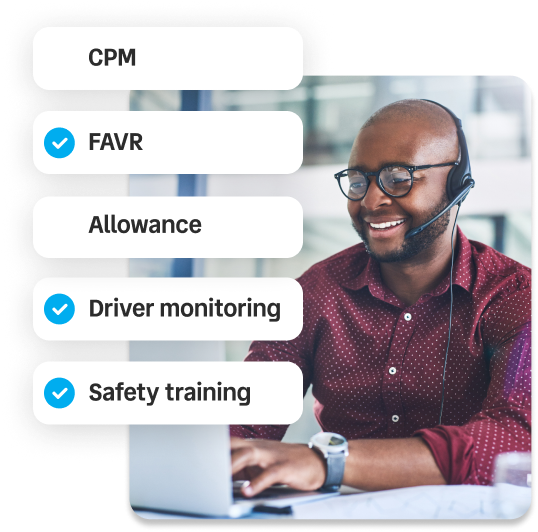
That places Motus alongside reimbursement specialists such as Cardata and CompanyMileage, and in purchasing conversations involving general expense tools. Its SAP Concur integration lets a customer keep an existing expense workflow while adding specialized mileage capabilities. The competitive argument rests on how much of the program a buyer wants one provider to administer.
Motus charges per driver, with volume discounts; optional capabilities and integrations influence the quote. Buyers should distinguish the subscription from the reimbursements flowing through it. A lower vehicle budget and a worthwhile software purchase are related propositions, but the arithmetic for one does not prove the other.
Its history helps explain the breadth. Established in 2004 as Corporate Reimbursement Services, the business became Motus and combined with Runzheimer under Thoma Bravo in 2018. That combination brought a long driving-cost research lineage to the platform. Permira announced an investment in 2021, with financial terms undisclosed. In February 2025, Motus acquired Everlance, extending its reach into smaller businesses and independent work.
Founder Gregg Darish described the early business in a 2014 interview as persuading employers to move from company cars to reimbursement. He also explained a neat reversal: the underlying calculation could charge employees for personal use of company vehicles. The same boundary had to be measured whichever side owned the car. That observation helps explain why Motus now occupies a space between traditional fleet administration, expense software and compensation policy, rather than fitting comfortably into just one purchasing category.
Inside the company, the published culture emphasizes working from anywhere and judging performance by results. Its own employees may choose different locations while serving customers whose staff travel between them. Those are different versions of the same administrative challenge: agreeing on what work requires without insisting that everyone arrange life identically. For Motus, flexibility creates the market, while consistent rules make that flexibility manageable. The calculation matters because the arrangement depends on people trusting it.

Keep the keys that fit
A reimbursement program cannot make every vehicle interchangeable. Specialized equipment may still belong in a company fleet. Employees taking responsibility for personal vehicles need clear policies, adequate coverage and an understandable calculation. Sparse business driving may call for a simpler model. Privacy expectations need an explanation before mileage capture becomes routine.
Motus’s August 2025 partnership with Element Fleet Management acknowledges that practical variety: organizations in the United States and Canada can combine fleet and reimbursement options. The question becomes which arrangement fits each job. Motus’s useful insight is that the business mile deserves its own design. The useful habit to copy is to design the policy before automating the payment.