At a large public university, nearly five thousand admitted students had accumulated in a backlog. They had applied. They had been accepted. They had not started classes. Some had been quiet for more than a year. The university had tried calling, emailing, and texting. A special email initiative had also failed to stir them. On paper, these were prospective students. In practice, they were becoming an archive.
- The opening: people who already showed interest, then stopped responding.
- The method: behavioral creative, paid outreach, and a clear next action.
- The buyer: colleges first; increasingly, other lifecycle-marketing teams.
- The test: completed actions, with a comparison group where possible.
The university wanted at least 3% of that list to register. It hired Motimatic, which put motivational content on Facebook, Instagram, and Google, adjusting delivery as people engaged. The company’s account reports 86 registrations in the first week and 314 overall, including more than 60 applicants whose original interest was over a year old. Silence, apparently, had concealed some unfinished business.
01 / The unfinished intention
Motimatic occupies an awkward interval in the student journey: after an intention exists and before the next task gets done. An application can stall. An admitted student can fail to enroll. Someone who attended college can stop out and never find a convenient route back. Each situation produces a different question for outreach. Treating everyone as a fresh prospect wastes the history the institution already has.
The company helps two-year colleges and four-year universities recruit, retain, and recover students through managed digital campaigns. The college sets the goal; Motimatic supplies strategy, creative, media delivery, and tailored landing pages. Students encounter the messages through familiar digital channels. They do not have to adopt a new motivation app before the institution can reach them.
Its early proposition had a pleasingly mischievous quality. Advertising infrastructure, usually employed to sell us another object, could carry encouragement to finish something we had already chosen. Alan Tripp and Greg Gibson founded the company in 2015. Investor GSV identifies Tripp as its founding CEO and Gibson as its founding CTO. Education and advertising shared a technical problem: an available message does very little until someone notices it.
02 / An odd-and-even experiment
The early evidence includes an unusually useful detail. A pilot started with 3,317 students enrolled in fall 2015 at an unnamed university. Its randomly assigned student IDs supplied the division: even numbers received Motimatic messaging; odd numbers formed the control group. There were 1,656 students in the first group and 1,661 in the second.
By the end of spring 2016, 59.2% of the messaging group had completed the term, compared with 54.1% of the control group. Using the displayed rounded rates, that is a 5.1 percentage-point difference, or roughly 9.4% relative lift. Those descriptions answer different questions. Keeping both in view prevents a modest numerical gap from acquiring an extravagant costume.
The report supports examining the intervention against a comparison group in that setting. It does not establish a universal graduation effect. This is a sensible distinction for a buyer: a persuasive case study can show that a campaign coincided with registrations; a well-designed holdout asks how many might have happened anyway.
03 / Four products, one next step
Today the machinery has four names. Create combines a creative service with a searchable asset library. Motimatic designs campaign content and keeps the assets available for updates and reuse. Its stated motivational drivers include efficacy, belonging, and urgency. For a small marketing team, the appeal is practical: the creative help arrives with a place to keep the work.
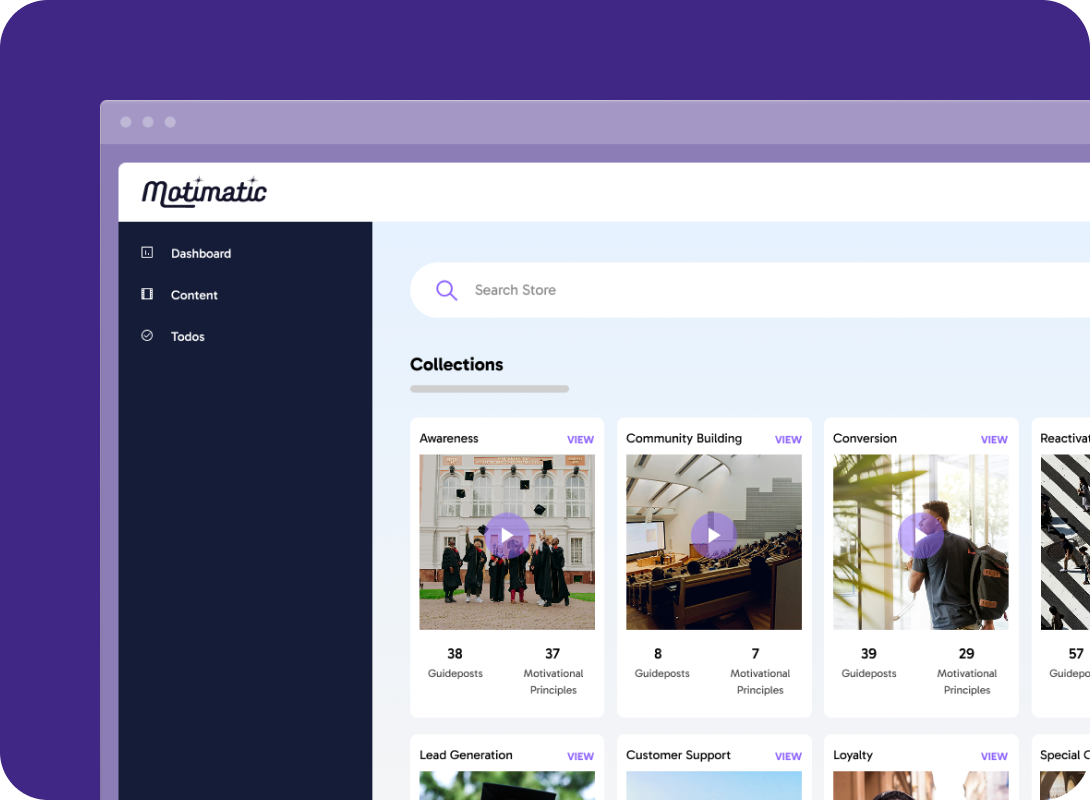
Acquire introduces new audiences to a brand and generates leads through managed paid campaigns. Reach handles audiences already known to the organization: stalled leads, active users, and lapsed customers. Lists or pixel-based audiences feed the process; segmentation shapes delivery. Reach works alongside email, SMS, and a CRM, extending the opportunities for a message to be seen.
Connect gives that attention a destination. It builds branded landing pages on the client’s subdomain, designed around one action and equipped with conversion tracking. The significance lies in the handoff. An ad asking someone to complete an application should lead to a page that helps with that task. Sending a motivated person into a thicket of unrelated choices squanders the moment.
- 01IdentifyFind the unfinished step
- 02PromptDeliver relevant creative
- 03SimplifyGive the click one job
- 04MeasureCheck the completed action
04 / The list remembers
Santa Barbara City College offers a concrete example of the sequence. Its work with Motimatic targeted former students and people who had applied without registering. The college reached back more than eight years. Campaigns first encouraged reapplication, then automatically switched to registration messaging when a student reapplied. That change sounds obvious until one remembers how often automated follow-up keeps requesting a task already completed.
Motimatic’s account reports more than 71,000 students reached across six social platforms and 565 combined actions: reapplications and registrations. Combined actions deserve their own label. They are not necessarily 565 distinct returning students. The useful lesson is the evolving invitation, with the institution’s record of progress determining what comes next.
Johnston Community College’s GuidePosts campaign supplied another example. The Drum’s June 2026 awards account describes prompts for portal visits, tutoring, advising, and registration across six digital channels. It reports 122 stop-out students returning and registering. The campaign won bronze in Education & E-Learning. A partner account from ZogoTech adds a crucial piece: Johnston used student patterns to identify audiences for re-engagement. Distribution had information to work with.
05 / Who pays for the nudge?
Motimatic sells to organizations. Its delivery combines services and a proprietary platform, giving a college a campaign team as well as software. In 2020 it introduced pay-for-results pricing; procurement partner Carahsoft describes many services as available on that basis. That arrangement can make the purchasing conversation easier for institutions whose marketing and student-success teams have limited capacity.
The company’s December 2024 enrollment commentary describes a university campaign returning $5 for each $1 spent. That is a reported return relationship, not a dollar price for another college. A buyer should define the billable event and agree on measurement before launch. Deposits, registrations, and students attending classes are different outcomes. The invoice and the success report should speak the same language.
“We would have been happy with 20 new students, but got more than triple what we asked for.”
Andy Benoit · Texas A&M University-Corpus Christi
Quoted in Motimatic’s April 2022 announcement
Investors have financed the model too: a $3.4 million Series A in February 2017, followed by $4 million in growth capital in April 2019. University Ventures and New Markets Venture Partners led the earlier round; City Light Capital led the later financing. Motimatic disclosed another investment in 2022. Its customer footprint reached 100 institutions that year, and current materials describe more than 300 partners.
The market around it includes enrollment agencies, internal marketing teams, and student engagement software. Element451, for example, markets a CRM that centralizes student data and workflows. Motimatic’s emphasis is campaign execution and paid lifecycle outreach. The distinction matters when a college decides whether its bottleneck is record keeping, staff capacity, creative production, or reaching people outside their inboxes.
06 / An invitation needs somewhere to lead
Motimatic’s public benefit identity becomes tangible in its campus food-resource initiative. From November 2025 through January 2026, it funded social outreach about food pantries, meal assistance, and emergency aid. Partner institutions supplied the resource information; Motimatic amplified it. The campaign’s premise was modest and useful: support already available on campus still needs to be discovered.
This also identifies a condition for the approach. Outreach depends on a viable next step. A reminder cannot itself supply a missing meal, remove an unaffordable bill, or create a course a student needs. Those are practical limits of the mechanism. The college must provide the service and a workable route to it; the campaign can help students find that route.

Under CEO James Dressing, the company now also targets SaaS and consumer subscription businesses. On September 16, 2026, it announced connected-TV campaigns, including 15- and 30-second ads across streaming publishers such as Hulu, Peacock, and Roku. The scope has widened from the student’s social feed to a broader set of customer touchpoints.
The lesson a reader can copy is more specific than “send better messages.” Identify the unfinished action. Separate audiences by what they have already done. Offer a useful next step. Change the invitation when they take it. Keep a comparison group when the campaign permits one. For a college, the unanswered admissions list may still contain willing students. A thoughtful invitation gives them a reason, and a route, to reply.