Everybody has an order. It may be a Big Mac with the sauce negotiated down to the molecule, fries destined for a shake, or nuggets arranged around a private parliament of dips. For years, these rituals belonged to customers. Then Morgan Flatley and her McDonald’s marketing team treated them as something more useful than trivia: a brief.
The thought is almost suspiciously simple. A restaurant present in more than 100 countries does not need to persuade the world that it exists. It needs to keep familiarity from curdling into indifference. In 2019, Flatley has said, McDonald’s was in danger of becoming “cultural wallpaper” - visible, established and a little meaningless. The brand had spent so much energy on the mechanics of the business that its voice had thinned out.
Her diagnosis was brisk: speak to everyone and you may reach no one. The repair began with the people already paying attention. Working with Wieden+Kennedy, her team started collecting what it called “Fan Truths,” the odd and affectionate behaviors that make someone recognize a McDonald’s observation before the logo finishes arriving. Famous Orders followed. Celebrities disclosed their usual combinations, but fame was the delivery vehicle, not the underlying idea. The useful truth was that an order can be a tiny autobiography.
“You can end up trying to talk to everyone. And you end up talking to no one.”Morgan Flatley
The drive-through is a better classroom
Flatley’s respect for observed behavior predates the phrase Fan Truths. While leading McDonald’s U.S. marketing, she worked the drive-through window at a restaurant in Oak Brook, Illinois. Through it came day laborers, families with comfortable means and people gathering coins from a cup holder. She described the range as powerful and exciting. The window turned “the consumer” from a segment into a procession of actual lives.
That is the practical advantage of leaving headquarters. A spreadsheet can reveal frequency, spend and churn. It cannot reproduce the sound of someone deciding whether the cup-holder has enough change for fries. Flatley’s version of customer obsession combines both kinds of knowledge. She has told young marketers that a modern CMO needs whole-brain thinking, empathy, curiosity and comfort with ambiguity. The list is useful because none of its items can do the job alone. Empathy without evidence becomes sentiment. Data without proximity becomes furniture.
The Fan Truths loop
Her own route to this work was less tidy than a leadership biography makes it appear. At Dartmouth, she identified as an athlete and remembers reaching graduation with a feeling closer to panic than destiny. She had spent years aiming at college; when college ended, the map did too. An early job in nonprofit consulting did not settle the question. What interested her most was watching the woman who owned the small firm run her business.
From her parents’ home, Flatley took personality inventories and considered what she actually liked: people, teams and the work of generating solutions together. Advertising became the next road. At Saatchi & Saatchi in New York she worked in account management on large packaged-goods brands, learning to appreciate creative thinking from the business side of the table. She then earned an MBA at Harvard Business School and joined PepsiCo.
A sports marketer with a long memory
PepsiCo lasted roughly 13 years, about a decade of it connected to Gatorade. Flatley led marketing and innovation for the sports drink, including “Made in New York,” the farewell tribute to Derek Jeter that won a Cannes Gold Lion. Later, as chief marketing officer for PepsiCo’s Global Nutrition group, she oversaw positioning and innovation across Quaker, Tropicana, Gatorade and Naked Juice.
The sports connection is more than a line on the résumé. Growing up, Flatley thought of herself as an athlete rather than an arts person. Team sports gave her a taste for collaboration, discipline and winning. She has described herself as fiercely competitive, though hidden behind a warm and friendly exterior. It is an amusing piece of self-reporting because it explains her leadership tension: the room should be safe enough for ideas to surface, but the work is still supposed to perform.
McDonald’s recruited her in 2017. By 2020, her team had helped the brand find a more fluent social voice and launched Famous Orders. The work collected awards, but its larger achievement was organizational. A local observation could become a global idea without forcing every market into the same costume. In later examples, Flatley pointed to campaigns in Japan and France alongside collaborations tied to Minecraft. The surface changed; the insistence on recognizable fan behavior did not.
The creative leader who declines the costume
Flatley makes an unusual admission for a global CMO: she does not think of herself as the creative person. She loves creativity, she says, but sees her job as surrounding herself with people who possess that gift, then nurturing and protecting their work. On a whiteboard in her office sits a phrase borrowed from Dan Wieden: “Don’t act big.”
The phrase earns its keep in a company of McDonald’s scale. Acting big can make a leader confuse altitude with insight. Flatley instead talks about casting diverse teams, creating psychological safety and admitting how little she knows in creative meetings. The point is not executive modesty as theatre. It is to stop rank from closing the conversation before a fragile idea has learned to stand.
There is also a useful restraint in the role she describes. The executive supplies the frame, the standard and the cover, but does not grab the pencil whenever the room grows quiet. For a company accustomed to operational consistency, this leaves a little productive disorder intact. An idea can still be surprising after it has passed through procurement, franchise relationships, local markets and the calendar.
“My job is to nurture it and protect it and give it a space to grow.”Morgan Flatley, on creativity
Relationships are another part of the machinery. In a 2023 conversation with PepsiCo marketer Greg Lyons, both described calling each other for advice after their careers diverged. Lyons had asked Flatley to join the discussion partly because he wanted time with an old friend. For all the discussion of platforms and data, Flatley returned to authenticity, kindness and bravery. Marketing technology changes quickly. The phone call to a trusted former colleague remains stubbornly compatible.
Her role also expanded. Flatley became global CMO in 2021, then added new business ventures in 2023 along with the executive vice president title. McDonald’s charged her with extending the brand beyond its established territory. In May 2026, Constellation Brands elected her as an independent director, citing her global brand-building work across consumer packaged goods and food and beverage.
Making the black box legible
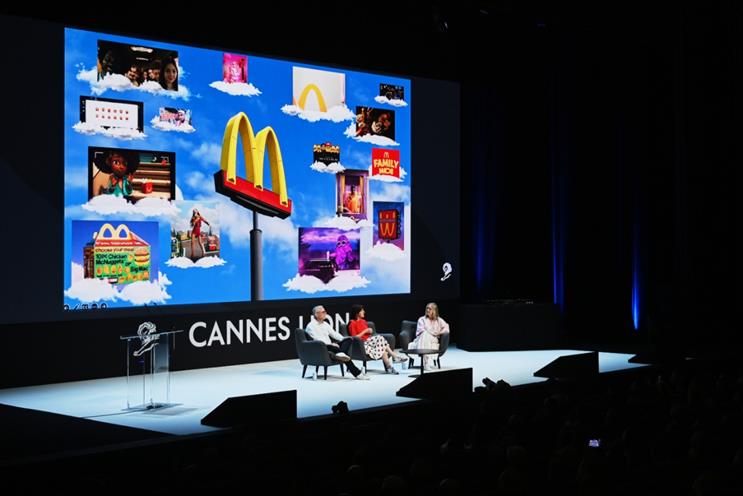
Creative recognition is only half the CMO’s argument. At Cannes Lions in 2024, McDonald’s finance chief Ian Borden described a company that once viewed marketing as a black box: expensive, consequential and insufficiently visible. He credited Flatley and her team with educating business leaders about the tools and data used to measure effectiveness, while aligning teams around consistent metrics.
This may be the less photogenic part of her record, but it is essential. A global campaign cannot live indefinitely on charm. Someone must explain why the investment belongs beside the other engines of growth. Flatley’s work joins creative permission with institutional translation. One protects the idea from being flattened too early. The other gives colleagues a reason to keep funding the conditions in which ideas happen.
Her career advice carries the same preference for process over costume. She has urged people not to do work merely for an end goal, because careers demand sacrifices and the present work needs to be worth enjoying. It lands with particular force beside her own graduation panic. The tidy retrospective arrived later. At the time, there were inventories at her parents’ house, an uncertain graduate and the dawning suspicion that she liked people and ideas more than the path she had chosen.
Today the scale is different: a global restaurant system, a venture remit and a public-company board. The useful instinct remains small. Watch what people do. Listen closely enough to hear the private joke. Build a room where someone can name it without being drowned out by the importance of the people present. Then make the business case clearly enough that the room gets another chance.
The arches were always large. Flatley’s contribution has been to make them feel observant.