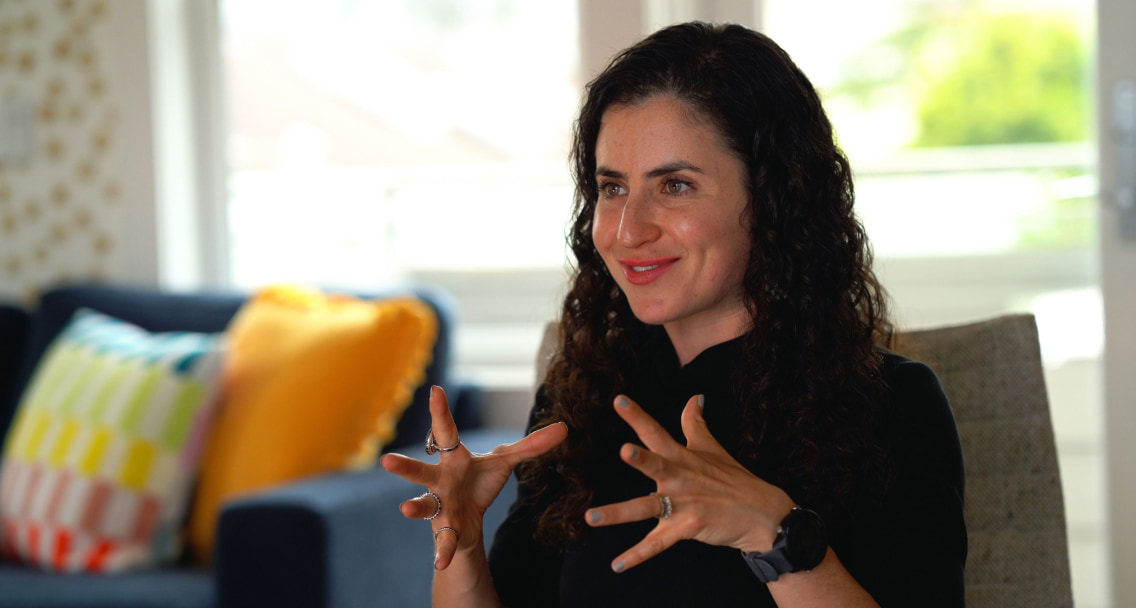
The woman who tried to rewire global money at 25 - and almost pulled it off.
Before most VCs had a crypto thesis, Morgan Beller was inside Facebook building one from scratch. She co-founded Libra, rattled central banks worldwide, and walked out to back what comes next. Now a General Partner at NFX, she bets on founders who believe something the world doesn't believe yet.
Morgan Beller has an unusual habit: she is never confused about why she is in the room. At a16z, she was the youngest partner on the deal team. At Medium, she closed acquisitions and built the subscription model before it was standard. At Facebook, she was the first person doing blockchain and crypto strategy - alone, for months, before anyone else was even briefed. At 25, she co-founded Libra.
These aren't coincidences. They are a pattern. She finds the room where something important is about to happen, gets there first, and does the work that nobody has defined yet. Then she moves on.
Today that room is NFX, the San Francisco-based seed fund organized around a single unifying idea: businesses where the product gets better the more people use it. Network effects. Morgan joined in September 2020 as the fourth General Partner, alongside James Currier, Pete Flint, and Gigi Levy-Weiss. She met Gigi in Israel in 2015 on a self-organized trip to study that country's startup ecosystem. Five years later they were partners.
Her focus at NFX is deliberately wide: crypto and Web3, financial infrastructure (stablecoins, wallets, rails), generative AI, space technology, and marketplaces. The thread connecting these verticals is not technology - it is infrastructure. She thinks in terms of rails, ports, orbits, and roads. Which systems does everyone else build on top of? Who controls those layers? What happens when those layers move?
What got me out of bed every morning was China. If you believe that the future of money is digital - which I think is just a fact - then the U.S. government is kind of shitting the bed on that; and China gets it.- Morgan Beller, TechCrunch Disrupt 2023
She writes. Prolifically. More than 24 essays in the NFX library, with titles like "Stablecoins Are Defense Tech," "AI Is Like Water," and "Ports, Rails, Roads, and Orbits." The essays are not takes. They are frameworks - usually built around a single specific claim about the world that the market hasn't priced in yet. Her February 2026 pair of essays reframe orbital infrastructure the way she once reframed digital currency: not as a technology bet but as a bet on who controls the stack that everything else runs on.
The writing is the investing, just in reverse order. She forms an opinion. The founders who share it - and can prove why - are the ones she writes a check to.
In 2018, Morgan Beller was doing corporate development at Facebook. She was also, quietly, reading everything she could find about blockchain. Not because anyone asked her to. Because she thought something important was happening and Facebook - with its 2 billion users - was the only company that could do something truly large-scale with it.
She pitched internally. Facebook gave her the mandate. For months, she was the only person at Facebook working on crypto and blockchain strategy. Then she brought in David Marcus, the former PayPal president, and Kevin Weil. Together they built what became Libra - a blockchain-based digital currency backed by a basket of global assets, designed to give billions of unbanked people access to stable digital money.
The June 2019 whitepaper detonated. Regulators, senators, and central bankers worldwide called it the single biggest threat to monetary sovereignty since Bretton Woods. Senate hearings. Treasury meetings. International Financial Stability Board reviews. Facebook's leadership was called to testify. Libra was modified, rebranded as Diem, scaled back, and eventually dissolved in early 2022 when Meta sold the assets to Silvergate Bank.
Morgan left in September 2020, before the formal end. She did not go quietly - she joined NFX and started writing about stablecoins, defense, and the dollar's geopolitical position within months. The thesis never changed. Only the vehicle did.
The footnote that rarely gets mentioned: Libra's announcement was a geopolitical catalyst. China accelerated its digital yuan program in direct response. The EU fast-tracked its digital euro. Libra failed as a product. As a forcing function for sovereign digital currency infrastructure, it arguably succeeded beyond any projection.
If we don't digitize the dollar, we risk losing its position at the center of the financial world.
History would suggest that legacy companies don't come up with anything interesting. It's the companies we haven't even thought of yet that will really bring the masses into crypto.
I go into work every day and know that I am the dumbest person in the room.
Do what you love. You'll be happier. You'll be better at it. And you won't have any regrets.
There's a case that FTX was a blessing in disguise... the laws of gravity do apply.
That was my first exposure to the 'tech world,' and I became completely intoxicated.
Morgan publishes extensively on the NFX platform. These aren't thought-leadership posts. They are pre-mortems and frameworks she uses to think through markets before she invests in them. If you want to understand her portfolio, read her essays first.
She volunteered at TechCrunch Disrupt NYC as a Cornell freshman in 2011. That single event redirected her entire career. Before it: Statistics major at Cornell. After it: VC intern at High Line Venture Partners within months. She describes the moment as becoming "completely intoxicated."
Her dog is named Josie Barklet - a West Wing reference to President Josiah Bartlet. The name is a flex: it implies you have seen enough of the show to appreciate the joke, and that you name things with care. Her dog accompanies her on San Francisco morning walks.
She takes founder candidates to pizza places and taquerias rather than Michelin-starred restaurants. The logic: how someone behaves in a casual setting tells you more about how they'll operate under pressure, in a bad quarter, in an underfunded sprint - than a white-tablecloth performance ever could.