A perfect plan can have a peculiar weakness: the person expected to follow it. Give an experienced manager a schedule that is mathematically efficient but difficult to read, and the schedule may remain a splendid arrangement of bars on a screen. Dr. Mor Brokman Meltzer has spent part of her academic career examining that awkward gap between a solution and its adoption. It makes an unusually good place to begin the story of a chief executive.
There is a pleasing inconvenience in the question. A computer can finish calculating before the people in the meeting have agreed on what the calculation means. Someone must understand the dependencies, explain the trade-offs and decide to proceed. Brokman Meltzer’s work puts that person back inside the problem. The human being is allowed to complicate the diagram.
Today she is the co-founder and CEO of Opmed.ai. Her route there runs through economics, information systems, research collaborations, an earlier startup and a move to the Boston area. Read those chapters together and a theme emerges: a promising idea has to become something another person can work with. The interesting decisions happen on the way.
The chart that loses the room
Her academic foundations were laid at the University of Haifa, where she earned a BA in economics and information systems and an MSc in information systems. The combination joins two kinds of attention: how resources are organized and how information supports decisions. Her later doctorate at Bar-Ilan University brought the questions closer to the everyday work of planning.
In 2012, she co-authored research with Irit Hadar and Ethan Hadar on evaluating software architecture in the cloud era. The paper examined the qualities architects cared about when comparing physical deployment, private cloud and public cloud environments. More technical possibilities had made the choice more complicated. Deciding which characteristics mattered was itself a piece of work.
That early subject has a familiar office afterlife. A list of options gets longer, the comparison table grows wider, and the meeting acquires another meeting. The study belongs to a particular period of software architecture, but the underlying question travels: what makes one arrangement preferable when the criteria compete? Brokman Meltzer would continue working around the point where a technically defensible choice meets a human decision.
By 2018, her collaboration with Dikla Perez and Roy Gelbard was examining software project plans. Their paper, An Optimal Point Is Not Enough, asked why managers might avoid an optimal Gantt chart. A plan can contain an efficient allocation of work and still demand difficult coordination. Every connection between tasks has to be understood by someone.
An optimal plan still needs a willing reader.
The question running through her research
A 2021 paper in Project Management Journal made the adoption problem more specific. Across four controlled experiments, experienced managers who saw a less complex plan were more likely to adopt it than those shown a more complex one, even when the plan was explicitly described as optimal. Knowing that an arrangement is efficient does not settle the matter.
The practical implication is modest and demanding: presentation belongs in the design. Imagine two illustrative plans with the same objective. One makes the next handoff obvious; the other requires a miniature expedition through arrows and overlapping tasks. The person responsible for delivery must live with that difference. The elegant answer needs an intelligible route through the working day.
Conceptual illustration of the article’s argument. No performance data.
A useful education in saying no
Her doctoral thesis received its award on November 3, 2021. Its title began, again, with An Optimal Point Is Not Enough, before specifying behavioral aspects of complexity in software project plans. Roy Gelbard and Dikla Perez supervised the work. Even in the longer academic formulation, the opening has the courtesy to give away the problem.
It also offers a useful way of reading a founder’s education. A thesis requires a question narrow enough to investigate. A business requires a problem repeated often enough to support a product. Both can suffer when the boundaries keep moving. Brokman Meltzer’s career has included the less comfortable instruction that comes from trying to build before the question is sufficiently precise.
She has described an earlier startup that struggled after serving too many kinds of customers across too many industries. The lesson was focus. An enthusiastic yes can carry a product in several directions at once; eventually the engineering bill arrives. Her subsequent academic work gave her room to specialize before another attempt at company-building.
There is no need to turn that episode into a decorative failure story. Its value is concrete: which requirements actually belong together? A request can be commercially tempting and still make the product less coherent. That is a decision a founder must keep making, often in conversations where the person asking sounds perfectly reasonable.
Three people around one problem
At Bar-Ilan, the route toward Opmed.ai included a conversation with Ariel Sella, managing director of UnBox Ventures. Brokman Meltzer approached the venture operation with the aim of applying her expertise in complex work-process networks. Sella helped narrow the application and suggested bringing in network-science researcher Professor Baruch Barzel. She also recruited Avi Paz as the technology co-founder.
The division of work is still visible in their titles. Brokman Meltzer leads as CEO. Paz is CTO. Barzel is chief scientist. Business leadership, software development and network research meet around the same problem. A founding team has to turn those different professional languages into decisions the others can use.
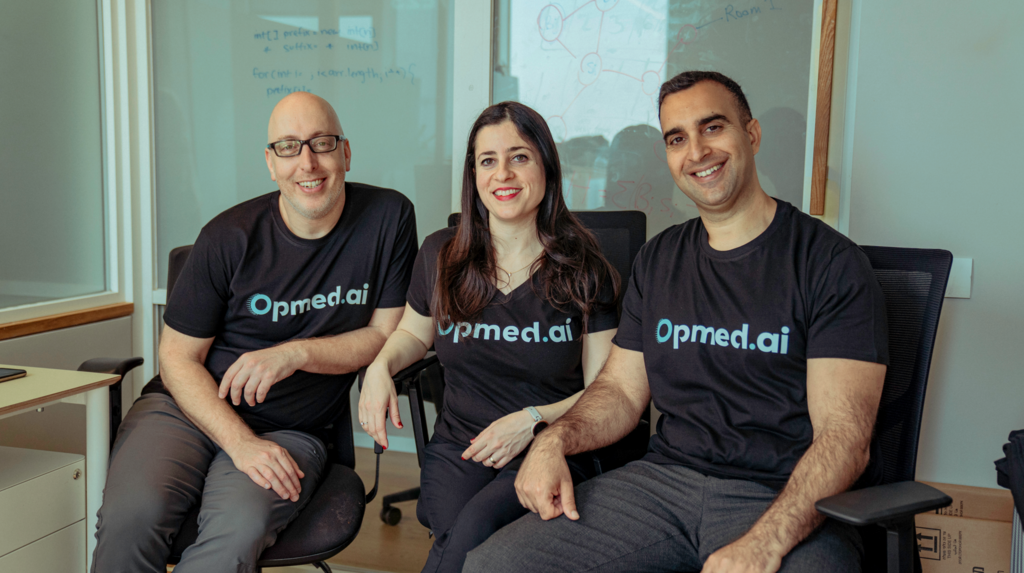
The team photograph supplies a less formal version of the organization chart. The three founders sit together in company T-shirts, with notes and diagrams behind them. No one has dressed as a job title. The distinctions show up in the work: a scientific model needs software, software needs a usable product, and a product needs a reason for someone to buy it.
The company’s current team extends across product, engineering, finance, marketing, sales and customer success. Those roles help explain what happens after a research idea leaves campus. Someone must manage delivery. Someone must hear the customer’s next objection. Someone must keep the accounts. Academic translation turns out to require rather a lot of colleagues.
The Atlantic enters the work plan
Another of her 2021 papers, Keep IT Together, examined team location and communication effort. Working with Perez and Gelbard, she studied how those conditions affected motivation to adopt complex plans. The experiment varied team size and whether members were located together. Coordination had a geography, and the geography mattered to the person managing the work.
It is an apt subject for someone who would help lead an organization across countries. The connection is a reading of her career, rather than a claim that a published experiment explains every executive choice. Still, it draws attention to something easily lost in an international growth plan: distance creates practical work for the people responsible for staying aligned.
Brokman Meltzer moved to Boston to develop the U.S. business while her fellow founders continued working in Israel. Her public profile lists Cambridge, Massachusetts. By 2024, the company described a team of around 30 people, with roughly 20 in Israel and the rest in the United States. The Atlantic had become part of the operating arrangement.
For an enterprise founder, proximity changes the texture of a market. A potential customer has colleagues to consult and decisions to defend. A conversation can reveal a requirement that a presentation never anticipated. Building near those conversations gives the chief executive a different view of the product’s journey from interest to commitment.
After the announcement, the work
On May 6, 2024, Opmed.ai announced a $15 million Series A. The participating investors included NFX, Grove Ventures, Secret Chord Ventures, UnBox Ventures and Sir Ronald Cohen. For Brokman Meltzer, the stated purpose was expansion in the United States. The number marked a financing event; it also created another set of decisions about where the company would put its effort.
Her work has also brought her back into contact with students. She spoke about entrepreneurship at MIT and collaborated with Bryant University students through the Rhode Island-Israel Collaborative’s International Business Practicum. The student team working with Opmed.ai won first place in the practicum competition. These are smaller entries in a founder’s public record, but they give the story a useful change of scale.
“Collaborating with these talented students has been a remarkable journey.”
Mor Brokman Meltzer · on the Bryant collaboration
In that setting, a business becomes an assignment that other people must investigate, understand and explain. The executive who once wrote research questions becomes someone students can question. There is a satisfying exchange in the arrangement: practical experience goes into the classroom, and a company gets a fresh set of people thinking about its market.
By June 2026, she was discussing the company-building journey in a recorded conversation with investor Renana Ashkenazi. The public role now includes explaining how she reached decisions as well as making the next ones. Her earlier work gives those explanations a particular interest. She has studied the point at which a plan stops persuading its intended user.
That leaves a practical question at the center of her story. What happens after the calculation, the pitch or the announcement? Someone has to pick up the plan and carry it into an ordinary working day. Brokman Meltzer’s career keeps returning to that person. The chart may be perfect. There is still a conversation to have.