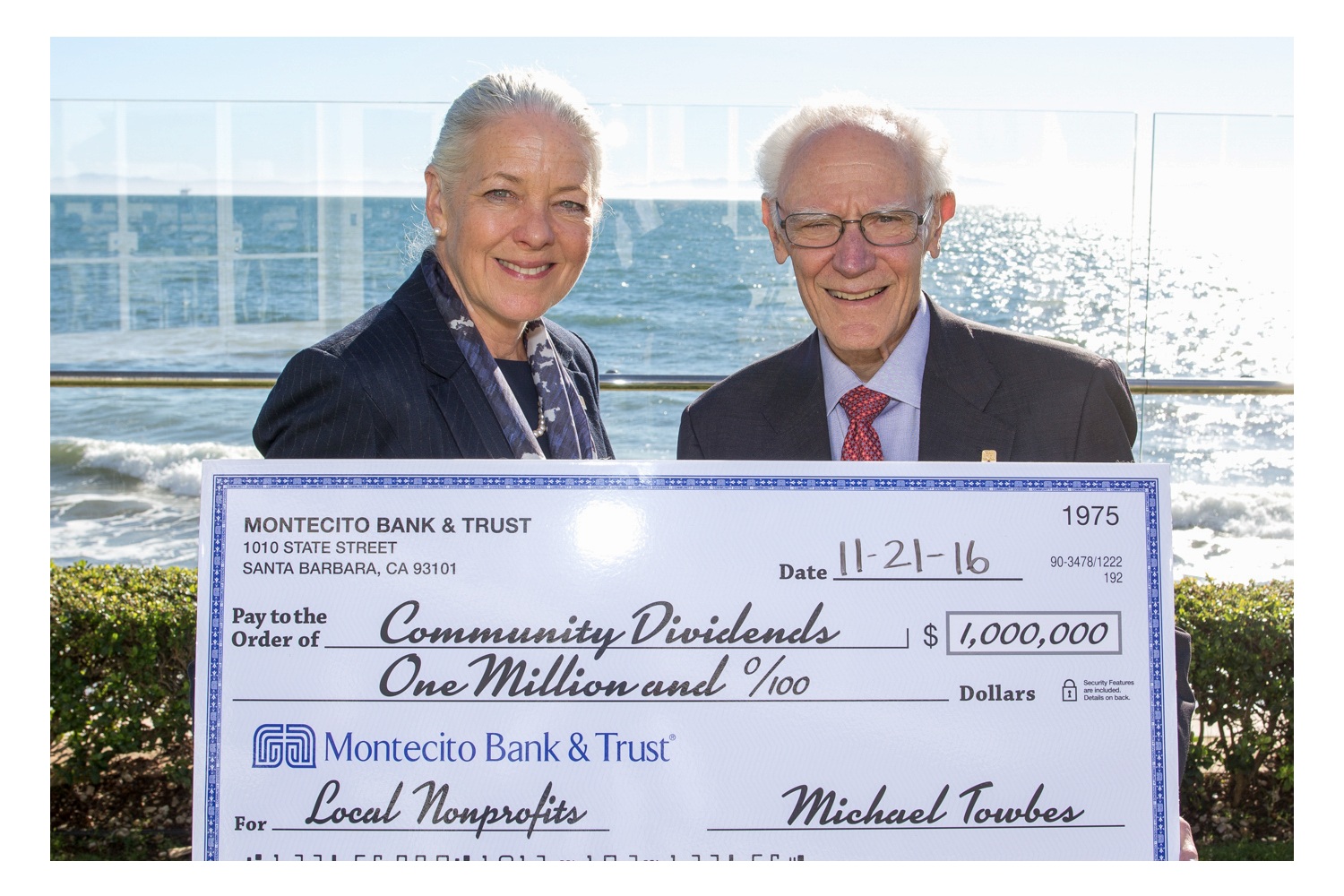
In 2003, Michael Towbes invited 100 nonprofit organizations to lunch. Each received a $10,000 check. The arithmetic was simple enough: one million dollars, distributed in a room. The interesting question was what would happen the following November. A surprise is easy to remember. A recurring expense is harder to sustain.
- Personal, business and nonprofit banking on California’s Central Coast.
- Lending, payment tools and trust services under one roof.
- Annual nonprofit giving, with employees helping choose birthday grants.
Montecito Bank & Trust kept holding the lunch. Community Dividends became an annual tradition, bringing nonprofit leaders together before Thanksgiving. By November 2025, the bank reported more than $24 million distributed since the program began. That is a useful starting point for understanding this institution: it made a public commitment, then kept putting it on the calendar.
One hundred envelopes
The company behind those checks does familiar banking work. People put money into checking accounts, savings accounts and CDs. Businesses borrow for equipment, property and working capital. Families seek mortgages. The bank’s wealth team manages investments and administers trusts. Its business model combines interest income with fees for banking and investment services.
Its customers include households, business owners, nonprofits, foundations and endowments across Santa Barbara and Ventura counties. For a nonprofit, the relationship can encompass a donation and the decidedly less photogenic work of paying staff, collecting money and managing reserves. Montecito offers nonprofit accounts alongside cash-management, payroll and merchant-service options. A grant buys something today; functioning financial plumbing helps the organization open tomorrow.

The trailer and the trust department
The bank opened on March 17, 1975, in a Montecito trailer. Its founding board included Towbes, Jerry Parent and John O’Keefe. Approval had arrived the previous year, with starting assets of $1.25 million. By December 1975, more than 4,500 accounts were open. A town had found a use for its new bank.
The subsequent history contains a reminder that local institutions have physical vulnerabilities. Fire destroyed the Montecito branch in August 1994; its replacement was completed two years later. In 1996, the trust and investment division opened, and Bank of Montecito became Montecito Bank & Trust. The extra words described an expansion into decisions that outlast a checking-account statement: inheritance, stewardship and family wealth.
Other additions followed. The bank acquired Valley Oaks National Bank in Solvang in 2001 and launched a mortgage division in 2016. Its March 2026 announcement lists 13 branches. The resulting position is specific: a regional bank with business lending and wealth expertise, serving customers who can reasonably expect their banker to understand the places where they operate.
The price of staying personal
That expectation does not make the software cheaper. In a March 2025 interview, CEO Janet Garufis described major technology upgrades as seven-figure commitments, comparable to a branch budget. “You just swallow hard and make the commitment,” she said. Customers accustomed to national banking apps bring those expectations to a local institution, too.
“You just swallow hard and make the commitment.”Janet Garufis, on technology investment, March 2025
One response has been a relationship with lending-software company Baker Hill. In January 2026, the bank described a process combining technology with a relationship banker who helps applicants through it. Garufis said small-business applicants usually learn a decision within 24 hours. That describes an expected experience, rather than a promise of approval or immediate cash.
The everyday prices are easier to inspect. Published cash-management bundles start at $10, $65 and $115 monthly, plus per-item charges. They add capabilities such as ACH origination, remote check deposit and Positive Pay, which helps flag unauthorized check and ACH activity. A business can compare its actual payment workload with the package rather than buying a reassuring name. For an owner who spends Friday afternoons processing checks, remote deposit addresses a concrete chore. For a firm handling many outgoing payments, the question shifts to authorization and monitoring. The right bundle depends on that workload; a higher monthly fee does not automatically make an account a better fit.
Personal customers face similar arithmetic. Everyday Checking lists an $8 monthly fee. Waivers include enrolling in eStatements while keeping a $500 minimum daily balance, having a primary holder aged 65 or older, or holding a formal trust account. Someone who wants frequent branch access outside the region, or who cannot meet a waiver, has a different calculation to make.
Let the employees pick
Inside the bank, giving has its own decision process. Anniversary Grants let associates campaign and vote for local nonprofits. At the March 2026 reception, 11 recipients received $3,000 apiece, including the Legacy Award recipient. Each also received a one-minute promotional video. The bank was supplying both money and material the organization could use to explain itself.
That mechanism is something other businesses can copy: set a recurring budget, give employees a meaningful choice, and provide a practical extra beyond the check. Montecito’s volunteer page also reports more than 7,900 annual hours of service. The bank’s people appear in the community in roles that extend beyond selling accounts.
Continuity helps explain the texture of the place. Bruce Stevens joined as an ATM assistant in 1985 and celebrated 40 years at the bank in 2025 as CFO and chief administrative officer. A career like that gives the phrase institutional memory something tangible: someone remembers the machines, the customers and several generations of decisions.
A bigger table
In 2025, the giving decision changed. With needs stretching across food, housing, healthcare and mental wellness, the bank found it difficult to select one area. It awarded $100,000 each to emergency funds at the Santa Barbara Foundation and Ventura County Community Foundation. The November luncheon’s total reached $1.2 million.
Generosity does not settle every banking question. Borrowers still need credit approval; investment assets can lose value. The useful test is whether the services, costs and regional access fit the customer. Montecito’s distinctive proposition is that those ordinary decisions happen inside an institution that also reserves a place for its neighbors at lunch.
Visit the bank · News & articles · Banking guides & demos · Watch: digital banking