On September 16, 2020, Monte Brem and Scott Hart rang Nasdaq’s closing bell without assembling their colleagues beneath it. StepStone’s team joined remotely from across the country. A private markets firm was celebrating its arrival on the public market, and the ceremony had become a collection of screens. For a business built across borders, the arrangement had a certain accidental aptness.
Brem had co-founded StepStone in January 2007. By the time of the bell, he was sharing the chief executive job with someone hired in that first year. There is an appealing symmetry to the picture: a founder and an early employee, together at a milestone neither could have reached alone. The more revealing part came afterward, when Brem began giving up the job that had defined his working life.
A business with room for the client
Before StepStone, Brem worked on corporate transactions and governance at Gibson, Dunn & Crutcher. He had earned a BA at San Diego State University, then a JD and MBA at the University of San Diego. Law and business gave him two ways to approach the same transaction: what an agreement permitted, and what it might accomplish. His subsequent career would require attention to both.
At Pacific Corporate Group, where he worked from 2002 to 2005, Brem became managing director and principal, and eventually president. The firm oversaw roughly $15 billion in institutional client commitments. He arrived at entrepreneurship having already worked inside the machinery of institutional investing. The questions involved other people’s capital, organizations with their own obligations, and decisions whose consequences extended beyond a closing dinner.
StepStone’s proposition gave those clients considerable room to specify the relationship. By 2013, Brem was describing customized accounts as part of the firm’s founding concept. The conversation began with how the investor wanted to work: which decisions it wished to retain, where it needed help, and how a portfolio should be constructed. The service had to accommodate the institution sitting across the table.
That approach sounds civil enough. In practice, customization makes demands on the provider. A different relationship can require different research, reporting and interaction. A pension investor building its own capabilities may need a different arrangement from an institution delegating investment decisions. Brem was building a business around those differences. The comfortable administrative fantasy that every client might want precisely the same thing had little place in it.
“StepStone was founded on the concept of doing customized accounts.”
Monte Brem, 2013
The founder went to Beijing
The global ambition involved a physical move. By July 2012, Brem had been living in China for more than two years. StepStone had established a Beijing office, and its investment activity there had increased substantially. He described an earlier level of around $25 million to $30 million invested in Chinese managers and deals, compared with an annual pace of $300 million to $500 million at the time of the interview.
These were investment figures, rather than evidence of returns. Their significance was the change in commitment. China had become a place where the chief executive lived and where the firm was putting more capital to work. Geography had acquired an address, a team and a much larger allocation.
His account of the opportunity was practical. Consumer businesses were a major focus, while other sectors were harder for foreign investors to access. He preferred local managers and local teams. He also identified a difficulty: a manager running both domestic renminbi funds and offshore dollar funds could face competing interests. He wanted managers whose commitment to their offshore investors was substantial enough to protect the relationship. Enthusiasm for a market still left plenty of room for reading the arrangements carefully.
A seat between the bull and the bear
In April 2013, Brem hosted a China investment debate featuring Daniel Rosen, founder of Rhodium Group, and James McGregor, author and senior advisor at APCO. Rosen took the bullish position; McGregor the bearish one. The title was refreshingly economical: “The China Bull/Bear Debate.” An entire conference industry might benefit from that degree of brevity.
The role placed Brem between two competing interpretations of a market where he had already committed time and capital. Hosting a debate does not establish a private temperament. It does show the professional company he kept and the questions surrounding his work. China offered investment possibilities large enough to attract international institutions, alongside uncertainties substantial enough to sustain a public argument.
Buying expertise, keeping the people
StepStone’s expansion also involved bringing existing teams into the organization. In December 2016, it closed its acquisition of Swiss Capital Alternative Investments, adding capabilities in private debt and hedge fund strategies. Swiss Capital’s management continued to lead those businesses. Brem connected the move to institutional clients facing low yields and needing additional ways to meet portfolio objectives.
The detail about leadership matters. Adding a specialist investment business involves people with their own judgment and relationships. StepStone was extending the range of work it could undertake for clients while retaining the people responsible for the acquired expertise. The company became broader through a series of arrangements that had to work internally as well as commercially.
The April 2018 completion of the Courtland Partners combination added another example. StepStone Real Estate then had nearly 50 professionals across the United States, Europe and Asia. Courtland had spent more than two decades working with institutional investors. Brem singled out its culture and the standards established by founder Michael Humphrey when explaining why StepStone pursued the merger.
It was a particular way to describe an acquisition. The attraction included the habits of an organization: how it treated clients and approached its responsibilities. Price and scale can be put in a transaction announcement’s opening lines. Whether colleagues can work together takes longer to discover. Brem’s emphasis acknowledged that the acquired team would have a life inside the combined firm after the announcement had stopped being news.
Two lecterns, one succession plan
In February 2019, StepStone promoted five people to partner and six to managing director. The appointments reached across investment work, investor relations, analytics and business development, with employees based in cities including Beijing, London, La Jolla and São Paulo. Brem credited the group’s contribution to the firm’s growth. The roster showed an organization developing leaders in several places at once.
Six months later, the promotion reached the chief executive’s office. Hart became co-CEO alongside Brem in August 2019. Brem described him as one of the first employees StepStone had hired and pointed to a dozen years of increasing responsibility. Hart had helped build the co-investment business and had taken on leadership of private equity. His preparation had happened through work inside the firm.
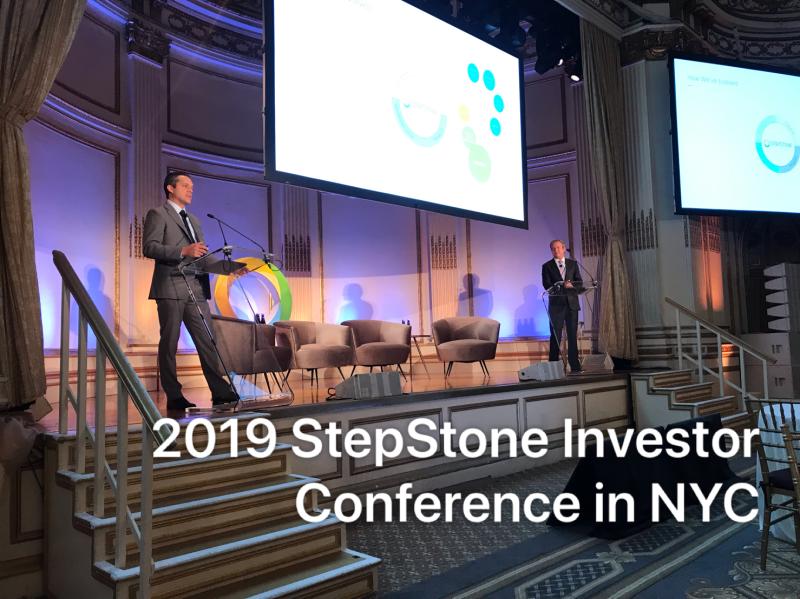
The explanation for shared leadership went back to the founding ambition: an organization intended to last for generations needed a management team that could develop. The overlap gave Hart a role in running the business while Brem remained beside him. Succession acquired a working period, with decisions to make and responsibilities to share. The founder’s future absence could be prepared for while he was still present.
That period contained consequential events. The Nasdaq listing came in September 2020. A year later, StepStone completed its acquisition of Greenspring Associates, extending its venture capital and growth equity business. The company Hart would ultimately lead was changing during the handover itself. Preparing the next chief executive did not require putting the rest of the organization on hold.
The job changes; the institution continues
Greenspring brought $18.9 billion in assets under management, measured at June 30, 2021, into the combination. The combined venture capital and growth equity operation included more than 70 investment professionals across the United States, Europe and Asia. Those figures give some sense of the organization involved in the transition. They describe a collective enterprise, with expertise and client obligations distributed well beyond its founders.
When StepStone announced the next stage in November 2021, Brem praised Hart’s work establishing European operations and developing client relationships. He also repeated the ambition that the firm should “last generations.” Hart became sole CEO on January 1, 2022. Brem became executive chairman and continued as board chair. The timetable converted a stated intention into a change in who held the operating job.
There was another adjustment in 2023. Brem’s executive chairman tenure ended on July 31; he began providing consulting services as executive advisor on August 1. He retained the chairperson role. By July 2026, StepStone’s proxy still identified him as board chair and described the advisory arrangement. His relationship with the firm had become a sequence of different responsibilities.
A founder’s biography can make every development look like the extension of a single personality. Brem’s career offers a more interesting picture when the other people remain in view: local investment managers in China, specialists joining through acquisitions, employees becoming partners, an early hire taking over as CEO. The organization grew through those relationships. Eventually, its founder changed his own place among them. That is a useful test of the ambition to build something lasting: the work continues under somebody else’s name on the chief executive’s door.