A suitcase is a peculiar thing to sell well. Make it badly, and the customer remembers you at the least convenient moment: beside a baggage carousel, holding a handle that has become a souvenir. Make it properly, and the customer may have no reason to buy another for years. Monos has built a company around the second outcome. Its next move involves coffee.
- The object: restrained luggage, everyday bags, and packing accessories.
- The promise: considered design and tested components, priced below traditional luxury.
- The puzzle: keep customers coming back when their suitcase still works.
In Chicago’s West Loop, the Canadian brand paired a store with Postcard, a café and music concept. The business logic is unusually easy to understand. “You don’t need another carry-on if you have one,” cofounder Victor Tam told Axios. A place to meet a friend, however, can earn another visit next week.
The suitcase gets someone through the door. Hospitality gives the door another purpose.
01 / The quiet object in a noisy airport
Victor Tam, Hubert Chan, and Daniel Shin founded Monos in 2018. The name borrows from mono no aware, the Japanese idea of appreciating fleeting beauty. That is a rather wistful assignment for an object destined to be shoved into an overhead bin. But it explains the aesthetic: simple shapes, restrained branding, colors that belong comfortably beside a coat or a hotel chair.
Monos serves travelers who care about how their equipment looks and how it behaves. Its territory sits between inexpensive utility luggage and traditional luxury. Away, July, Béis, and Calpak compete for similar attention; Samsonite and Travelpro offer familiar practical alternatives. Monos’s distinction rests on a particular combination of design, component choices, and direct selling. Minimalism alone is hardly exclusive property.
Its expertise becomes clearer when the suitcase moves. The classic Carry-On has a polycarbonate shell, four spinner wheels, a telescopic handle, a TSA-accepted lock, and a removable compression pad. Those features address small but persistent irritations: steering through a queue, keeping clothes contained, finding something without excavating the entire bag. Good luggage has to perform while its owner is distracted.
02 / A treadmill for your suitcase
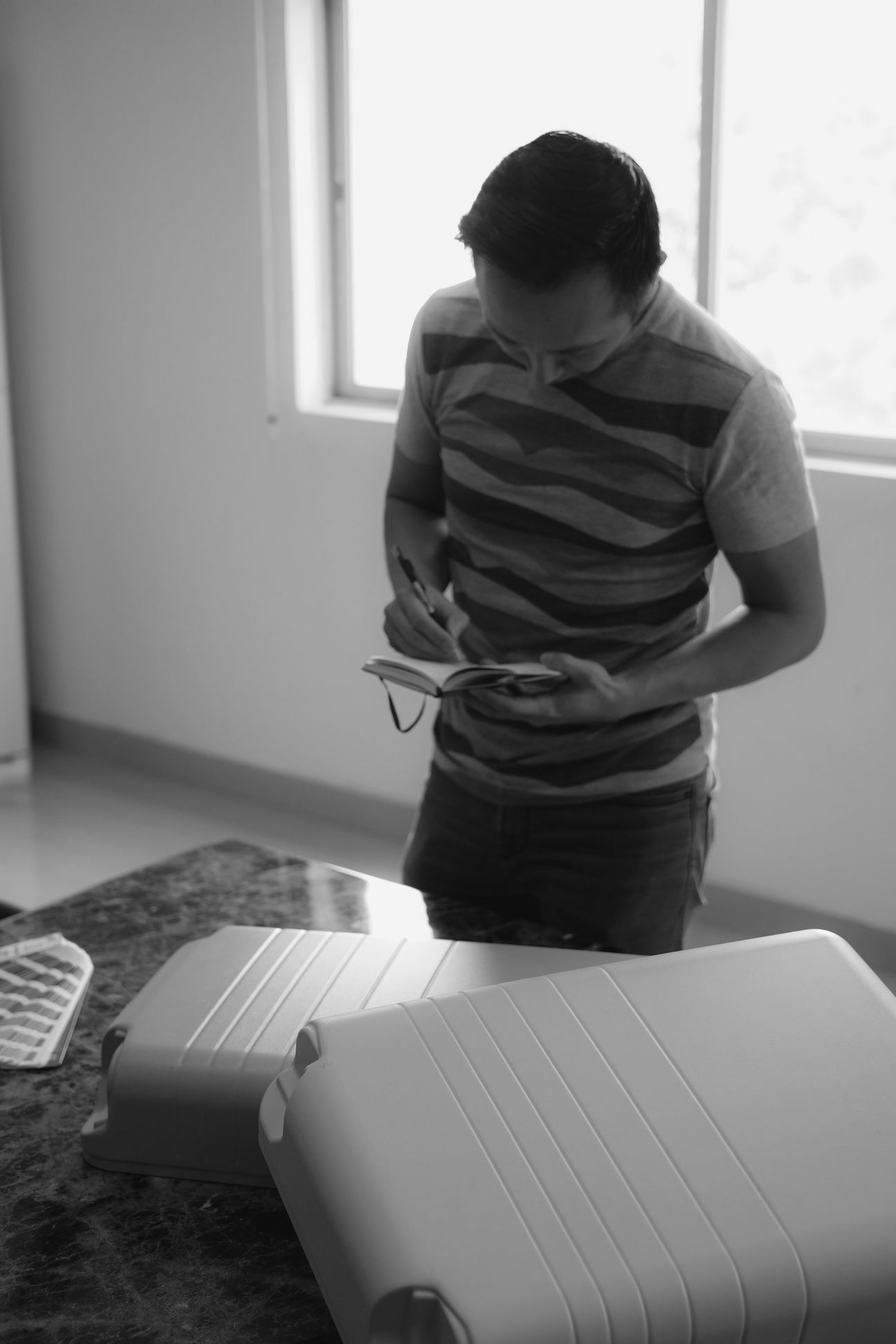
Monos publishes a battery of 40 tests. The details are more informative than the familiar luggage adjective “durable.” In its tumble test, a carry-on loaded with 16 kilograms goes into a rotating chamber containing obstacles. Its wheel abrasion test runs for the equivalent of 32 kilometers. A cold-drop procedure chills a case to -12°C for four hours before dropping it on surfaces, edges, and corners.
These are the company’s testing procedures, rather than a guarantee about every encounter with baggage handling. Still, they show where the design attention goes. A handle must survive repeated stress. Wheels must tolerate uneven ground. A shell must absorb impact. The useful lesson for any product business is specific: describe the punishment your product can take, then show how you checked.
The classic Carry-On’s listed regular US price is $275, before promotions. Its published exterior measurements are 22 by 14 by 9 inches, including wheels and fixed handles; capacity is 39.9 liters. The buying decision should begin with an airline’s actual limits and the traveler’s packing habits. A larger case buys room and can surrender compatibility. An attractive color cannot negotiate with a baggage sizer.
03 / When the destination disappeared
The first major disruption came from outside the suitcase. The pandemic shut down travel soon after Monos began. Tam’s account of the response is revealing: the team assessed its ability to design products, bring them to market, and sell online. It developed the CleanPod UVC sanitizer in under six weeks. He said it generated seven-figure revenue within two months.
That account is a founder’s report, not an independently audited product breakdown. The practical point survives the qualification. Monos had capabilities that extended beyond luggage. A new demand gave those capabilities somewhere to go. Tam described returning that momentum to luggage and travel accessories. A pivot like this requires product development, sourcing, and distribution skills that already exist; improvisation alone cannot manufacture them.
In 2022, Monos announced a US$10 million Series A and a US$30 million Series B. Venn Growth Partners led both, with Strand Equity participating; Michele Romanow joined the second round. The stated uses included inventory, product development, hiring, and channel expansion. Capital would help turn a promising range into a larger operation, with more stock and more ways to reach customers.
04 / The second purchase is a different problem
Monos has expanded into Metro backpacks, totes and duffels, packing cubes, wallets, and other accessories. Classic, Expandable, Hybrid, and Aluminum luggage offer different material and capacity choices. These products give an existing customer another problem to solve: a commute, a weekend, a tangled packing routine. For another retailer, the move worth copying is that sequence: earn trust with one useful object, then address the tasks around it.
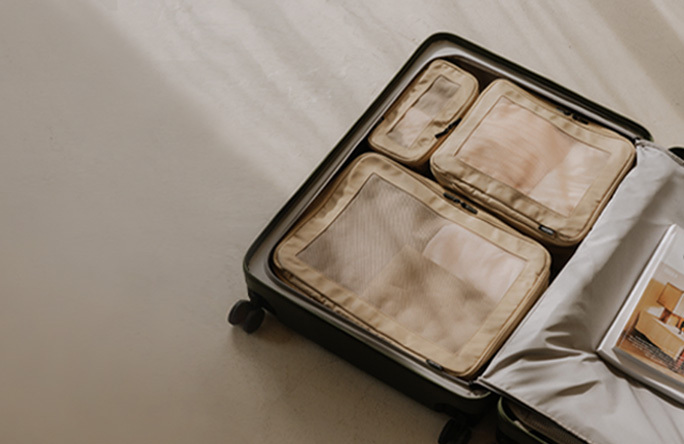
Physical retail adds something a screen cannot supply: the chance to lift, roll, and pack the object before committing. Postcard extends the experiment into everyday visits. It also introduces another operating challenge. A pleasant shop does not automatically produce a good café. Monos must make the food, service, and atmosphere worthwhile in their own right, even for someone who already owns all the luggage they need.
05 / Read the promise all the way through
The environmental proposition has a measurable checkpoint. B Lab lists Monos as certified since November 2024, with an impact score of 84.5 against the 80-point qualifying threshold. Tam has also described an internal carbon tax that spread climate accountability across departments. Certification assesses the business; it does not make a suitcase impact-free. Longevity still depends on maintenance, repair, and actual use.
Buyers should give the warranty the same attention as the shell. Current standard lifetime coverage concerns qualifying failures of wheels, handles, and locks. Airline damage requires optional upgraded protection. The 100-day luggage trial requires unused, brand-new condition and original packaging: pack it at home, roll it indoors, decide there. Those distinctions matter more than a reassuring badge. Monos’s proposition becomes strongest when the customer understands exactly what the beautiful object is being asked to do.