Early in his career, a mentor put a choice to Mohd Iskandar Shafi’i: “One day, would you rather become a king... or a kingmaker?” It is a rather grand question to carry into a working life. Most career advice concerns a promotion, a salary, perhaps a better chair. This one concerned who would get the crown.
The question resurfaced in his conversation with Proust My Startup host Vanessa Moulédous. By then, Iskandar was co-founder and CEO of Growth Charger, the Kuala Lumpur venture platform working with founders, universities and public agencies. The kingmaker reading of his career is an appealing one. His work puts him beside people preparing to build businesses of their own.
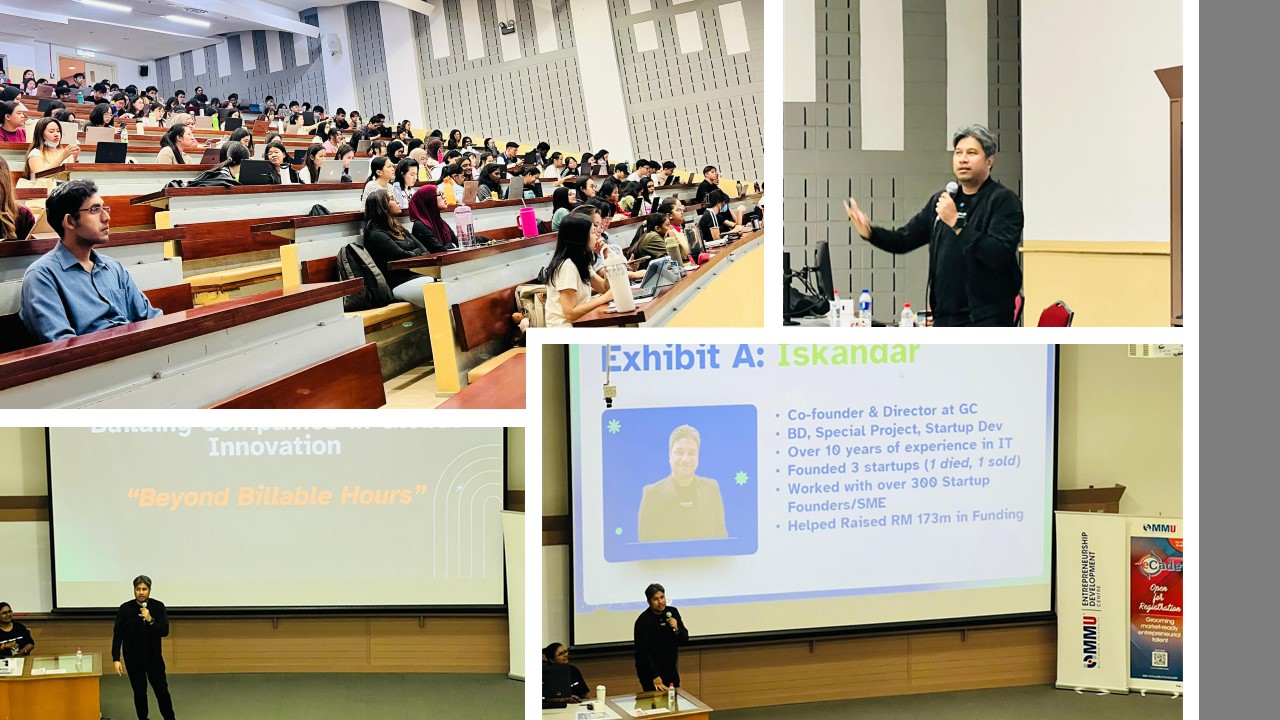
There is a useful complication, though. He has been a founder himself. During a May 2025 university talk, his presentation described three startups founded, with one closed and one sold. His introduction allowed both outcomes into the room. For students weighing entrepreneurship, that is a more interesting calling card than an uninterrupted procession of victories.
One closed, one sold, three attempts
The slide called him “Exhibit A: Iskandar”. Beneath that cheerfully forensic heading came the particulars: more than ten years of experience in IT, work in business development and startup development, and the three ventures. The parenthesis about their different fates did quite a lot of work. A sale and a closure could occupy the same line without either erasing the other.
That small piece of self-presentation helps explain the appeal of an operator teaching entrepreneurship. Starting a company leaves room for several endings. A mentor who acknowledges that range can talk about execution without making the whole undertaking sound like a moral examination in which successful people have simply tried harder.
His current platform, Growth Charger, was founded in 2020. It describes a remit spanning acceleration, venture building and innovation programmes across Southeast Asia. Those activities place the company between people developing something new and institutions able to help them test, finance or commercialise it. For Iskandar, the work gives the kingmaker question a practical setting: people, programmes and business decisions.
The customer gets a vote
In 2024, MYStartup and Growth Charger selected 26 startups from 136 applicants for a four-month pre-accelerator. The intake covered businesses in green technology, smart living, hospitality and digitalisation. A founder could be working on something very different from the next team and still face the same immediate difficulty: finding out whether anyone wanted it.
Iskandar’s instruction was plain: “Speak to your customers, refine your product and think about scale”. The order deserves attention. Conversation comes before refinement; refinement comes before expansion. It leaves the prospective buyer with an inconvenient amount of influence over the founder’s beautiful plan.
The programme offered mentors, learning modules, collaborative spaces and market exposure. Those are ways to organise a search for a viable business model. They cannot make a reluctant customer enthusiastic by administrative decree. Iskandar’s emphasis on product-market fit keeps the central question close to the people who might eventually pay.
The cohort’s scale also gives his work some texture. Twenty-six selected teams means different assumptions to examine and different conversations to arrange. An accelerator may appear to be one programme from the outside. From the founder’s seat, its usefulness depends on whether the advice changes the next decision.
Four months focused on product-market fit. Selection figures describe this intake, not business survival.
An appointment with the awkward questions
A September 2024 Cyberview Living Lab Accelerator schedule shows what that work can look like at the level of a day. At CoInnov8 in Cyberjaya, Iskandar and Sean Liew were assigned a session on stakeholder mapping and identifying customers. Later came a pitching clinic. Iskandar shared a judging room with Brendan Beh of Sunway iLabs.
The timetable placed teams into successive fifteen-minute slots. Other mentors included Daren Tan and Hafiz Khairi. It is a small but revealing arrangement: founders moving through a scheduled encounter with people able to examine their proposition, while a broader group supplies expertise beyond any single mentor.
Stakeholder mapping is an ungainly phrase for a useful exercise. Who uses the product? Who approves it? Who pays? Those people may have different interests. Before a company can persuade them, it has to recognise them. The workshop title makes Iskandar’s customer-first instruction concrete enough to put on a calendar.
His public teaching returns to the same subject. In November 2024, he led an interactive market-validation workshop at Multimedia University’s Cyberjaya campus. The two-day programme also covered incorporation and intellectual property through other speakers. That combination put the customer question beside the practical business of establishing and protecting a company.
“Speak to your customers, refine your product and think about scale”
Iskandar Shafi’i · MYStartup Cohort 3
A lecture hall with a business problem
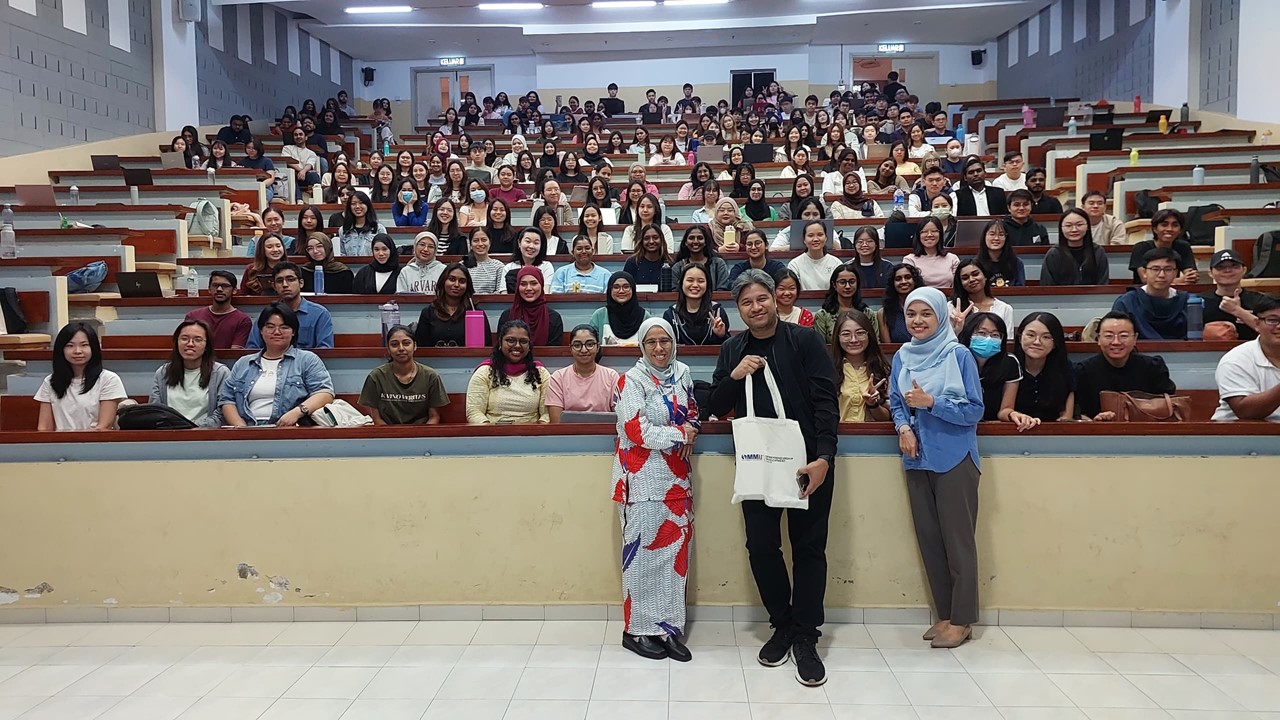
On 14 May 2025, Iskandar spoke at Multimedia University’s Melaka campus for its I3 Entrepreneur Series. He began with the reason for starting a business, then worked through validation, teamwork and adaptability. Funding stages, rules and profits also entered the discussion. The audience got an account of entrepreneurship with its administrative furniture still attached.
He drew on his own experience and encouraged students to learn beyond textbooks, with mentors and collaborators around them. That is a recognisable extension of his accelerator work. A founder needs room to try things, people who can challenge a decision, and enough commercial understanding to see what a promising idea will require next.
Photographs from the session show him holding a microphone before a tiered lecture hall, with his career slide projected behind him. The students occupy the larger part of the scene. It is a fitting composition for this chapter of his working life: the experienced founder has the floor, but the possible next businesses are sitting in the audience.
Getting an invention out of the university
The university relationship has also taken a contractual form. On 25 October 2024, Iskandar signed a memorandum of understanding with Universiti Sultan Zainal Abidin as a director of GC Management Ventures, the company known as Growth Charger. The ceremony in Putrajaya placed him directly in the work of building institutional relationships around innovation.
A further step came on 27 May 2025, when Growth Charger and Taylor’s University signed an agreement for the Taylor’s University Innovation Accelerator. Researchers, postgraduates and alumni were its intended participants. The planned sequence ran from capacity building to pitching, incubation and a final showcase, with training, internal funding, mentorship and access to validation networks.
Taylor’s identified 22 selected projects. The announced areas included emerging technologies, renewable energy, sustainability, culture, arts and tourism. Iskandar described Growth Charger’s contribution in terms of helping academic research reach its commercial potential. Here, the founder-building work begins with people whose starting point may be an invention rather than a company.
The distinction matters to the shape of his job. A university has research expertise; a prospective business needs decisions about users, teams and markets. The accelerator gives those questions a place in the development process. It also puts Iskandar in contact with another kind of early founder, someone learning how a research project might become an enterprise.
- 01 Capacity building
- 02 Pitching
- 03 Incubation
- 04 Final showcase
A ticket to a larger room
Competition supplies a more visible expression of his ambitions. In August 2024, Growth Charger announced that it would host Malaysia’s Startup World Cup finals. Cradle’s MYStartup, MDEC, WORQ and CloudMile were among the partners. The local winner would have a route to the global competition in Silicon Valley and a chance to compete for a US$1 million investment prize.
That last distinction is useful: the million dollars belonged to the global contest. Winning in Malaysia offered passage to another round, alongside access to investors and fellow founders. Iskandar framed the event as a way to put Malaysian entrepreneurial talent before an international audience.
In July 2025, Qarbotech won the Kuala Lumpur final at Asia School of Business. Its work in agricultural technology gave the event a specific business to send forward. Iskandar again emphasised connecting Malaysian startups with global opportunities. The setting had changed from a workshop room to a competition stage, while the connecting role remained familiar.
An introduction becomes more consequential when the founder has something ready to discuss. That is where his programme work and competition work meet. One creates occasions for scrutiny and preparation; the other creates a larger audience. A trophy is an excellent conversation starter. The conversation still needs a business inside it.
Going further while staying in Sarawak
His geographic ambition also runs east. In March 2025, Iskandar and the Growth Charger team visited TEGAS Digital Village for discussions with TEGAS CEO Udin Bujang about entrepreneurship and talent development in Sarawak. It was another institutional relationship, with the region’s founders and opportunities at its centre.
By the Startup Innovation Showcase in Kuching on 2 February 2026, Growth Charger was named as accelerator partner for SDEC’s Digital Village Accelerator. Seven selected DiVA ventures appeared at the showcase. The programme combined mentorship, business-development support and pilot opportunities with seed funding of up to RM150,000.
DiVA had widened eligibility to companies outside Sarawak that planned to establish operations there within six months. Iskandar’s accompanying ambition was to help startups grow internationally while keeping activity anchored in Sarawak. Expansion, in that formulation, should also develop talent and economic opportunity at home.
That adds a place to the kingmaker idea. Helping a founder reach a global stage is one task. Helping a region retain the activity that follows is another. Iskandar’s work now reaches across both, from asking who the customer is to helping arrange the institutional support around the answer. The next crown, if one appears, will have quite a few people behind it.
Away from the programme descriptions, his Proust My Startup appearance offers a smaller detail to remember: he enjoys science fiction and art, and jokingly calls himself an “exhausted pigeon” when faced with the early-bird-or-night-owl question. Even a career spent encouraging founders apparently requires an alternative bird classification.