Rosemarie Truman approached Goldman Sachs with something more troublesome than a résumé: a proposal. She had studied how trading instructions passed from a desk to the floor of the New York Stock Exchange and devised a plan intended to save $40 million by reducing errors. Her suggested compensation was one percent of the savings. The firm offered her a job. The salary, she later recalled, was missing a zero.
It is a good joke about youthful bargaining. It also introduces a habit that runs through her working life. Truman looks for a gap between what an organization possesses and what it could accomplish, then tries to build a process across it. At Goldman, that meant a trading workflow. At the Center for Advancing Innovation, the nonprofit she founded in 2012, it means helping inventions acquire the companies they need.
A job application with a balance sheet
Her education had room for several ways of thinking. At Smith College, where she studied from 1990 to 1994 and graduated with high honors, she combined mathematics, economics, and industrial engineering and operations research. Comparative literature and French supplied another register. Numbers could test an argument; language could help someone else understand it. Her professional life would require both.
Wall Street was the beginning of a career that moved into technology and strategy. At Oracle, she worked in advanced technology. At Ernst & Young, her work included eBusiness strategy. At Marsh & McLennan, she held a global strategy role. Eventually she led IBM’s innovation and research-and-development strategy practice. The employers changed; the questions concerned how an organization could make better use of its capabilities.
Truman’s specialty became commercial due diligence and portfolio strategy: deciding which opportunities deserve resources and how to develop them. That work involves choices a demonstration cannot settle. A technology might function beautifully while a proposed business remains difficult to finance or sell. The challenge is to make judgments about the whole enterprise, including the people and circumstances around the invention.
Her corporate background helps explain the particular nonprofit she chose to build. CAI would work on the commercial journey of research, using challenges to bring together people with different skills. A scientist’s understanding of an invention could sit alongside an entrepreneur’s business experience and a lawyer’s attention to rights and agreements. Someone had to organize the conversation and give it a destination.
The business around the breakthrough
Based in Bethesda, Maryland, Truman built CAI around identifying promising inventions and helping teams pursue their commercial potential. The organization describes a process that includes screening technologies, recruiting entrepreneurs, assembling teams, training participants and connecting them with mentors. Its central unit of work is a company taking shape around an opportunity.
Consider the division of labor. An inventor may understand why a technical approach works. A commercial partner must examine how it might be used, who needs it and what a plausible business would require. Legal expertise helps establish what the company can license. Financial planning tests the resources required to proceed. These are connected problems, and a team has to learn to make connected decisions.
- 01Find the inventionAssess commercial potential
- 02Assemble the peopleCombine technical and business skills
- 03Work the planTraining, mentors and financial thinking
- 04Build the companyPursue licensing and capital
In September 2016, her work took her inside a national laboratory. Pacific Northwest National Laboratory appointed her director of innovation impact. The appointment described a brief covering commercialization, business engagement and economic growth. It also credited the startup initiatives she had launched at CAI with more than 33 companies and 21 partnership or collaboration agreements.
Her stated aim at PNNL was to help create new markets and knowledge-based jobs from the laboratory’s inventions. That language gives her ambition a useful scale. The desired outcome extends beyond a successful pitch or a licensing document. It includes people working in businesses that can carry research into practical use, and a local economy that benefits from their presence.
A space race with paperwork
NASA offered a particularly vivid setting for that ambition. Its Space Race competition, run with CAI in 2016, invited entrepreneurs to build businesses around agency technologies. The inventions included a robot for excavating resources and a system for harvesting wind power with airborne vehicles. Space supplied the romance. Company formation supplied the agenda.
The associated Startup NASA licensing initiative addressed a practical constraint: young businesses needed to conserve cash while securing intellectual-property rights. Eligible startups could license NASA technology without an upfront payment and with no minimum fees for three years. CAI’s competition added business training, expert mentorship and an opportunity to pursue private seed funding.
The sequence mattered. Teams developed their plans and presented them to judges. Finalists would incorporate businesses and apply to license selected technologies. There was work to do after the applause: establish an entity, secure rights and begin the long process of developing a product. A prize could help, but the company still needed a route forward.
“They’ve been tested rigorously”
Rosemarie Truman, on NASA inventions, 2016
Truman was interested in the testing already behind these technologies. That made them a different starting point from an idea sketched on a napkin. Even so, proven engineering leaves commercial questions open. Turning a technology designed for one demanding environment into something a customer will purchase requires a different set of decisions. The challenge gave entrepreneurs a place to begin making them together.
The invitation still needs an answer
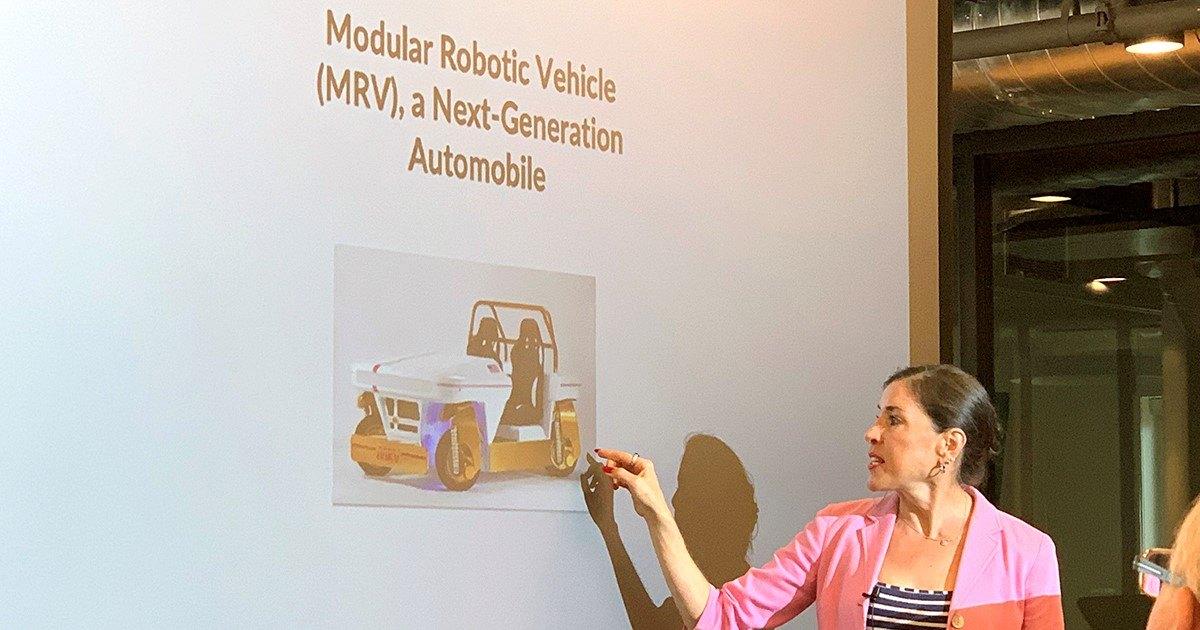
Three years later, in Northwest Arkansas, the problem was more earthbound. The SCALE challenge, supported by the Walton Family Foundation, aimed to help launch 20 supply-chain and logistics companies. Truman was holding information sessions to attract participants. As of July 16, 2019, 40 teams had registered. An ambitious program still needed people willing to enter it.
This is a revealing scene in a career usually described through strategy and growth. The work included explaining requirements and getting prospective teams to consider the commitment. The eight-month virtual program was free to participants. It offered a structure for developing businesses around supply-chain technology, but a structure only becomes useful when someone agrees to work within it.
Recruitment belongs in the story because it gives the process some friction. A funder’s support, an available invention and a regional opportunity do not automatically produce a company. People must decide whether the opportunity fits their skills and circumstances. Truman’s information sessions dealt with that decision at the beginning, before anyone had a new business to celebrate.
SCALE stood for Supply Chain and Logistics Enterprises. Its competition invited individuals as well as teams, with a progression through pitching, team formation, business planning and investor engagement. The format allowed someone to enter through an interest in building a business, rather than arriving with every ingredient already secured. Finding the missing ingredients became part of the work.
There is an appealing practicality to making a contest out of that process. A deadline gives an intention a date. A required plan makes a team explain its assumptions. Mentors can examine an argument before an investor is asked to finance it. In Truman’s version of startup matchmaking, the introduction comes with assignments.
A useful person at the next table
Her interest in connections has also taken her outside accelerator programs. In 2021, she became chair of the advisory board at Relatus, a platform concerned with professional networks and knowledge. In explaining the appointment, she spoke about the time she had spent finding the right people to help accomplish her goals. It was a familiar problem, now expressed through another business.
The attraction is easy to understand. A network has practical value when someone can find the expertise required for a particular decision. For a startup team, access alone leaves plenty unresolved. The people involved need enough shared understanding to work together. Truman’s advisory work sits naturally beside the effort to assemble teams with complementary capabilities.
She has made room for less conventional encounters, too. A 2019 CODAME art-and-technology salon included her introduction to the SCALE challenge and a follow-up group session. In January 2023, she hosted Spicy Innovation, a restaurant series bringing the innovation community together around Washington, DC. The opening stop was Atxondo, with Spanish cuisine on the menu. Networking could at least be spared an indifferent conference sandwich.
Conversation is also the format of her podcast, Dragons, Gazelles, & Unicorns. Its guests come from entrepreneurship, research institutions and technology transfer. An August 2026 episode featured aerospace entrepreneur Grant Anderson discussing operations, leadership and resilient companies. The subject fits the larger concern running through her work: what allows a group of people to build something that lasts?
CAI also reported more than $3.3 billion raised by its startups. These organization-reported totals describe different outcomes; launching a company and financing it are separate milestones.
Truman continues to write about careers and nonprofit leadership. Her public calendar also points toward teaching: she is scheduled to speak on consulting careers at an October 28, 2026 virtual workshop. The audience may bring different scientific specialties, but the career question is recognizable. How can an ability developed in one setting become useful in another?
Her own route supplies several answers without pretending the transitions happen by themselves. Finance led into technology and strategy; strategy became a way to help organize new ventures. Along the way, her work has required proposals, training sessions, introductions and patient attention to whether a team can do what its plan promises.
The thread is responsibility. A promising invention leaves many tasks unclaimed. Someone must investigate the market, assemble colleagues, understand the rights, explain the finances and keep going after the presentation ends. Truman has made a career of getting people to pick up those tasks. The next chapter of an invention begins when a group of people agrees to write it together.