A pilgrimage can begin with an administrative problem. Before the journey comes the booking: a hotel, a flight, permission to travel, a way to get from one place to the next. Each arrangement can be perfectly reasonable on its own. Put them together, and the traveler acquires a second occupation: coordinating everybody else. Mohammed M. S. BinMahfouz has spent much of his working life on the other side of those arrangements. At Umrahme, the booking platform he founded and leads, he is trying to make them fit.
His career has moved through travel companies, aviation, bank payments and pilgrimage services. Read in order, the jobs look varied. Read backwards from Umrahme, they begin to resemble an unusually thorough apprenticeship. He has worked with the trip, the transaction and the institutions that make both possible. The interesting part of his story happens where those responsibilities meet.
There is a modest phrase in his public explanation of the business that deserves more attention than the usual promises of technological transformation. In 2019, while discussing Umrahme’s agreement with Saudi Arabia’s Ministry of Hajj and Umrah, he said: “We believe in minimalism and ease.” It is an appealing ambition for an industry in which a traveler’s folder can become almost as important as the suitcase.
A travel career takes a banking detour
BinMahfouz’s professional life began in 1996, managing Mahfouz Travels & Tourism Co. and Mahfouz Aviation Co. This was travel as a working business, involving agencies and aviation services. His later move into online pilgrimage booking followed years inside the machinery of getting people from one country to another.
In 2005, he joined Saudi Arabia’s National Commercial Bank as a product manager for its e-commerce business. He established the department and later became vice president and head of payment operations across the bank. In 2013, he returned to travel at Elaf Group, taking responsibility for travel and tours and Hajj and Umrah as a vice president.
That banking chapter supplies a useful way to understand the company he would build. Buying a journey requires a sequence of commitments. Money changes hands before the promised experience takes place. Every confirmation matters. A traveler needs confidence that the booking on a screen corresponds to something waiting at the destination. Payments experience belongs quite naturally in this story.
His Elaf years also put a specific international route into view. In 2015, he spoke about Biman Bangladesh Airlines operating daily flights between Jeddah and three Bangladeshi cities. His concern was practical: more flights would meet demand and support travel between the two countries. Long before the language of apps and digital platforms takes over, there is the essential question of whether people can actually get there.
Seven words, a considerable amount of work
By 2019, BinMahfouz was publicly representing Umrahme in its dealings with the Ministry of Hajj and Umrah. The platform’s agreement with the ministry placed his ambitions inside a regulated pilgrimage market. It offered approved external agencies a business-to-business booking system and provided support for electronic Umrah visas.
The wording of his pitch was deliberately practical: a unified place for arranging an Umrah trip from anywhere in the world. There was room in that proposition for an agency arranging a group as well as for the pilgrim whose attention was fixed on the destination. Simplicity on the customer’s side required coordination on the company’s side.
“We believe in minimalism and ease.”
Mohammed M. S. BinMahfouz · 2019
This is where the founder’s background becomes relevant again. An aviation business, a payments department and a pilgrimage operator each see a different piece of a trip. Umrahme’s proposition asks them to connect. A tidy booking experience depends on several untidy commercial relationships behaving themselves at the same time.
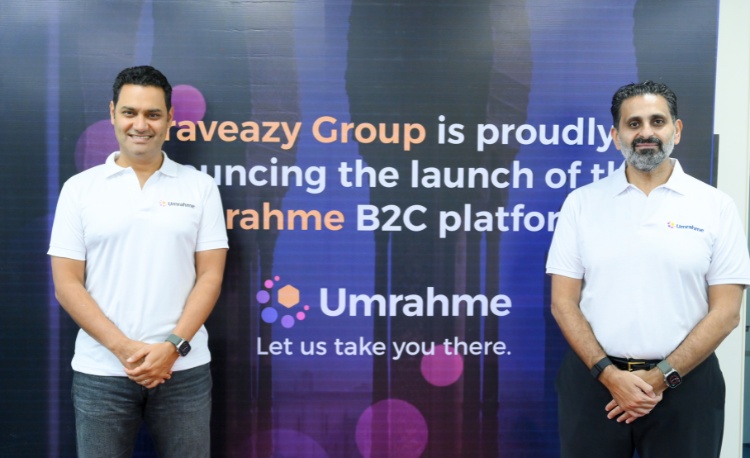
Within Traveazy Group, Umrahme sits alongside Holidayme. That gives BinMahfouz a setting that already includes online travel. Investor Algebra Ventures describes the group’s approach as giving travel agents digital tools with the ease associated with consumer booking, alongside analytics and marketing capabilities. An agent remains part of the journey; the tools used behind the counter change.
The customer would still like to speak to someone
A booking system can be available before people are comfortable using it. BinMahfouz acknowledged that difficulty at the Halal in Travel Global Summit in 2022. Customers accustomed to meeting an agent or making a telephone call could resist a process with less human interaction. Changing habits, he explained, was a major challenge.
That admission gives the business story some welcome texture. The obstacle was partly the relationship people already trusted. Asking someone to arrange a significant religious journey through a new interface asks them to reconsider how reassurance is delivered. A clean screen cannot answer every concern simply by being clean.
He also distinguished between the demands of direct customers and those of travel agencies. Individual travelers wanted choice; agencies needed efficient, straightforward answers for their own customers. The platform had to listen across that ecosystem. This is a more demanding assignment than persuading everyone to click the same button.
For BinMahfouz, then, serving agents and serving travelers are connected tasks. The product must respect the person who wants control over an itinerary and the intermediary who helps another person feel ready to go. A familiar voice and a digital reservation can occupy the same journey.
What a booking figure can tell you
In April 2022, Umrahme reported that cumulative bookings had passed 3.5 million pilgrims since its inception in 2019. It also reported 80 percent business growth during the first half of Ramadan. These were the company’s figures, attached to its account of demand for direct bookings and customizable packages.
Pilgrims covered by cumulative bookings, according to Umrahme’s announcement. A historical company figure.
The packages brought flights, accommodation, transfers and visas into the offer. Customization mattered because travelers wanted more say over their plans, including where they stayed. The product’s appeal lay in allowing decisions to be made together while leaving room for individual preferences.
BinMahfouz linked those results to investment in the product. He also discussed adding local tourism experiences and financial technology to the offering. The ambition was already extending beyond the initial reservation: once someone could arrange a pilgrimage, what else would make the visit easier to plan?
A familiar app, a different way in
In November 2024, Muslim Pro announced an Umrah booking service with Umrahme. The partnership placed pilgrimage planning inside an app its users already knew. The service allowed travelers to customize their arrangements from their phones, and its announcement singled out younger Muslims in the United States and United Kingdom.
BinMahfouz described growing demand among Muslims in Western countries for flexible ways to arrange Umrah. The partnership offered another entrance to the same operational system. It also reflected a sensible distribution idea: the place someone starts planning a trip need not be the website of the company assembling it.
For a founder who had discussed resistance to digital booking, this was a useful development. Familiarity can come from several places: an agent, a brand, an app used for other purposes. The work is to connect that familiarity to a booking the traveler can understand and manage.
The train enters the itinerary
On January 13, 2025, BinMahfouz represented Umrahme at the signing of a memorandum of understanding with the Haramain High-Speed Railway through Saudi Railway Company. The stated focus was integrating reservation systems and improving access to train tickets through Umrahme. It was a concrete extension of the connected journey he had been describing.
A railway agreement makes a useful antidote to vague talk about digital travel. There are actual seats, actual departure times and actual passengers who need the reservation to hold. The convenience of finding a ticket online depends on the systems exchanging the right information. BinMahfouz’s work has repeatedly returned to this boundary between a simple customer decision and a complicated institutional arrangement.
His interest in the transaction side has continued. A certificate records his completion of a seven-week introductory fintech course, provided by Emerging Market Financial Training with Fintech Saudi, in February and March 2024. For someone who had already run bank payment operations, returning to a course offers a small, specific detail in a career usually described through executive titles. The subject of how money moves has remained in the picture.
The next ambition is consistency
By June 2026, his attention was on the unevenness that can remain after digital services are introduced. He described differences between operators and connections on the ground, and the continued reliance of some businesses on manual processes and WhatsApp coordination. Better tools for suppliers, bookings and invoicing were part of his proposed answer.
He put the priority plainly: “The biggest opportunity right now is consistency.” The sentence fits the career. Travel management taught him about movement; banking put him inside transactions; pilgrimage services brought those concerns together around a particularly meaningful journey. Across those settings, a promise has to survive its passage from one organization to another.
His public posts sometimes step away from those institutional concerns. In one, he described buying ice cream for the people who clean his neighborhood’s streets, calling attention to their daily work and the pleasure of a small gesture. It is a warmer register than a railway agreement or a payments department, and a reminder that his public life also has room for the people encountered close to home.
There is something pleasingly exacting about that aspiration. Consistency demands attention to ordinary details long after a launch photograph has been taken. A passenger should be able to recognize the journey they booked in the journey they receive. For BinMahfouz, the missing steps are the avoidable ones between deciding to go and being able to leave.
Follow the journey
More from BinMahfouz and the businesses he works with.