A customer still has Mike Patel’s ear. That is a modest detail for a business biography, where acquisitions usually receive the larger type. Yet it is a useful place to begin. Patel personally approached an early customer to try the software he was developing. More than twenty years later, the relationship still included conversations about new features. The company had aged. The conversation had stayed open.
For a software founder, that creates an interesting obligation. An early user remembers the promises, the awkward first versions, and the requests that never quite disappeared. There is nowhere to hide behind a launch date. A product has to earn its place again whenever somebody sits down to use it. Familiarity can be a demanding customer.
Mike, also known as Mitesh, founded Meditab Software, whose beginnings date to 1998. He has appeared publicly as both CEO and chairman. Those titles describe authority. The more revealing thread is the work around them: getting people to try a system, hearing what they want changed, and keeping a business attached to the everyday experience of its users.
The first version is only an introduction
Patel began developing the company’s flagship platform in 1998. His early business experience had already given him a practical interest in technology and workflow. Software offered a way to change how work moved through an organization. The appeal was operational: fewer obstacles between a task and its completion.
That origin gives the subsequent career a particular shape. Patel approached software from the position of somebody trying to make an existing business function better. The question begins with the work. What takes too long? Where does information stop moving? Which routine asks people to accommodate a tool that ought to accommodate them?
These are unfashionable questions in the best possible sense. They survive changes in terminology, devices, and sales pitches. An office can acquire an impressive new system and still have the same old bottleneck. A founder who remains interested in the bottleneck has work to do long after the demonstration ends.
There is also an unexpectedly revealing biographical detail. In 2013, improving software for clients was described as Patel’s hobby. Most people choose a pastime that gives them a change of subject. His apparently came with a feature list. It is a small piece of humor in a career whose public record is largely devoted to work.
A conference with room for the customer
By 2013, Meditab was organizing a first user conference for one of its product communities. The plan included customer presentations, individual sessions, and roundtable discussions. Users would have several ways to take part, including opportunities smaller than a roomful of raised hands.
The design of such an event matters. A presentation lets a company explain its decisions. A conversation lets a customer question them. A private session makes room for the detail that is too particular for the main stage and too important to its owner to leave unanswered.
Patel spoke then about the importance of customer engagement, education, and relationship building. Those words can be used rather casually in business. Here, the proposed schedule gave them an ordinary, useful form: time together, questions, and people talking about the same product from different sides of the desk.
A company can learn something uncomfortable in those rooms. What looks like a minor adjustment to its developers may occupy an unreasonable portion of someone else’s day. The customer supplies the scale. Listening is useful partly because it gives the person building the tool a chance to revise what counts as a small problem.
“If it’s working, he wants to do it better.”
Renee Williman, a longtime customer’s administrator, on Patel
The product has to keep its appointments
A platform that stays in use accumulates responsibilities. Existing customers need continuity while new features arrive. Training has to keep pace. So does support. The glamorous part of software is the new capability; the less photogenic part is helping somebody use it on an ordinary working day.
Patel’s public product announcements show him dealing with that continuing work. In April 2013, Meditab introduced a cloud delivery option for one of its products. He connected the development to client input and the team’s efforts to refine the offering. A different route to the software could open the door to additional customers.
In July 2014, another announcement introduced an updated version of the flagship platform. The release included new functionality and bug fixes. That pairing deserves a little respect. Software needs both the ambition to add something and the patience to repair something. The second rarely gets invited to make a keynote speech.
Read together, these moments give Patel’s career a rhythm: build, put the work in front of users, revise, and keep supporting it. The repetition is part of the business. A release is a point in the relationship, and the relationship continues into the next working morning.
Buying a business with its own history
On September 4, 2024, Meditab and DrCatalyst announced the acquisition of Fox Meadows Software. Fox Meadows had been established in 1994 and was already a longtime reseller. The transaction therefore involved a business with existing relationships, its own experience, and customers accustomed to a particular way of working.
Patel’s stated rationale centered on combining the businesses’ strengths and broadening the solutions and support available to clients. Acquisitions are often narrated through the buyer’s appetite. His explanation put the customer offering in view. The practical question was what the combination could make available.
There is a useful tension here for any founder. Building gives a company time to develop its own habits. Acquiring brings another set of habits into the room. Established relationships have value precisely because they already exist. Preserving that value requires attention after the announcement has done its job.
The questions across the lunch table
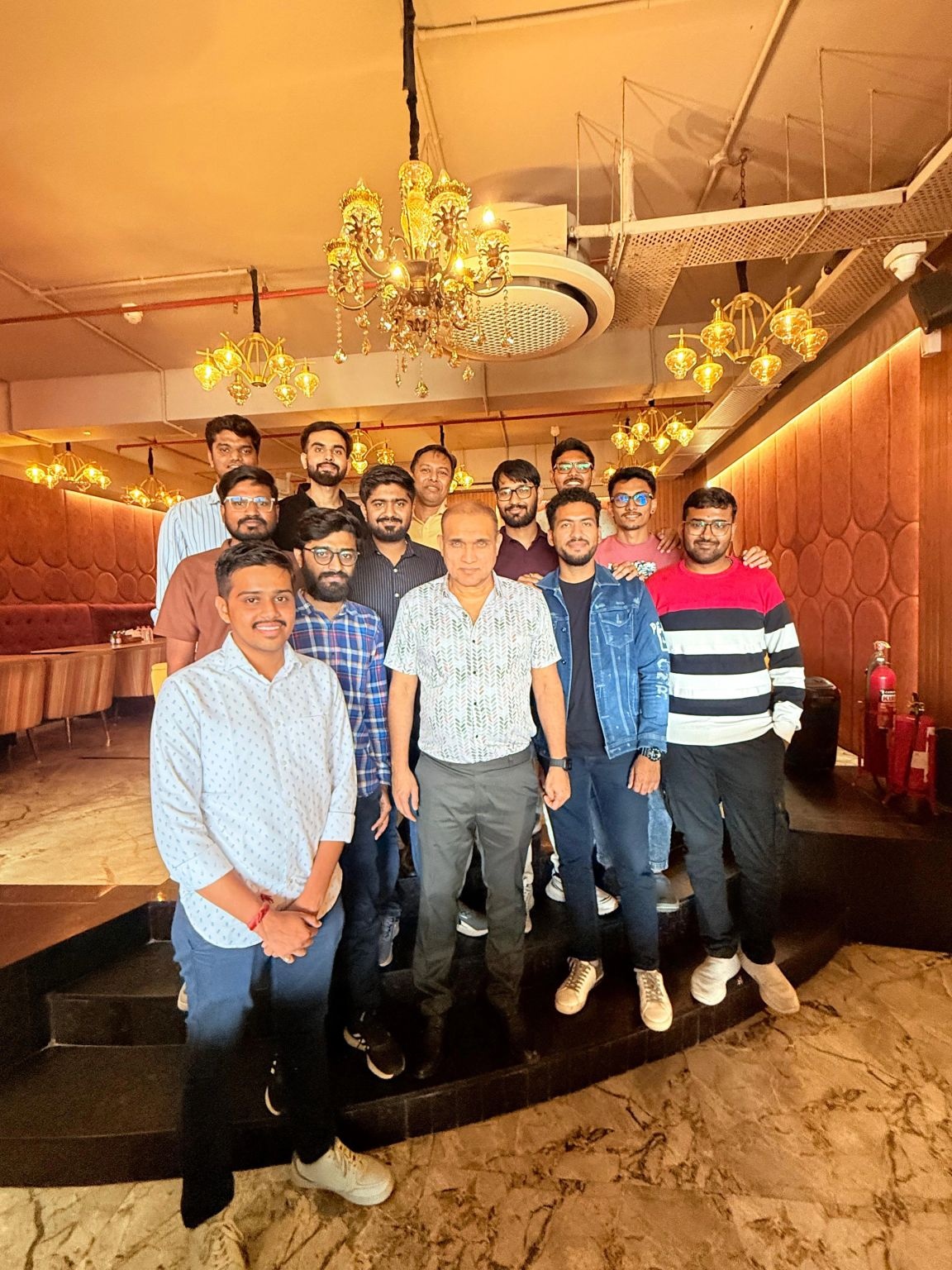
In February 2025, a team lunch with Patel became a discussion about building a business. The questions covered his founding journey, keeping up with industry trends, the role of sales and marketing, and the choice between starting from scratch in a new market and acquiring an established operator.
That last question connects neatly with the Fox Meadows transaction. It is also a more interesting question than a request for a motivational slogan. Building and buying ask different things of a company. One requires creating a foothold; the other requires understanding the foothold somebody else has already made.
The published account records the subjects the team raised, rather than a transcript of Patel’s replies. The subjects themselves are telling about the occasion: colleagues had access to a founder and used it to ask about decisions. Lunch briefly doubled as a business classroom, with rather better prospects of dessert.
Another perspective arrived in August 2026, when Tejas Poojara reflected on leaving Meditab after nearly a decade. He thanked Mitesh Patel alongside other leaders for guidance, support, and opportunities. It is a specific colleague’s acknowledgment, with the texture of a working relationship built over years.
Poojara’s account describes learning opportunities, demanding work, and trust during his time at the company. He recalls presenting product improvements and working with clients as well as colleagues. His thanks to Patel sits within a wider acknowledgment of the people who helped him develop. That wider frame matters. A founder’s influence reaches other people through an organization, with all the shared effort that the word implies. Careers inside a company have their own stories.
Two stops beyond the product meeting
In April 2025, Patel appeared at a foundation-laying event in Visakhapatnam, also called Vizag. Alongside Meditab Group executive vice president Venkata Balagani, he met Andhra Pradesh IT minister Nara Lokesh. Their discussion concerned IT prospects, investment opportunities, and the region’s future growth.
The occasion was associated with the Taj Varun Bay Sands development. Patel’s documented part was the meeting and business discussion. It places him in a different setting from the product announcement: a conversation about where future work and investment might go.
That month also brought an appearance closer to Meditab’s California base. Patel and Balagani met California State Treasurer Fiona Ma at a Miracles University CalKIDS program event. Meditab participated as lead sponsor supporting Miracles University, a nonprofit dropout prevention program serving Sacramento County.

These appearances widen the view of Patel without requiring a grand theory of his character. One concerns potential business activity in an Indian city. The other concerns an education program in California. Both belong in a career that has extended beyond the first product and the first group of customers.
There are smaller glimpses of company life, too. In 2024, Meditab celebrated Patel’s birthday across the office. A birthday gathering asks less of a founder than a strategy session, though it offers its own reminder of how many people now share the working day. The event belongs to the ordinary calendar of an organization that has continued for decades. Alongside the product deadlines and business decisions, there is still an occasion to stop work and mark another year.
Still open to revision
Patel’s story has room for the corporate milestone and the ordinary exchange. The acquisition belongs beside the user conference. A discussion about new markets belongs beside a customer asking for a better feature. Different scales of decision, each with people on the receiving end.
The early customer relationship offers a particularly good ending because it resists a tidy finish. Software that remains useful needs another conversation, another adjustment, another answer. For Mike Patel, the business begun in 1998 has continued to supply those occasions. Better software leaves something on tomorrow’s list.