Before Minou Clark learned to read an algorithm, she learned to read a room. She was a theater kid, devoted to the old mechanics of attention: timing, voice, gesture, pause. At Hamilton College, she sang with the Hamiltones, the school's coed a cappella group. Performance was not a detour from the executive career that followed. It was the rehearsal.
Her first professional stage was considerably stranger. Clark ran social media for The Maury Show, writing as Maury Povich to the show's online audience. She has called it a kind of method acting. The job required a young woman at a keyboard to inhabit the public voice of a television host in his seventies, then persuade a crowd to react. The subject matter was paternity tests and televised drama. The craft was narrative.
Clark noticed that a post could work like a scene. It could hold attention, release tension, and provoke a response. Digital media, she later said, was "an extension of a theater stage." The internet supplied instant reviews in the bluntest possible form: clicks, comments, shares, silence.
Act IThe applause had a dashboard
BuzzFeed came next, during the years when a quiz could ricochet through millions of lunch breaks by evening. Clark made content and studied its wake. Why did one idea travel while another collapsed? Which emotion made someone pass a story to a friend? Her public BuzzFeed archive still holds the delightful archaeology of that period: celebrity posts, personality quizzes, internet jokes, 100 entries in all.
She was learning to treat virality as something more rigorous than luck. A headline was a hypothesis. Distribution was part of the creative work. Data did not replace taste; it exposed whether taste had found company.
That education became a route through New York media. Clark moved into audience development and growth roles at HuffPost, PopSugar, People, Entertainment Weekly, Yahoo, and the company now called Dotdash Meredith. The logos changed. Her question stayed put: what makes people care enough to do something?
At 11:11 Media, founded by Paris Hilton and Bruce Gersh, the assignment widened. Clark joined early and helped build the digital side across film, television, audio, music, books, consumer products, and the web. It was a founder-led universe where a cultural moment might become a video series, a partnership, or a product before a traditional company had finished its meeting about the meeting.
As senior vice president of digital, Clark's team helped drive 70 percent audience growth and more than one billion video views in 2023. ADWEEK put her on its Top 50 Business Leaders list that year. By then, the theater kid's instrument had changed. She was still moving audiences, only now across a portfolio.
- Perform for a room
- Read the reaction
- Scale the audience
- Build the business
Act IIThe job she nearly declined to chase
In 2024, RealSelf approached a turning point. The company had history, authority, millions of registered users, and a prominent place in online aesthetics. It also had a business that had been losing money and a brand tied too tightly to search traffic. Clark almost did not interview.
Her hesitation was rational. Every RealSelf chief executive before her had been a man. She had never been a CEO, nor had she spent her career in the aesthetics industry. She assumed the board wanted the familiar pattern: prior chief executive experience, category credentials, the usual uniform. Instead, her first board meeting ever was as CEO.
The lack of category tenure gave Clark permission to ask elementary questions without embarrassment. Why did a company serving a largely female audience not feel more consumer-led? Why wait at the end of a Google search when discovery was happening in feeds, newsletters, creator conversations, and group chats? Why behave like a static reference shelf in a culture moving by the hour?
Clark brought what she calls a media mentality. The phrase sounds breezy until one sees the operating consequences. The company invested in social storytelling, newsletters, editorial franchises, brand partnerships, creators, and direct relationships with readers. It moved its headquarters from Seattle to New York, closer to the media and consumer culture Clark had spent a career navigating. A full visual identity and site overhaul followed.
She did not begin with the public reveal. In her first months, Clark met individually with 150 employees. She asked where the company had stalled, what frustrated them, what they feared, and what they wanted to build. It was a listening tour conducted at human scale inside a digital company. Silos loosened. Roles and accountability sharpened. Disagreement became permissible.
Act IIIAttention with somewhere to go
The turnaround showed up quickly. RealSelf returned to profitability within six months. By Clark's second anniversary, she said the company had added more than one million newsletter subscribers organically and grown its digital footprint by more than seven percent. Social video views had risen 177 percent year over year, engagement 130 percent, and the newsletter audience 41 percent. The email list passed three million subscribers, with reported open rates above 60 percent.
Numbers can flatter almost any executive story if arranged with sufficient lighting. These figures matter because they describe a coherent bet. Clark reduced reliance on borrowed discovery and built places where an audience could return by choice. She joined culture to commerce without pretending the two were strangers.
Her favorite formulation is "clout that converts." The wording carries a wink, but the logic is disciplined. Clark starts with what an audience cares about, not what a company hopes to sell. Cultural relevance earns attention. Useful information earns trust. Only then does the business get to ask for something.
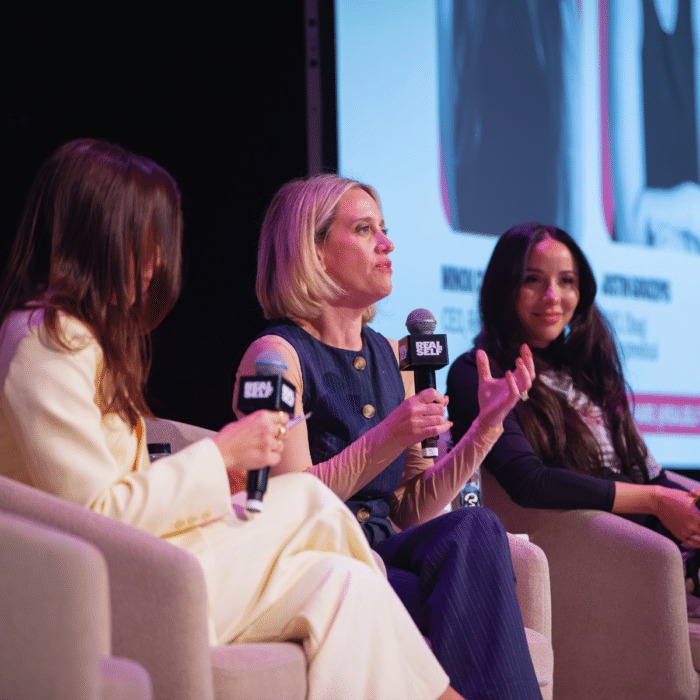
RealSelf's rebrand was correspondingly less polite than a corporate font change. The voice grew conversational. The company staged a New York Fashion Week launch for more than 500 guests, built brand activations, and recast its website as a destination rather than a directory. In 2026, Clark said the company earned its first Webby nomination and award. The transformation became visible enough for the founder, Tom Seery, to praise its boldness in public.
The hard currencyTrust without the corporate throat-clearing
Clark inherited a business whose value rested on credibility, yet her solution was not to make its language more institutional. She pushed in the opposite direction. RealSelf could be rigorous and still sound like someone a reader might willingly invite into a group chat. It could acknowledge the emotional weight of a decision without turning the conversation into a lecture. It could have a point of view without becoming careless.
This is a more difficult balance than the rebrand photographs suggest. A playful voice can attract attention, but attention evaporates if the underlying experience feels flimsy. Authority can steady a brand, but too much solemnity makes people scroll past. Clark's response was to divide the labor: culture opens the door; useful information gives someone a reason to remain.
The same division appears in her leadership. Warmth does not remove standards. Candor does not require cruelty. Clark talks about intellectual honesty and psychological safety, phrases that risk becoming office wallpaper unless a leader is willing to be challenged in public. Her version links permission to responsibility. People can dispute the plan, and then they must help carry the chosen one.
That may be why the one-on-one meetings matter more than their impressive count. Listening was not a ceremonial prelude to decisions already made. It gave Clark a map of the institution she had been asked to change. The media operator entered through the audience. The CEO began backstage.
BackstageA CEO without the costume
Clark's public persona resists the polished distance long associated with the title. Podcast hosts repeatedly describe her as candid and self-aware. She talks openly about the awkward leap into a job before certainty arrives. She favors a flatter culture, encourages challenge, and has built a leadership group that is predominantly female for a company whose audience is predominantly female.
There is a useful tension in her approach. She is an operator who loves the messy voltage of pop culture. She trusts data but speaks about instinct. She can discuss accountability and then compare a rebrand to a Kris Jenner-level facelift. The humor does not dilute the analysis. It keeps the analysis connected to the way people actually speak.
Her Paris childhood matters here, too. Clark has said it shaped her relationship with culture and taste. She speaks French and English fluently, belongs to YPO and Chief, and advises the Aesthetic Industry Association. Yet the most revealing credential may remain theater. It taught her that an audience is never an abstraction. It is a collection of people deciding, moment by moment, whether to stay.
Two years into the role, Clark called the job the greatest education of her career. This is believable because education, for her, appears to be a habit rather than a phase. The Maury account taught voice. BuzzFeed taught feedback loops. Legacy media taught distribution. 11:11 Media taught speed and founder conviction. RealSelf is teaching what happens when those skills must survive a balance sheet, a board, and Monday morning.
The room is larger now. It includes employees, partners, providers, readers, and a restless internet with no obligation to pay attention. Clark's advantage is that she has never mistaken the audience for scenery. She listens for the response, changes the timing, and keeps the story moving.