- Zzazz gives individual articles, videos, podcasts and datasets a changing benchmark price.
- Its engine learns from content features, comparable items and what readers actually do after seeing a quote.
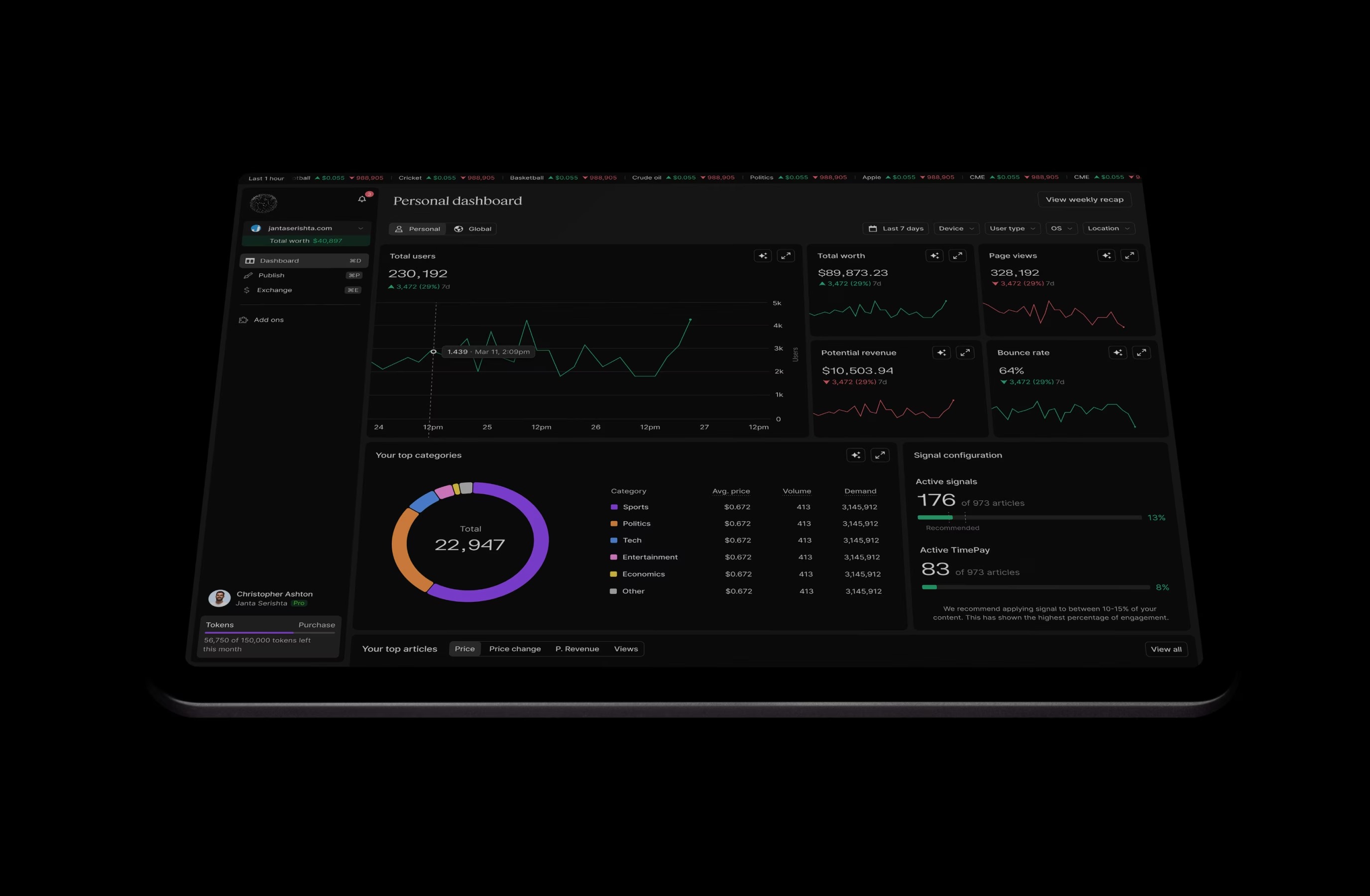
- The product is sold as market plumbing: search, a publisher dashboard, an embeddable signal, a WordPress plugin and planned APIs.
- The model is most useful where there is repeated demand, measurable access and enough feedback to correct a bad opening price.
The internet has a peculiar sense of value. It can tell you, to several decimal places, what it cost to put a sneaker advertisement in front of a 34-year-old in Milwaukee. It can auction that chance in the time between a click and a page load. Yet the article beside the sneaker - the reason the reader arrived - is usually assigned one of two prices: nothing, or the cost of an entire subscription.
Zzazz begins with the suspicion that this is absurd. The San Francisco company is building what it calls a Liquid Pricing Model, or LPM: a system that assigns a live price to a single piece of information. An article can be hot now and ordinary tomorrow. A research report can be valuable to a lawyer and irrelevant to everyone else. A video can decay slowly, spike after an event, then find a second life months later. Zzazz wants the price to move with that life.
The peculiar problem of the $0 article
Publishers have long sold proxies. Advertising prices an impression. Subscriptions price a bundle. Traffic dashboards count attention. None of those measures asks the smaller, more awkward question: what would someone pay for this item, at this moment, with this context?
The idea behind Zzazz predates its current branding. A patent family with a 2016 priority date describes a self-learning valuation function for digital content. It looks for attributes in a new item, compares that item with earlier ones, estimates its useful lifetime, presents a price and then adapts when consumers buy - or do not buy. The refusal matters. A price that produces silence is not merely a failed sale; it is a training signal.
No purchase is still an observation. The next quote carries the memory of the last offer.
“LLMs predict the next token. LPMs predict the next price.”Zzazz's neatest one-line distinction
The line is cute, but it carries a real design choice. A language model asks what expression is likely to follow. Zzazz asks what economic response is likely to follow. Its public product describes a quote with a Quantitative Market Value, or QMV, plus a confidence score, forecast, comparables and a 14-factor trust decomposition. The dollar figure grabs the eye. The confidence band is the more honest part.
A model is not a market
This is the central difficulty. Anyone can print a number next to an article. A market price only becomes interesting when people can act on it, creators can be paid and the result returns to the model. Zzazz has therefore built a set of connected surfaces rather than one clever predictor.
ix.live
A free reference index where readers search priced information, compare values and follow a topic over time.
Publish + Signal
A site connection, dashboard and embedded badge that puts the live quote where a reader encounters the work.
Machine Economy Lane
A planned rights-aware route for software agents to request, pay for and document access by call, document or token.
QMV Private
A planned isolated version for banks, law firms, healthcare organizations and governments with private corpora.
There is also a WordPress plugin. This is less glamorous than “the first market for information,” and perhaps more important. Markets need inventory. A plugin turns the abstract pitch into a familiar publisher action: install, connect, show a price, measure interaction. The public directory showed only 20-plus active installations when checked, a reminder that the accessible product footprint is still early even while the company's own network figures are much larger.
What it costs, and who gets paid
The consumer proposition is deliberately granular. Instead of purchasing a monthly bundle to read one desired story, a person can pay for the item, use a time-based advertising option, or encounter another access lane chosen by the publisher. For publishers, Zzazz's own documentation advertises an 80/20 split and net-45 fiat payouts. The company is the pricing and settlement layer; the creator keeps ownership and licenses access under chosen terms.
The split is easy to understand. The harder calculation is whether a moving per-item price produces more revenue than a fixed paywall without adding more reader friction.
For an AI agent, the same logic becomes a rate card. The proposed interface can quote rights separately - view, summarize, retrieve or train - and return an auditable receipt. That is a sharper product than generic “AI licensing.” The buyer knows the permitted action; the publisher has a transaction record; the machine does not need to negotiate a new bilateral contract for each document.
What failed first was the proxy
Zzazz's origin story is not presented as a dramatic pivot. The change of mind sits at the industry level. The web spent decades treating the impression as value because impressions were measurable. Then platforms optimized the proxy: headlines chased clicks, pages chased inventory and publishers learned that enormous attention could still yield a thin margin. Subscriptions repaired part of the problem but restored the bundle, not the price of an individual work.
Generative AI makes that mismatch harder to ignore. When machines can create and summarize material cheaply, volume becomes abundant. Provenance, rights, utility and timely access become more valuable. Zzazz's wager is that software agents will need the same thing human procurement departments need: a price they can quote, a right they can understand and a receipt they can audit.
The bit worth copying
A publisher does not need to build a global exchange to borrow the useful logic. The transferable lesson is to replace one blunt gate with an observable experiment.
- Price the unit people actually want. Test the article, dataset or episode, not only the annual bundle.
- Keep a floor. A model should not be allowed to discover a price that violates production cost, brand position or contractual rights.
- Record refusals. An offer ignored is evidence about timing, audience and price - if the instrumentation is clean.
- Show uncertainty. A confidence score is more useful than false precision, especially for new or unusual material.
- Close the loop. A recommendation without settlement data remains an opinion dressed as a decimal.
The conditions hidden in the confidence score
Dynamic pricing becomes persuasive when there are repeated transactions, comparable items and a short enough feedback cycle to learn. It is less convincing for a one-of-one investigation, a tiny audience, a public-interest document that should remain open, or a publisher whose readers interpret every price change as unfair. Sparse data can make the opening quote look scientific without making it wise.
There is also a behavioral trap. A reader may pay because a price signals quality, or refuse because it signals opportunism. News is especially sensitive: raising the price during a crisis could maximize a local curve while damaging a publisher's long-term trust. The clever implementation is not “always charge what the market bears.” It is to make editorial rules, access obligations and price floors part of the system.
| Alternative | What gets priced | Where Zzazz differs |
|---|---|---|
| Advertising | The impression and audience | Zzazz centers the information asset. |
| Subscription paywall | The bundle over time | Zzazz can quote one item at one moment. |
| Micropayment platform | A fixed item or wallet debit | Zzazz makes the item price adaptive. |
| Data marketplace | A dataset or license | Zzazz extends the logic to everyday media and machine access. |
This positions Zzazz somewhere between publisher software, an AI valuation service and a marketplace. Piano or Zephr can manage access. Axate-style products can meter payments. Patreon and Substack can monetize a relationship. Data exchanges can license a corpus. Zzazz is making a different object primary: the changing estimated value of the individual piece.
The price is not the verdict. It is the opening line of a negotiation conducted by clicks, payments and time.
That distinction keeps the project interesting. If Zzazz merely tells publishers that an article is worth $1.411, the decimal will become theatre. If it can repeatedly quote, transact, settle and learn across people and machines, the number becomes infrastructure. The company's grand claim is a market for information. Its real work is more prosaic: convincing enough pages to carry a price and enough readers to answer it.