The file arrived at 11 p.m. That was the first problem. A client needed 250 presentations, each with 119 color pages, at a Houston conference by eight the next morning. Mimeo's Memphis crew could print and bind them, but the ordinary overnight shipping window had shut. So the company found an extraordinary window: a private plane. The flight added $6,500 to a $34,000 order. The client agreed. By two in the morning, boxes were headed for the airport; by breakfast, the presentations were in Houston.
This was not a charming anecdote about heroic employees doing the impossible. It was an expensive demonstration of what Mimeo had chosen to sell. The company had promised that a late order could become a finished, delivered object by morning. Once a customer plans a conference around that promise, the company is selling certainty as much as ink.
- Mimeo lets companies order and distribute printed documents and digital training material through online platforms.
- Its original edge was a late-night ordering cutoff backed by production near the Memphis shipping hub.
- Customers include training teams, marketers, schools and photo book buyers; the company said it served more than 15,000 customers globally in 2025.
- The lesson to borrow: remove the customer's coordination work, then design the operation around the deadline you advertise.
The errand that became a factory
In 1998, Jeff Stewart, David Uyttendaele and John Delbridge saw an office ritual ripe for replacement: someone carried a file to a copy shop, discussed paper and binding, waited for proofs, then worried about delivery. Their company, first called EasyCopy.com, put that ritual in a browser. The change sounds obvious now. At the time, it meant persuading people that a complicated document could be assembled accurately without standing at a counter.
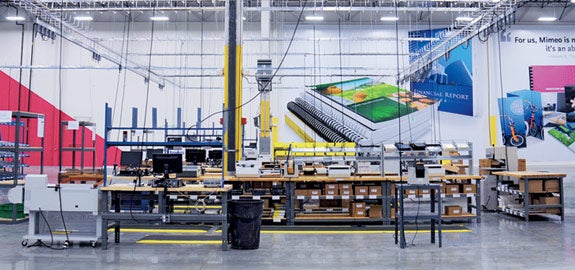
The browser was only the shop window. Behind it came file handling, online proofing, job routing, binding, packing and a night shift. Mimeo set its first print operation near the FedEx hub in Memphis. That choice made a geographic fact part of the product: a document produced late could still meet the planes moving overnight. In 2000, Mimeo began taking orders for bound documents as late as 10 p.m. Eastern and offering delivery as early as 8 a.m. the next morning.
A local copy shop could make a good binder. A commercial printer could handle a large run. Mimeo's different proposition was the handoff between order, production and distribution, carried through one online workflow. The customer could upload a PDF, choose finishes, inspect the proof, save it in a library and ship finished copies to many recipients. For a sales manager with a morning meeting in another city, those handoffs are the work.
The price of a promise
The Houston flight shows the limit of any neat efficiency story. Software can shorten the ordering process; it cannot make an aircraft wait. When the client sent the file after the shipping cutoff, Mimeo bought another transport option. The account in Inc. gives an unusually clear price: $40,500 in all for that job, including the $6,500 flight. It would be foolish to treat that as a normal Mimeo quote. It is the cost of a deadline colliding with a missed cutoff.
“The content for the books wasn't ready yet.”Inc.'s account of the 250-presentation Houston order
The ordinary business is less theatrical. Mimeo charges for printed work and fulfillment, and provides tools for repeat ordering and content distribution. Its Print platform handles manuals, proposals, reports, brochures and marketing pieces. Its Marketplace product gives an organization a branded catalog where employees or partners can order approved materials themselves. The central team controls what's available; the local team gets what it needs without a string of emails to procurement.
Consider a training company with dozens of classes and constantly revised workbooks. The hard problem is not merely making copies. It is ensuring that the instructor in one city receives the current edition while the partner in another city orders from the same approved library. One Mimeo customer case says a software company's training operation grew 600% using Print, Marketplace and Digital together without adding overhead. That figure comes from Mimeo's own case study, but the mechanism is easy to understand: move routine ordering to the people who need the material while keeping version control at the center.
Paper meets permission
Mimeo's move into digital courseware was a practical admission: some training material belongs on a screen. Launched in 2015, Mimeo Digital lets administrators distribute course content, control access and see engagement. A training department can update a manual once and give learners the new version without collecting old binders. For MathWorks, Mimeo says the platform and its Salesforce integration cut class setup time by at least 40%. MathWorks used individual watermarks and expiration dates to protect the training content it sells.
That customer story explains the company better than the phrase “print technology.” Mimeo serves the movement of content, whether the destination is a conference table or an iPad. Paper brings permanence and immediate use; digital brings revisions and permissions. Many customers need both. The company also exposes APIs, so organizations can connect print and digital distribution to systems where orders already begin.
There are limits to this model. A late, unique job going to a remote destination may need a premium shipping solution. A buyer with cheap in-house capacity, plenty of lead time and no distribution problem may find little reason to outsource. And a digital-only team may need nothing printed at all. Mimeo's advantage is clearest when many people need different versions of approved material, in multiple places, on a deadline.
One factory, several lives
The company has followed that production skill into markets that look unrelated until you watch the workflow. Mimeo Schools makes custom planners, exercise books and yearbooks. Mimeo Photos turns files from phones and Apple Photos into photo books, calendars and gifts. Packaging Studio, launched in 2024, applies short-run customization to boxes and labels. Different buyers, same basic sequence: design, approve, make, deliver.

The expansion has had a map. Mimeo acquired a UK printer and school planner business in 2011, expanded in Germany in 2014, and moved its headquarters to Memphis in 2018. In December 2025 it acquired KnowledgePoint Print Services, a UK training-courseware specialist. Mimeo said the combined group supported more than 3,000 UK customers and 15,000 globally. Those acquisitions deepen the production and customer network, especially for organizations sending training materials across borders.
That reach also changes what the company competes against. FedEx Office and local copy shops remain obvious alternatives for documents. Internal print rooms can be excellent when volume is predictable. Digital training tools can distribute files without any press. Mimeo's pitch sits between them: the ordering system, content controls, manufacturing and delivery are joined, so a customer spends less time managing the join.
What a deadline teaches
The copyable part of Mimeo is not the private plane. Most businesses should avoid buying one to rescue a sale. The useful idea is to locate the hour when the customer's work becomes painful and redesign every step before and after it. Mimeo picked the anxious evening before a meeting. It gave customers a way to place a complex order from a desk, then made the factory and shipping schedule answer that click.
The funny thing about a bound report is that nobody wants to think about it. They want the meeting to begin, the class to run, the campaign to launch. Mimeo has spent more than two decades making that lack of thought possible. When the materials are on the table at eight, the company's work disappears. For a service business, invisibility can be the finest proof of all.