The master’s thesis concerned music and the image of a country. The unexpected lesson was about books. Kinga Jentetics, then working in marketing and drawn to literature, found that turning her research into an ebook was an obstacle course of formatting and storefronts. When she finally published it, readers appeared in the United States, Russia and Mexico. The audience was international. The machinery for reaching it felt oddly provincial.
Jentetics joined two technically minded friends, Robert Csizmar and Adam Rendes, to build PublishDrive. The idea took shape in Budapest in 2014; the platform opened to the public in 2015. Today the company, based in Redwood City, California, offers distribution for ebooks, audiobooks and print-on-demand editions. It also sells tools for royalty accounting, sales analysis, book promotion and AI-assisted metadata. The manuscript remains the author’s job. Much of the paperwork after it has a home on one dashboard.
- PublishDrive sends books to retail and library channels and lets publishers manage them from one account.
- Its current distribution plans use fixed subscription fees and take no additional PublishDrive commission from net store royalties.
- The economic appeal rises with a productive catalog; a new author must still weigh the recurring bill.
- Abacus handles multi-author royalties. Publishing Assistant helps with metadata and covers. Both are priced separately.
A store is easy. Stores are a job.
An author can upload directly to a retailer. Many do. The difficulty grows when the same book needs an ebook edition, a paperback and an audiobook, each with different files and prices, sent through stores and library networks with different rules. A correction to a description becomes a series of corrections. Sales arrive in separate reports. A co-author asks a simple question - how much did we earn? - and someone opens a spreadsheet.
PublishDrive packages that labor. A user uploads and manages titles, chooses channels, adjusts regional prices, follows store performance and runs promotions in one place. Its current homepage says the distribution network covers more than 50 stores and 240,000 libraries in more than 100 countries. Earlier company material counted more than 400 storefronts. The changing labels are a reason to check the channel list for the particular market an author cares about, rather than treating one network total as a guarantee of sales.
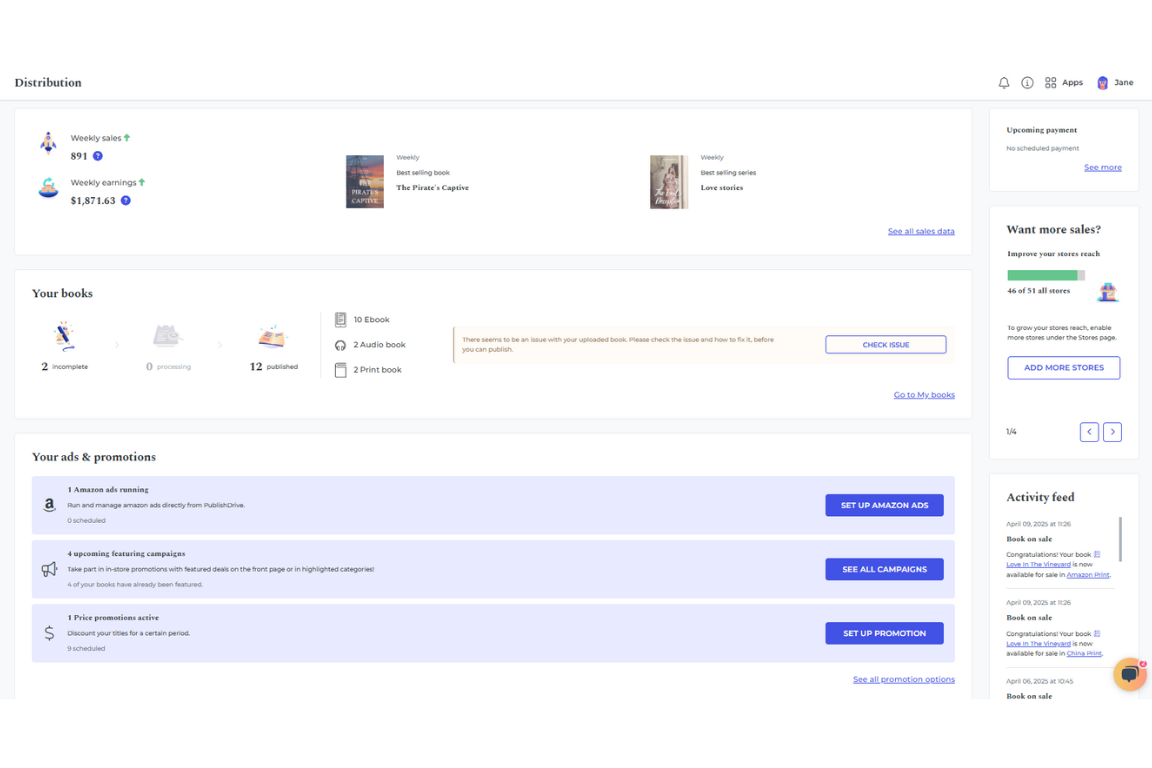
Its customers range from one-book writers to publishers with a release schedule. The company’s own examples include romance author Quinn Loftis, nonfiction author Marc Reklau and J-Novel Club, which publishes translated Japanese light novels and manga. That range explains why a distribution company began acquiring the habits of business software. A solo writer worries about reach; a house with dozens of contributors worries about whether every royalty statement adds up.
The unusual invoice
PublishDrive began with royalty sharing, the familiar aggregator bargain: low upfront cost in exchange for a share of what the book earns. In October 2018 it introduced a $100 monthly subscription as an alternative. The pitch was straightforward. A prolific author could pay for access to the network without paying a growing percentage on every sale. In 2019 the company stopped offering royalty-share pricing to new accounts. The old plan persists for some legacy customers, but the public offer now revolves around subscriptions.
“Everyone has a story to tell.”PublishDrive’s stated mission
The current free plan sends one ebook to Apple Books, Barnes & Noble and Kobo. For new signups, that three-channel limit began on February 24, 2026. Paid monthly distribution starts at $16.99 for three titles, climbs through six and 18-title tiers, and reaches $99.99 for 48 titles. Annual billing lowers the effective monthly price; larger catalogs get a quote. Stores still take their own shares. “Keep 100%” means 100% of the royalty left after the store’s deduction, not the full price a reader pays.
A useful piece of arithmetic
Imagine an author with three titles deciding between PublishDrive’s $16.99 monthly Starter plan and a hypothetical distributor charging 10% of net store royalties.
Illustration only. Actual alternatives, channel coverage and plan terms vary. At this fee, the simple break-even is about $170 in monthly net royalties.
That calculation is the company’s distinction and its limit. If royalties are small, a recurring subscription can cost more than a percentage. If sales are steady, the fixed bill can be less painful than a meter that rises with success. An author already comfortable with direct retailer accounts may value the extra controls less. An author enrolled in Amazon’s KDP Select cannot distribute that same Kindle ebook widely during the program’s 90-day exclusivity term. Choice of channel is a strategy, not a virtue.
The back office grows around the book
Distribution exposed the next chores. PublishDrive introduced Abacus in 2019 to import reports, calculate contributor splits and produce statements. It can work with sales from outside PublishDrive, including reports from other retailers and aggregators. That detail matters: a publisher’s royalty problem does not politely stay inside one distribution account. Abacus currently advertises a free first title and $1.49 per additional title each month, with custom pricing for larger operations.
There are other extensions. A free converter turns a simple DOCX manuscript into an ebook file. Print tools prepare files and covers for print on demand, where books are produced after an order instead of in a speculative stack. The Publishing Assistant proposes descriptions, categories, keywords and covers using AI; its credits are bought separately. Those suggestions may save time, but the author still has to decide whether a cover tells the truth about the genre and whether a description gives a reader a reason to care.
The company’s funding followed that widening brief. After early support from Startup Wise Guys, a 2017 Credo Ventures investment and Google Launchpad participation, PublishDrive announced a Series A led by Lead Ventures in 2022. A third-party funding record puts the round at about $2 million; the company’s announcement itself did not give an amount. Its stated plan was to expand print on demand, audiobooks, ebooks and automation. In this business, the glamorous phrase “global distribution” eventually becomes printer specifications and contract math.

What the map really says
A wide network is useful, though it does not make each channel equally important. PublishDrive’s 2026 market report says Amazon and Amazon Print accounted for 77% of sales value in its own ecosystem. That is a striking admission from a company selling wider distribution. It also makes the case more credible. The remaining channels provide other routes to readers and reduce dependence on a single account, even while the dominant store remains dominant.
Reklau’s case illustrates the risk side. After his Amazon account was closed, he moved to broader distribution through PublishDrive and reported sales in Apple and Google channels. The company says the move helped his revenue; that is a customer account, not a controlled experiment. Its value is simpler: a writer dependent on one storefront has one point of failure. A writer with many channels has more work to coordinate. PublishDrive charges to coordinate it.
The transferable move is to price the work an audience already does badly. Jentetics began with a thesis that was awkward to format and surprisingly international to sell. The company first solved delivery, then saw the reports and payments that delivery created. Its flat fee was a bet on authors who would rather know the bill before the book succeeds. For those writers, the appeal is perfectly ordinary: fewer tabs, fewer spreadsheets and one more evening to write.