In a laboratory, a sequencing machine can make a modest biological question look like an extravagant computing problem. A scientist wants to know which immune cells responded to an experiment, or which antibody deserves another round of testing. The machine replies with millions of short strings of letters. Somewhere between those two sentences sits a queue: software, scripts, specialists, and often a spreadsheet that has survived far longer than anyone intended.
MiLaboratories began by shortening the computational part of that queue. Its founders helped create MiXCR, a tool for extracting T-cell and B-cell receptor repertoires from sequencing data. The method appeared in Nature Methods in 2015, six years before the company’s stated 2021 founding. Today the larger ambition is Platforma: a visual workspace that lets research teams carry those results into a decision about what to test, compare, or advance.
- The engine: MiXCR turns raw immune sequencing reads into structured receptor and clonotype data.
- The new bet: Platforma joins that analysis to workflows for antibody discovery and wider biological research.
- The customers: academic labs, biotech teams, pharmaceutical R&D groups, and the bioinformaticians who build their methods.
- The economics: qualifying academic software access is free; hosted compute costs extra; commercial terms are negotiated.
01 / The first bottleneckA very fast answer to the wrong handoff
MiXCR solves a hard, specific task. It aligns raw reads to immune receptor genes, corrects errors introduced during sequencing and amplification, assembles clonotypes, and reports what it found. It can work across bulk and single-cell assays, as well as RNA sequencing data where receptor reads are only a fraction of the whole. For a bioinformatician, that is a capable engine. For the person deciding tomorrow’s experiment, the output is still only a beginning.
That distinction explains the company’s turn. The original software did not fail at its job; the surrounding workflow still asked a biologist to wait for someone else to transform analysis into a usable view. MiLaboratories describes the lag as a computational bottleneck in modern biology. Platforma is its attempt to make the next steps - filtering candidates, comparing samples, tracing lineages, spotting sequence liabilities - available in one place. It is a shift from “What does the file contain?” to “What should we do next?”
“We believe that opening our platform to the developer community will accelerate the adoption of modern computational tools.”Stan Poslavsky, CEO, at the 2024 Platforma SDK launch
The founders know the specialist side of this problem. Dmitriy Bolotin, Stanislav Poslavsky and Dmitriy Chudakov were authors of the MiXCR paper; the company’s 2024 announcement also names Alexey Nechaev as a co-founder. Poslavsky is CEO, Bolotin CTO, Chudakov CSO, and Nechaev COO. Their history gives MiLaboratories a peculiar advantage in a crowded market: it can build the friendly interface around a computational method its own team spent years developing and publishing.
The customer measure is reported by the company, not an independently audited count.
02 / The new workspaceThe decision is the product
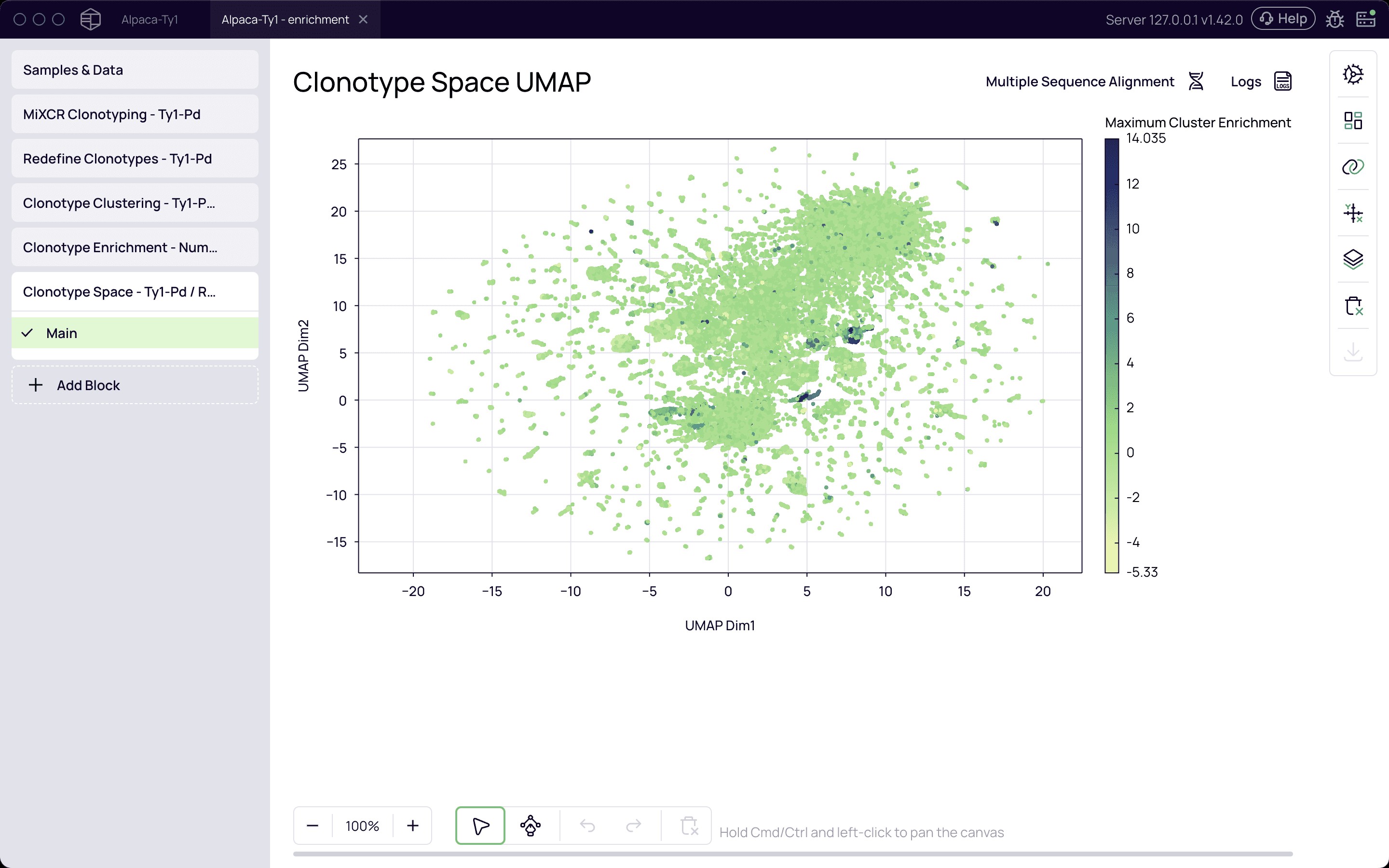
Consider an antibody discovery campaign. A team sequences a pool of possible binders. MiXCR can identify the receptor sequences and group related ones. Platforma then offers blocks to inspect enrichment, map sequence families, weigh liabilities that could make a molecule awkward to develop, and rank candidates against several pieces of evidence. A high count may be useful; it is seldom the entire case for spending the next experiment on one sequence.
The interface is designed for scientists who would rather inspect their own assay than ask for a new script every time they change a filter. The open Platforma SDK gives computational colleagues a different job: package their methods as reusable blocks, connect them through a common data layer, and make the logic inspectable. It is a sensible division of labor. A bioinformatician can keep inventing methods; a biologist can keep asking questions.
There is a practical distinction between Platforma and a stack of separate tools. A team can keep the analysis path visible from raw data to a plotted result, while adding its own methods. The company offers a desktop interface and a backend that can run inside a customer’s private cloud or on premises. That matters when the data describe proprietary drug candidates or sensitive clinical work. The software also serves broader multi-omics and translational immune research workflows, though biologics discovery is the clearest expression of its current pitch.
03 / What it costsFree software does not mean free computation
MiLaboratories makes a deliberate offer to academic researchers: qualifying non-commercial use of Platforma and MiXCR is free. An academic lab can install the desktop app and use local or institutional computing resources. If the lab chooses Platforma Cloud, compute and storage are billed separately. The published academic price is one dollar per credit, with usage charges for CPU, memory and storage. The company’s example puts a ten-sample TCR/BCR project at about $165 in compute plus $10 a month in storage. That is an illustration, not a quote for every experiment.
Biotech and pharmaceutical users can request a free trial, then discuss a commercial license or enterprise deployment. No standard enterprise price is posted. The company’s 2024 Series A announcement said its cumulative funding had reached $10 million; it did not clearly separate the amount raised in that round from the total. Investors included Kfund’s Leadwind fund, Speedinvest, Acrobator and TEN13. The funding and the SDK launch arrived together, a fair indication that MiLaboratories was financing a broader product and a sales effort, not simply another version of MiXCR.
04 / Beyond the softwareA kit, a partner, and a more specific question
The company also knows that data begins at the bench. In 2024 it granted Miltenyi Biotec exclusive rights to its RNA kit technology for immune sequencing, pairing MiLaboratories’ assay work with Miltenyi’s production and commercial reach. In 2025, ImmuneWatch integrated its DETECT block into Platforma, letting users annotate what a T-cell receptor may recognize. These arrangements point to the same idea from opposite ends: make experimental input easier to generate, then make its biological meaning easier to examine.
MiLaboratories sits between several markets that usually speak different dialects. Immune repertoire software competes on accuracy and protocol support. Antibody discovery platforms compete on the quality of the candidate decision. Enterprise bioinformatics competes on deployment, governance and fit with the lab’s existing methods. Platforma tries to join all three. Its strongest claim is not a universal shortcut to a drug; it is a shorter, clearer path from a sequencer to a reasoned next experiment.
There is a useful lesson here for anyone building scientific tools. Start with a difficult computation that researchers already trust. Watch where its result goes next. Then package the handoff so the expert can expose their method without becoming the permanent operator of every question. The approach is especially suited to teams with repeated sequencing workflows, shared protocols and enough data for decisions to become a bottleneck. Where experiments are rare or the biology itself is still poorly understood, a polished interface cannot make the evidence stronger. It can, however, make the limits visible sooner. That may be the most honest kind of speed a laboratory can buy.