Mike Peregudov is sitting on boxes again. In October 2026, the Whizz co-founder and CEO described spending twelve to fourteen hours a day on them in a new office. His consolation was a photograph of Jeff Bezos in Amazon’s early days, using a door as a desk. A successful exit, a venture fund and another company later, furniture was apparently still a negotiable expense.
The detail suits him. Peregudov works on both sides of the founder’s table: raising money for a business that rents electric bikes to delivery workers, and helping invest in other founders through s16vc. From a distance, those jobs might suggest a life conducted entirely through presentations. Up close, there are boxes, batteries, workshops and the persistent question of how to keep somebody else working.
A dinner business, before the bicycles
He was born and raised in St. Petersburg, studied engineering at the city’s Electrotechnical University, then worked in marketing and product management. In 2014 he started Partiya Edy, also known in English as Food Party, a meal-kit delivery business. It brought the ingredients for dinner to customers who would do the cooking themselves. The subscription concerned something satisfyingly physical: food had to arrive.
Yandex acquired the business in 2018. Peregudov stayed to run it before leaving in 2020. That sequence matters more than the pleasing punctuation of an exit. He had spent years dealing with recurring customers and physical goods, where a payment on a screen still entails work somewhere else. Later, bicycles would give that experience another address.
The route was not direct. His next venture, Pivot, offered cohort-based education for people moving into creative careers. In April 2022, he was discussing how to support students making that transition and how a learning community could distinguish itself. The customer’s problem had changed; his interest in helping someone make a working life had survived the move.
Pivot ultimately closed. He later described preserving the remaining capital and redirecting it toward Whizz. The episode is an awkward but useful part of the biography. A founder can bring experience to a new market and still discover that the business does not work. Experience gives you comparisons. It does not grant immunity.
The co-founder who joined after opening day
Whizz began operating in February 2022. Peregudov met Alex Mironov and Ksenia Proka that summer and initially joined as an investor and adviser. In January 2023, he became a co-founder and CEO. His own announcement makes the chronology unusually clear: he saw something worth backing, spent time alongside it, then decided to step inside.
It also gives his colleagues their proper place. Mironov, Proka and Artem Serbovka were already building the business. Peregudov later thanked all three for creating and running Whizz and allowing him to help. The origin is a collaboration, with different people arriving at different moments. Founding teams, like dinner parties, need not begin with everyone sitting down simultaneously.
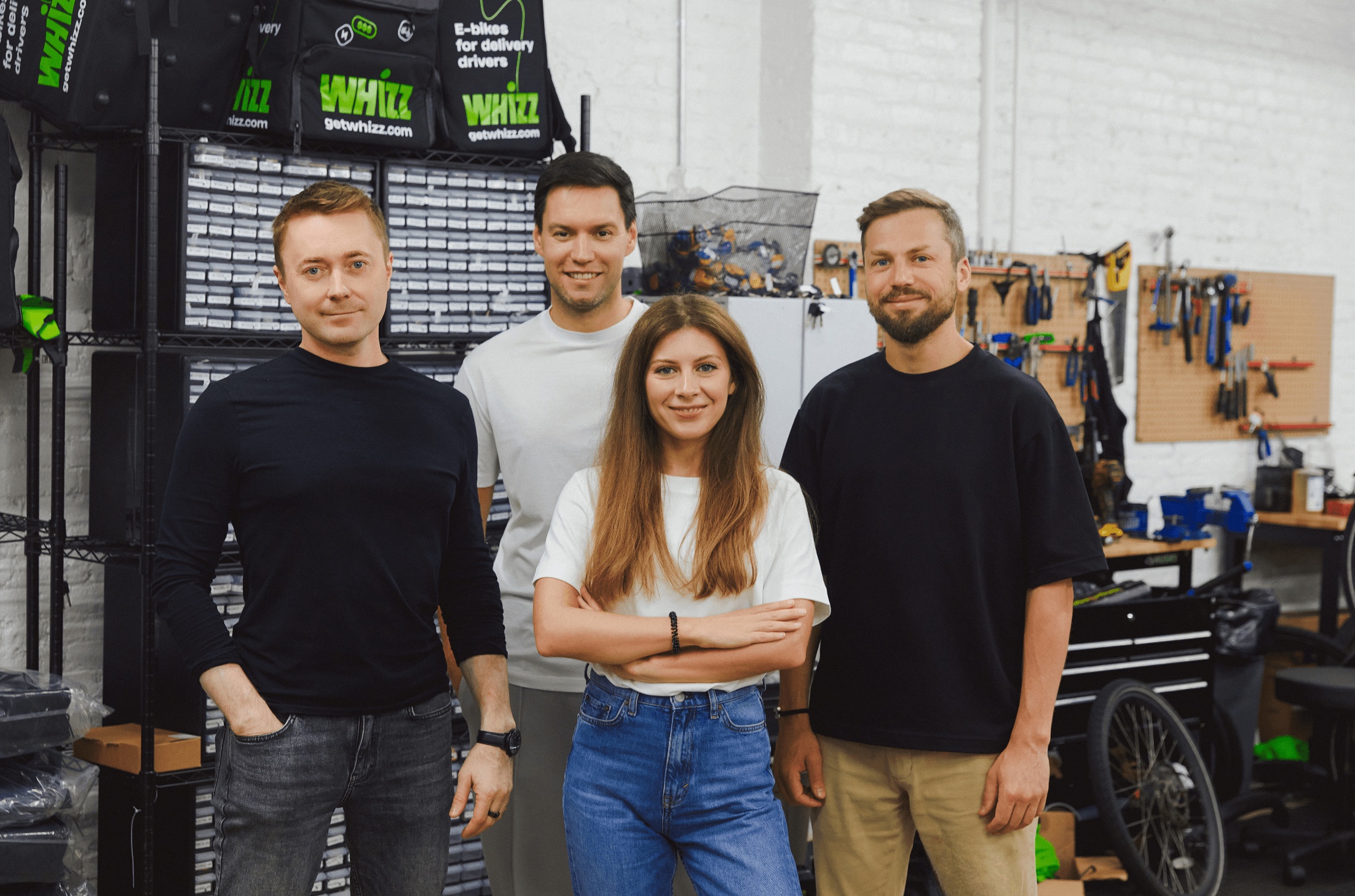
By the end of 2023, Peregudov was describing nearly fourfold growth in revenue and fleet during the year. He also singled out a less photogenic change: a focus on the economics of each rental. His account put margin improvement alongside the bright green bikes. The enthusiasm was there, but so was the spreadsheet.
A bicycle is somebody’s workplace
Peregudov explains the customer’s predicament in plain terms. A newcomer to the United States can be ready to deliver food yet lack the money or credit history to buy an e-bike. Renting spreads the initial expense. Maintenance matters because a bike used for work will encounter flat tires, worn brakes and the occasional disappearance.
Being an immigrant himself gives him a direct point of connection. He has talked about the paperwork and delays involved in getting established. A person waiting for a credit history to develop still needs an income in the meantime. Whizz’s customer is trying to solve that immediate problem, rather than acquire a pleasing new gadget.
In January 2025, he reported that customers typically rented for five or six months. That detail complicates the familiar assumption that ownership is always the destination. For someone testing a job, settling into a city or expecting another opportunity, a temporary arrangement can have its own logic. The vehicle must serve the working life the customer actually has.
The unromantic advantage
Asked in 2023 about the difficulty of growing Whizz, Peregudov pointed to maintaining service as demand increased. The company had invested in its own automation platform to coordinate operations and reduce costs. A growing fleet creates more opportunities to rent a bike, along with more opportunities to misplace a part or disappoint a customer.
He also enjoyed a particular question from riders: could they buy the bikes? By then, Whizz had begun offering purchases alongside rentals. It is a revealing detail about his approach to the product. The customer who likes the equipment may want a different financial relationship with it. The business has to notice.
In 2024, Whizz secured a financing package combining $5 million in equity and $7 million in venture debt. The distinction belongs in the story. Equity brought investment into the company; debt helped finance the fleet. More bicycles require money before those bicycles can collect monthly payments. The balance sheet has a very literal set of wheels.
His description of building in America included the sheer number of people with an interest in the outcome: governments, neighborhoods, unions, activists and others. Selling a subscription was only one relationship among many. A delivery bike enters public space every day. Its operator cannot keep the city outside the business plan.
Monday comes with spare parts
By September 2025, Peregudov described an operation of roughly 5,000 bikes, about 4,500 on active rental, and more than 3,000 repairs each month. Those are dated operating figures, and they make the work tangible. A fleet photograph shows the machines. The repair count suggests what happens after the photograph.
Whizz had started with a West Village shop and 100 bikes. Expansion brought different demands: Philadelphia, Washington and San Francisco were distinct operating environments, with San Francisco’s hills prompting a different bike model. Peregudov’s account is full of adaptation at this level. Geography eventually gets a vote on the product specification.
“Good question. I ask myself the same thing every Monday.”
Mike Peregudov, on choosing such a difficult business, September 2025
He also said Whizz offered support in six languages, with English only the third most used. That is a useful measure of how closely a company has to resemble its customers. He had even considered a documentary about delivery workers. The ambition suggests curiosity about the lives surrounding the fleet, beyond the next rental payment.
The fund named after an apartment
His other professional circle began around a Moscow apartment at 16 Shmitovsky Proyezd. In an October 2026 account, Peregudov traced s16vc back to founder gatherings there: friends building companies and comparing experiences. The community accumulated conferences, shared trips and other occasions to meet. Eventually, some of its members had money from their own businesses to invest.
Seven friends pooled capital. The address supplied the name, and later the numerical joke continued into fundraising: $16 million for a first fund, then $64 million. At first, they combined their own companies with Sunday calls to manage the investments. As the fund developed, dedicated managers took over the daily work.
Peregudov’s favorite benefit, in his telling, was that friends living in different parts of the world now had an official reason to gather. A strategy session supplied the respectable explanation. Friendship supplied the attraction. The fund’s own website still identifies him as a co-founder alongside his Whizz role, a useful connection between the investor and the person sitting on boxes.
Still carrying the laptop home
His recent writing has the same mixture of operational obsession and dry self-observation. In September 2026, he described walking home with his laptop open because Claude was deploying something. In October, he argued that too many employees can leave a company doing too many low-priority tasks, while its strongest people spend their time managing rather than doing the essential work.
On October 20, he wrote about a visit to Whizz’s Miami office followed by an s16vc strategy session. The two roles remain interleaved. One puts him among bikes and the demands of a new location; the other among founders making decisions about their own companies. Each offers material for thinking about the other.
His public channel says he wants to help entrepreneurs make breakthroughs and that he simply likes writing. Both impulses are visible in the posts: passing along an observation, admitting a complication, finding something funny in the effort. For all the discussion of capital and automation, the durable subject is people trying to get something working. Sometimes that begins with a bicycle. Sometimes it begins with finding a chair.