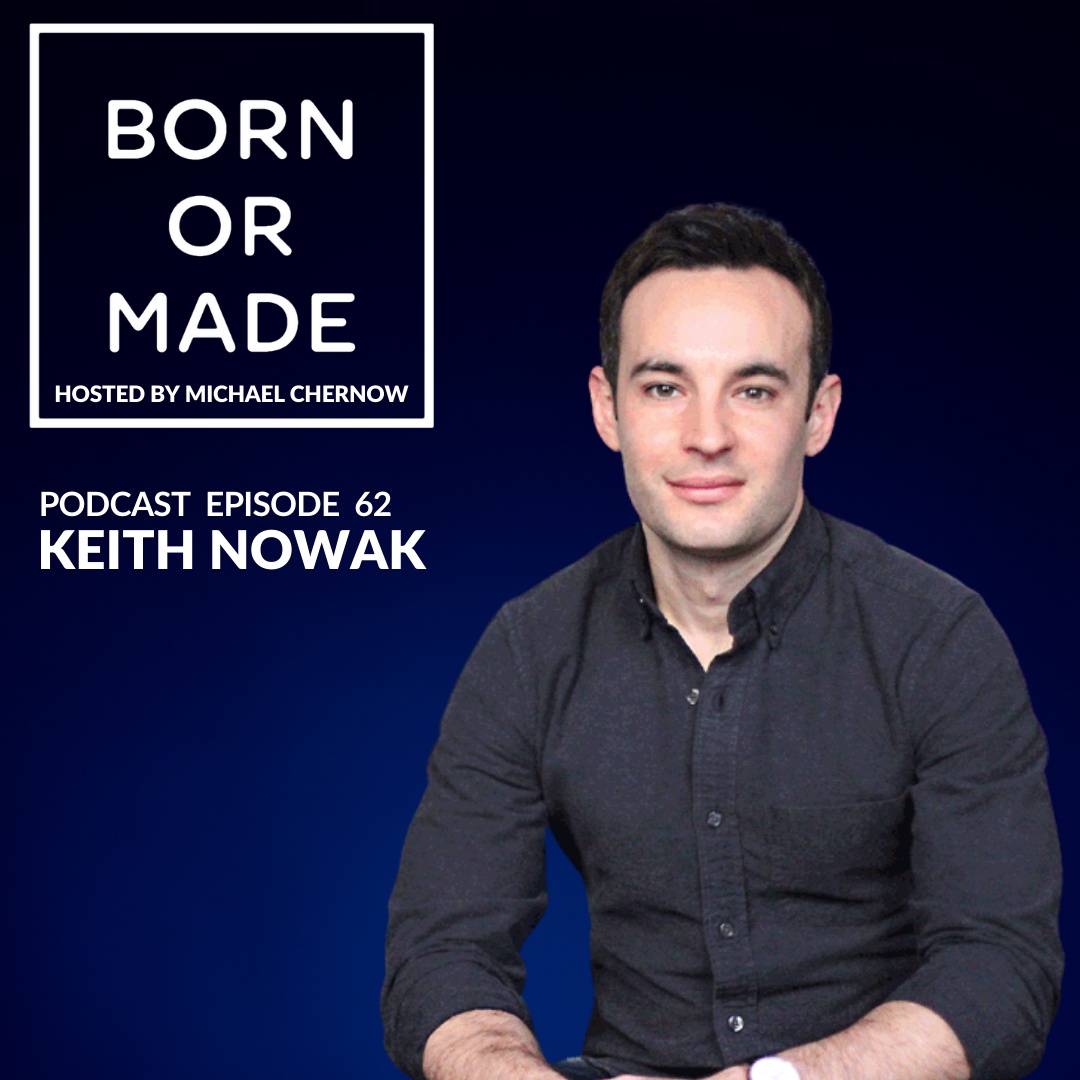
Keith B. Nowak once ran a company that could not change direction fast enough. Years later, he would invite customers to tell him where a pocket ought to go. Between those two moments sits a useful question: how do you keep working at something without becoming the last person to notice that it needs to change?
It is a question with room for a soccer player, a startup founder, an investor and the co-founder of a men's training apparel company. Nowak has been all four. Today, as CEO of Ten Thousand, he sells clothes for people who expect to spend a fair amount of time doing things repeatedly. His own career offers a less tidy version of repetition: attempts, adjustments, a closed business, another attempt.
The shorts are easier to photograph. The judgment behind them takes a little longer to explain.
The first lesson had no drawstring
Before the apparel business, there was soccer. Nowak played professionally in Italy, going overseas at eighteen. He later attended Boston University, where his public profile lists the years 2002 to 2006. The athletic background stayed with him as his working life moved toward technology and investing. So did an interest in what happens when effort meets an uncooperative result.
His early company, Imercive, worked in instant messaging and marketing. It closed in 2009. In a subsequent account of its failure, Nowak described a business that had remained attached to a strategy for too long. By the time the company wanted to pursue a different approach, it had too little capital left to execute it properly.
There is an uncomfortable distinction in that account. A busy company can feel fast while making its consequential decisions slowly. Activity provides its own reassuring soundtrack. The calendar fills. People work. The harder admission, that the plan itself needs revision, can wait until the money will no longer permit much revision at all.
Nowak made that admission publicly. In April 2010, investor Charlie O'Donnell pointed readers toward his startup postmortem. The account was specific about a CEO's mistake: waiting too long to pivot. It gave the failure a mechanism, which is considerably more useful than giving it a flattering name.
That episode deserves to remain in the story alongside the later funding rounds. Entrepreneurship is often edited like a holiday album: only the photographs in good weather survive. Nowak left an account of the rain.
A customer on both sides of the table
Before Ten Thousand, Nowak spent three years leading seed and Series A investing for a family office. The portfolio included early investments in Everlane, Warby Parker and ClassPass. That work gave him a view of consumer companies from the investor's chair, with its questions about demand, distribution and what might persuade a customer to return.
Outside the office, he was a customer with a more immediate complaint. His sporting life had expanded beyond a single discipline. Running, triathlon and CrossFit called for gear that could accommodate different kinds of training. He and Eugenio Labadie wanted a focused assortment of clothes that could travel between those activities.
The partnership joined Nowak's business experience with Labadie's interest in design. Building the product took time. In a 2020 interview, Nowak discussed a two-year stretch spent developing the prototype and the steep learning curve involved in entering apparel. Knowing consumer businesses did not abolish the need to learn how to make the thing.
In October 2015, the early range was almost comically concise: one pair of shorts and one shirt. For a shopper accustomed to a wall of near-identical options, the founders had provided a mercifully short meeting. Their objection to seasonal turnover was practical. If a fit worked, why should the arrival of a new collection make it disappear?

Please complain about the pocket
By February 2016, the assortment had reached three products, and the founders were trying something that made their interest in revision tangible. Through a program called Labs, customers could buy a limited run of an Endurance Short prototype at a reduced price and help refine it.
The questions were wonderfully unglamorous. How did it fit? Should a pocket move? Could the liner construction improve? A customer could answer after actually wearing the garment. The resulting conversation had a purpose beyond generating enthusiasm for a launch: it could change the next version.
The Endurance Short was a lighter, stripped-down relative of the Foundation Short. Those differences mattered because the founders were working from particular uses. Running presented different demands from cross-training. A small collection still required decisions, and customers could supply information that a product photograph would never reveal.
- 01Prototype
- 02Wear test
- 03Feedback
- 04Revision
Four steps. Plenty of opportunities to move a pocket.
There is a family resemblance between this process and the problem in Nowak's earlier business. Both concern how quickly reality gets a hearing. It would be too neat to turn a failed messaging company into the secret recipe for a pair of shorts. The episodes do, however, make his career interesting to read together. He has described the cost of delayed adjustment and helped build a business with an explicit way to gather objections.
By 2017, Ten Thousand was serving customers across the United States. Nowak had expected a brand with particular appeal in New York, perhaps Los Angeles too. Orders from every state complicated that picture in a welcome way. A restrained New York aesthetic could find an audience well beyond its home city.
The investor who wanted a business
Nowak's investor background also makes his comments about growth worth considering. In a 2019 conversation, he emphasized profitability and avoiding a business dependent on repeatedly raising capital. That is a concrete preference from someone who had worked on the other side of investment decisions.
“Focused on profitability and not just raising capital every 12 months!”
Keith Nowak, 2019
A profitable business still has choices to make about investment. Inventory must arrive before a customer can buy it. New channels require people and attention. As Ten Thousand grew, Nowak's ambitions included a larger audience and more ways for people to encounter the product. The early desire for focus would have to coexist with those demands.
A $21.5 million Series A was announced in 2023, led by Provenance with participation from Fernbrook and Alfa. Earlier investors included Warby Parker co-founder Dave Gilboa. There is a pleasing crossing of paths in that last detail: a founder associated with a company in Nowak's earlier investment experience was now among the backers of his own apparel business.
Series A announced in 2023, with plans spanning inventory, hiring, marketing and retail exploration.
The accompanying plans were operational: expand the team, invest in inventory, explore retail and develop partnerships and marketing channels. These are the less cinematic consequences of wanting more customers. Someone has to make enough shorts, keep them available and arrange for the next person to discover them.
In August 2025, Forza announced a further investment as part of Ten Thousand's Series B. The announcement extended the company's financing story. For Nowak, the continuing editorial tension is easy to see: how does a founder preserve the attention given to a small assortment while managing the demands of a growing organization?
Taking the clothes into the room
Partnerships offer one answer to the discovery problem. Ten Thousand's early relationship with Equinox put the brand inside a place where people were already training. Nowak described that kind of retail relationship as a way to build awareness. The setting could explain the product through proximity to its intended use.
In 2023, Ten Thousand announced a three-year partnership with Life Time covering men's training apparel for its Dynamic Personal Training team and specified classes. The arrangement also included events, exclusive products and in-club activities. It gave the brand a presence among trainers and participants, extending a relationship beyond an online transaction.
Life Time subsequently named Ten Thousand presenting sponsor of its 2026 LT Games. The announcement described a hybrid competition combining strength and endurance tasks. For a founder whose original frustration concerned clothes tied too narrowly to one sport, an event built around different demands was an apt place to appear.
His father's lesson about direction
In 2026, Nowak began publishing short reflections under the title Train To Live. The writing moves away from garment specifications toward the qualities he thinks training develops: capacity, steadiness and the ability to make decisions when a day stops going according to plan.
One May essay supplies a personal connection. His father, a Marine, had taught him a saying associated with General Oliver P. Smith and changing direction under pressure. Nowak used the memory to consider the difference between leaving a difficulty behind and deliberately repositioning. Continuing along the original route can become a refusal to acknowledge changed conditions.
Read beside the Imercive account, the essay gives the younger founder's problem a later vocabulary. His subject is judgment: accepting the situation, choosing another direction and committing to it. The fatherly advice remains close enough for him to return to it years later.
June's Hard To Surprise considers what remains available after the easy momentum of a day has gone. July's What You Can Control returns to attention, effort and following through, while accepting that outcomes depend on more than personal will. These are modestly sized essays about a large ambition: becoming more capable when circumstances become inconvenient.
The trajectory gives Nowak's story its shape. There was a business he could not turn quickly enough, time spent evaluating other founders, and an apparel company that asked customers to help revise the product. Now there is writing about how to recognize when a direction needs changing. The next useful answer might concern a company. It might concern an ordinary difficult afternoon. It might still concern a pocket.