A shopping cart is an unpromising object on which to hang a fashion career. It has no season, no silhouette, no invitation to dinner. But when Mike Karanikolas explains his part in the beginnings of REVOLVE, he comes back to the mechanism that lets a customer actually buy something. “I built our shopping cart,” he recalled. Michael Mente designed the interface and menus. Between them, they had the beginnings of a store.
The division is useful to remember when looking at the photographs. REVOLVE’s public world has included festival parties, trips with creators and clothes presented as invitations to a more interesting weekend. Karanikolas’s work has often concerned what happens behind that invitation: technology, logistics, finance and the calculations that determine which clothes should be waiting when someone clicks.
There is a small comedy in this arrangement. A business associated with being seen rests partly on a founder whose responsibilities are difficult to photograph. A replenishment decision rarely asks anyone to hold its good side. Yet that decision belongs in the story of the dress as much as the person wearing it.
A job disappears. A shop takes shape.
Karanikolas graduated from Virginia Tech in 2000 with a bachelor’s degree in computer engineering. He worked as a software engineer at NextStrat from 2000 to 2002. The enterprise software business put him in the orbit of Mente, the colleague who would become his co-founder. It also placed both young men inside the wreckage of the dot-com economy.
The partnership survived the employer. They began looking for something they could build together, examining online demand rather than beginning with a lifelong ambition to sell clothes. Search behavior suggested that people wanted to buy apparel online. For someone trained to work with systems, the interesting part was the gap between that interest and the shopping experience available to satisfy it.
In 2003 they launched REVOLVE with $50,000 of their savings, working from a home in Buena Park, California. Neither arrived with a fashion career behind him. Their early advantages were more practical: they could build the website, understand its behavior and keep changing it. The house served as an office and a place to hold merchandise. The internet’s promise still required somewhere to put the boxes.
“I built our shopping cart.”
Mike Karanikolas
The denim disagreed
One early assumption was thoroughly reasonable: jeans would be difficult to sell online. Fit matters. Sizes vary. A fitting room appears to have certain advantages over a browser window. Karanikolas and Mente expected denim to be a troublesome category, then found that customers were willing to buy it. The merchandise supplied an answer their initial reasoning had missed.
That is an instructive beginning for a retailer built around measurement. Data can sound like a device for proving how clever the founder was all along. Its more useful function is to make the founder change his mind. The customer need not share the elegance of the original theory. She needs a pair of jeans.
The founders’ account of their early business emphasizes testing and adjustment. With their own money committed, cash flow mattered immediately. A purchase order was a decision with consequences for the next purchase order. Their technical background offered a way to keep learning from transactions, rather than rely entirely on an outsider’s first impressions of an unfamiliar industry.
Two Michaels, separate jobs
Even the names needed an operating rule. Both founders are named Michael. They settled on Mike for Karanikolas and Michael for Mente, a modest piece of administrative design that saved everyone repeated clarification. Karanikolas is the engineer by training; Mente became the partner most associated with the creative and commercial presentation.
They had lived together from 2000 to 2006. Later, as their responsibilities separated, they could spend much of their working time handling different parts of the company. Shared leadership did not require a permanent duet. It required knowing which decisions belonged where, and when to bring a question back to the other person.
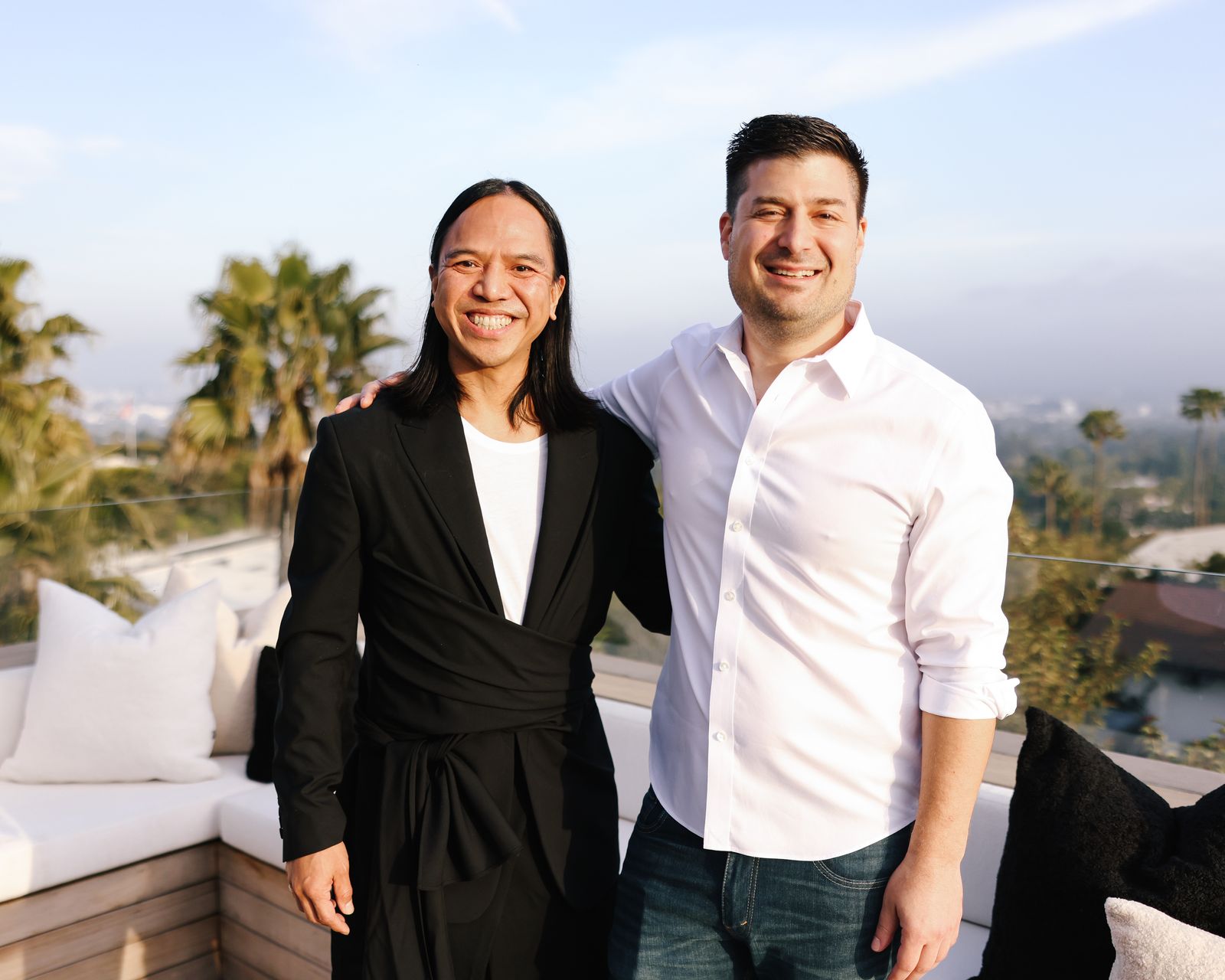
That distinction helps explain Karanikolas without dressing him up as a solitary inventor. He works within a partnership. His analytical responsibilities and Mente’s merchandising and marketing work meet in the same transaction. A customer experiences the result as one store, even when its leaders have arrived there from different directions.
What happens after the click
By 2015, REVOLVE was examining more than completed sales. It watched products people clicked, revisited and placed in baskets. Those signals helped the company decide what to reorder. Automation supported the process, with a human buyer approving orders. A sale remained the clearest expression of demand, but the steps before it could make the picture less blurry.
The appeal of this approach is fairly ordinary once translated out of retail language. Stock too little of something people want, and the opportunity leaves with the disappointed customer. Stock too much of something they do not want, and the surplus sits there, waiting for a discount. Both mistakes become expensive when repeated across a large assortment.
REVOLVE’s technology made it possible to treat individual products as questions that could be revisited. What is receiving attention? What is converting that attention into a purchase? Which items deserve another order? The answers are commercially useful because clothing creates so many variations. Color, cut and timing complicate a decision that looks wonderfully simple when the package arrives.
- ObserveClicks, baskets, purchases
- EvaluateDemand signals
- ApproveA human buyer
- AdjustStock and reorders
Illustrative sequence based on the company’s described 2015 approach.
The party had colleagues
The more visible half of the business deserves equally careful attribution. REVOLVE worked with fashion blogger Rumi Neely in 2009, before Instagram became the center of so much fashion marketing. The opportunity was to reach people through someone whose choices they already followed. The relationship between a reader and a blogger could carry a recommendation further than another advertisement.
Raissa Gerona helped shape the company’s subsequent approach to creators and experiences. She pitched the founders on meeting customers where they were already finding inspiration: blogs and social platforms. Her role matters in a profile of Karanikolas because it shows the range of judgment required around him. A system that recognizes demand needs people who understand how desire travels.
He and Mente received the EY Entrepreneur Of The Year award in Greater Los Angeles’s Retail & Hospitality category in 2015. In 2019 they joined the BoF 500. Those acknowledgments describe a joint enterprise. The company’s public identity grew through many contributors, while Karanikolas continued to carry the operational and analytical side of its leadership.
The numbers acquire an audience
REVOLVE went public in June 2019, raising about $212 million. The shopping cart now belonged to a business whose performance would be examined every quarter by people who might never buy a dress. For a founder accustomed to reading customer behavior, the public market added another audience with a different timetable.
By the second quarter of 2026, group net sales reached $347.4 million, up 12 percent from the same period a year earlier. Net income was $18.6 million. International sales grew 16 percent. These are company results, produced across the organization; they provide scale for Karanikolas’s responsibilities without making every dollar a personal accomplishment.
Year over year. Bars share a 0–20% scale. Net income: $18.6m; free cash flow: −$10.9m.
The figures also resist a too-neat success story. Free cash flow for that quarter was negative $10.9 million, even as earnings rose. Working capital helped explain the difference. Growth, profit and cash are related measures with different jobs. For an executive whose remit has included finance and logistics, their disagreement belongs on the same page as the sales increase.
The next cart is already being built
In 2026, the founders were discussing artificial intelligence across the business, including tools for communication and search. REVOLVE had also entered permanent physical retail, opening in Aspen in 2024 and at The Grove in Los Angeles in January 2026. Stores introduce decisions that a website cannot automatically record, such as what happens when a rack moves across the floor.
September brought an announced venture with Donatella Versace to develop an independent beauty and fashion business. REVOLVE would contribute technology, operations, consumer intelligence and distribution; Donatella would lead its creative vision. The announcement described a business being developed, with its name and first launch still to come. The ambition carries the old partnership logic into a new relationship.
In October, the group expanded Kendall Jenner’s role to Global Creative Director of FWRD and named her an ambassador for REVOLVE Los Angeles. The people and products have changed considerably since the Buena Park house. The work still involves giving creative choices somewhere to go, and giving customers a workable way to respond.
Karanikolas’s career makes that connection unusually tangible. He began by writing the part that accepted an order. Now the questions stretch from inventory to new ventures and from a browser to a shop floor. Fashion supplies the changing surface. His enduring subject is how the business underneath it should work.
Keep reading, watching & listening
- REVOLVE · company website
- Mike Karanikolas · LinkedIn
- The co-founders on their partnership · Inc.
- From software to fashion · Foundr interview
- Trading-day interview · Bloomberg video
- AI and retail · The Business of Fashion podcast
- The merchandise decisions · Digiday
- Q2 2026 financial results
- The announced Donatella Versace venture
- Kendall Jenner’s expanded role · October 2026