A technology company finishes a whitepaper. The diagrams are tidy. The argument has survived a committee. Somewhere, a marketing manager clicks Publish. Now comes the awkward part: the person who needs the information is running a hotel, a warehouse or a chain of stores. Getting those two people into the same conversation is the business of Retail & Hospitality Hub.
- Executives get curated retail and hospitality technology intelligence.
- Technology providers buy distribution, advertising and lead-generation campaigns.
- The content-syndication starting point is 100 guaranteed leads, with off-target replacements.
The Hub sits inside Knighthouse Media, with Korry Stagnito serving as CEO and Head of Content. That combination of titles captures the enterprise rather neatly. This is a publisher that must understand what an executive wants to read and a marketing business that must understand whom a vendor wants to meet. The overlap is its commercial territory.
The interesting number is 100
Start with the campaign FAQ. A client commits to at least 100 guaranteed leads. Campaigns of up to 250 leads are scheduled for completion within five weeks, often sooner, according to the company. Contacts arrive in Excel batches or travel directly into a customer relationship management system through an API. These are delivery specifications, the plumbing behind the promise.
minimum commitment
of up to 250 leads*
*Company-stated campaign timeframe. Larger campaigns are quoted individually.
More revealing is the acceptance mechanism. Clients can reject leads that miss their agreed targets; replacements do not count toward the guarantee until they qualify. Extra leads above the guaranteed quantity carry no additional charge. The FAQ says the invoice follows the client’s agreement that the campaign has been completed successfully.
“We don’t charge for leads that exceed the guaranteed quantity.”The Hub’s content-syndication FAQ
The economics depend on the brief. Cost per lead varies with the target persona, geography and campaign requirements. Account-based targeting and suppression lists can affect the price. A marketer therefore has to specify the audience before comparing quotes. A hundred vaguely relevant names and a hundred agreed-fit contacts are different purchases.
There is a contractual wrinkle worth reading alongside the sales pitch. The public terms put the payment schedule in the proposal and make the full fee payable if a client cancels after signing. The guarantee concerns campaign delivery. A buyer still needs to understand the commitment before approving the work.
The reader and the buyer
The paying customer is quite specific: the Hub says it works exclusively with mid-market and enterprise technology companies. Their solutions serve retailers, foodservice operators, consumer-goods and direct-to-consumer brands, supply-chain leaders and hospitality chains. Its client categories stretch from payments and payroll to merchandising, digital signage, infrastructure and logistics.
The audience on the other side consists of people making operating and technology decisions in those businesses. The website divides its coverage into five channels: retail, foodservice, manufacturing/DTC, supply chain and hospitality. A vendor’s case study can thus enter a setting already organized around the reader’s work. That context is the attraction of a specialist publisher.
- DefinePersonas, geography, fields and qualifying questions
- DistributeGated email, telephone outreach or both
- DeliverAgreed-fit leads into Excel or a CRM
Campaign assets include eBooks, infographics, case studies, webinars, podcasts and videos. Clients approve landing pages and required form fields. They can add qualification or intent questions, test multiple assets and exclude unwanted contacts. In a double-touch campaign, a prospect downloads two different pieces in separate email campaigns. That records repeated engagement; it does not establish that a purchase is imminent.
Before distribution, a second opinion
Arti moves the conversation upstream. The Hub’s AI-powered content-scoring service assesses a retail technology asset before a marketer spends money distributing it. Its report includes a comparative lead score, a percentile ranking, buyer-intent analysis and three recommendations tied to content attributes. Uploading an asset for a report is free.
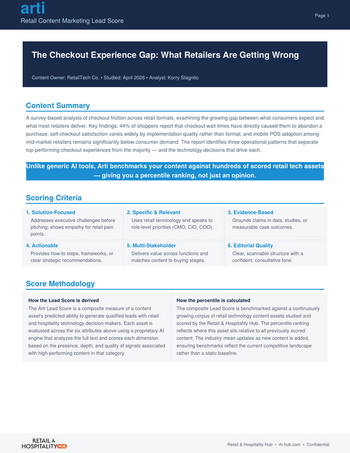
The company describes a benchmark drawn from hundreds of scored retail technology assets. Its percentile places a document within that growing corpus. Read that as a content comparison. A high ranking does not, by itself, tell a sales director how much revenue will follow. The useful proposition is more immediate: revise the message while revision is still cheaper than distribution.
The publishing products work on different clocks. Thinking Out Loud curates technology thought leadership weekly. New Tech Now rounds up deployable solutions every other week. Knowledgeable Resources sends alerts about events, promotions and technology. Together, these give the business ways to maintain contact between individual campaigns. An audience has reasons to return even when it is buying nothing.
The dinner hiding in the grocery aisle
Then there is Retail Plate. Co-published by Stagnito and Phil Lempert, it is a joint venture between the Hub and SupermarketGuru.com, with research from Grocery Doppio/Incisiv. The digital magazine concentrates on foodservice at retail: the deli, prepared-food counter and other places where a shop competes for a meal occasion.
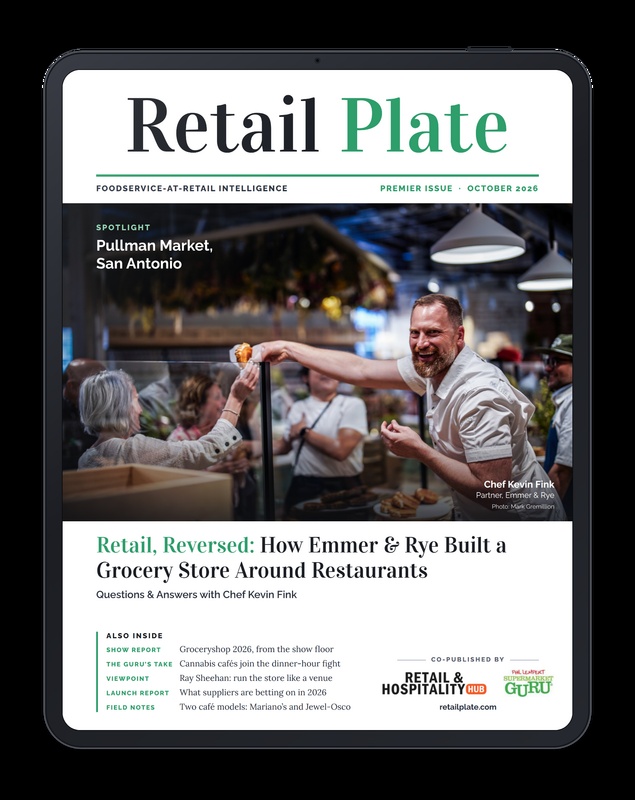
Its October 2026 premiere issue features Pullman Market in San Antonio, including a conversation with chef Kevin Fink. The publication addresses foodservice vice presidents, fresh-merchandising directors and deli category managers. The editorial choice makes the company’s name more concrete. Retail and hospitality meet in the same building, sometimes at the same counter.
Stagnito’s background spans trade-media brands including Progressive Grocer, RIS News and Hospitality Technology. The Hub also appears on official Groceryshop and Shoptalk partner lists. Those connections place it within the industry’s established information circuit, alongside trade publications and events that compete for executive attention.
What the marketer can take home
The transferable lesson is practical. Define an acceptable lead before commissioning distribution. Match the asset to a particular operating problem. Decide which questions establish fit, where the contact will land and who will follow up. The Hub’s controls give a client ways to make those decisions explicit.
The model fits a technology provider with useful expertise, a defined audience and a sales process ready to continue the conversation. It becomes less useful when the brief is vague or when a team treats a download as a signed order. The Hub can arrange a measured introduction. What happens after the introduction remains the client’s work.