Mickey Du was on a college break in 2005 when curiosity pulled him down a dead-end alley in San Francisco's Hayes Valley. There was commotion near a rolled-up garage door. Behind it, a barista was making coffee for a young Blue Bottle. Du ordered a cup. The encounter was small enough to miss and strong enough to redirect a life. “The flavor explosion blew my mind,” he later recalled. “It made me realize what was possible.”
Coffee people have a talent for turning liquid into autobiography. This cup became Du's before-and-after. Before it, coffee was familiar. After it, familiar was no longer sufficient. The annoying thing about learning how good an everyday object can be is that every mediocre version begins to feel like a design failure. For Du, the office coffee machine eventually became an especially conspicuous offender.
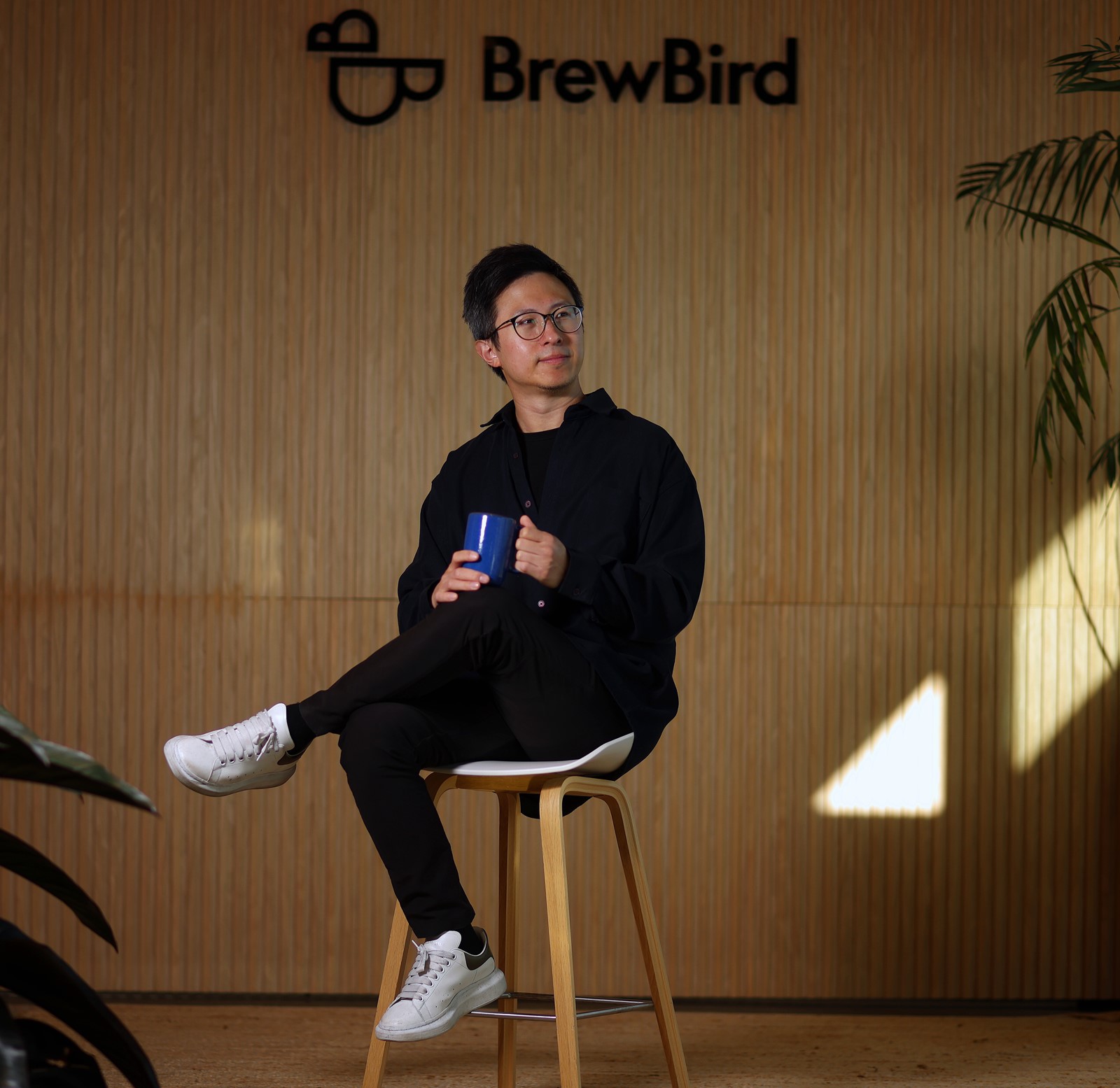
Two decades on, he is the co-founder and chief executive of BrewBird, a San Carlos company building a connected brewer for workplaces and hospitality spaces. Its pods contain whole beans from specialty roasters. A code on each pod tells the machine what it holds and how to treat it. The machine grinds, heats, brews and dispenses in about 60 seconds. The spent pod is designed to be compostable. The experience has one button, because the complexity has been sent backstage where it belongs.
01 · The apprenticeship
A consumer ritual wearing a robot costume
Du did not take the usual route through roasting or cafe operations. He studied economics and psychology at New York University, then worked in corporate finance and strategy at drinks company Diageo. He moved into early-stage investing at Innovation Works in China, where he discussed how status, design and function shaped Chinese demand for the iPhone. The subject was technology, but the deeper interest was consumer behavior: why an object becomes an experience, and why people decide it belongs in their lives.
At Stanford Graduate School of Business, Du was co-president of the entrepreneur club and chief financial officer of the student association. After Stanford came a period in product management at NerdWallet and then venture investing at Atypical Ventures. Finance, consumer goods, software and early-stage companies make an oddly tidy education for a coffee machine. BrewBird has all four inside it: capital-intensive hardware, a repeat-purchase consumable, software control and the fragile optimism required to build something that must work near boiling water before breakfast.
“Third wave is coffee as craft and terroir. Fourth wave is the same craft and terroir, engineered for consistency and impact.”Mickey Du
That phrase, “engineered for consistency,” gives away his product mind. A cafe's pour-over depends on a chain of judgment: bean dose, freshness, grind size, water temperature, pressure and time. BrewBird tries to capture those decisions rather than ask the drinker to reproduce them. Du has explained that a pod might contain 19.1 or 19.2 grams, while its code tells the brewer enough about the coffee to generate the recipe. The romance stays in the cup. The fuss is assigned to the machine.
The recipe travels with the beans
02 · The skeptical palate
First, convince the people most likely to object
The dangerous word in specialty coffee is convenient. It carries memories of stale grounds, plastic capsules and brown liquid with the emotional range of office carpet. Du says local roasters were skeptical when BrewBird approached them. Their craft was sacred; a machine promising to automate it sounded less like distribution and more like surrender.
Then they tasted the coffee. Du describes the reaction moving “from skepticism to wow.” It is a useful detail because BrewBird's pitch depends on partnership. The company does not need to become the Bay Area's fifteenth notable roaster. It needs the existing fourteen to trust the countertop. Verve, Mother Tongue, Equator and other roasters supply the identity and the beans. BrewBird supplies the format, brewer, data and office route. The pod becomes a tiny shipping container for somebody else's standards.
This makes BrewBird as much a distribution system as an appliance. Small roasters can reach corporate campuses without operating a cafe inside each building. Offices get variety without a shelf of unrelated machines. Drinkers can move from a floral light roast to something darker while the brewer handles the technical change. The arrangement respects the part each participant is good at, a business model with the rare courtesy of good table manners.
Sustainability is built into the format rather than added as a lecture. The fiber pods are made to be compostable and avoid the plastic waste associated with conventional capsules. Brewing on demand also addresses the less visible waste of batch coffee poured away after it goes stale. Du has been blunt about the desired behavior: the product should win because people prefer it. Virtue may open the conversation, but taste has to close it.
03 · Four waves in the break room
The office has to earn its coffee break
Coffee's four waves, in Du's shorthand
Du divides modern coffee into four waves. First came household names such as Folgers and Maxwell House. Starbucks and Peet's made the cafe a daily setting. The third wave treated coffee as craft and terroir, closer to wine than fuel. His proposed fourth wave keeps that specificity but uses data and automation to make it consistent and scalable. BrewBird is the thesis sitting on a counter, glowing blue and asking for a cup.
Its first market is the workplace, a location with more existential questions than an appliance normally encounters. Hybrid work turned every office amenity into an argument for the commute. Printers lost early. Free snacks endured. Coffee occupies unusually promising ground because it is both practical and social. A cup can sharpen a morning, excuse a pause or turn two people standing near a machine into a conversation.
Du says one customer began with two BrewBird machines and expanded to 43 after noticing more traffic at the location where the first machines were installed. The claim comes from the customer, he says, through its own badge data. A brewer cannot carry an office culture by itself, and a cappuccino has yet to fix a bad meeting. Still, repeated rituals do more cultural work than grand gestures. A workplace becomes tolerable, then pleasant, by accumulation.
“We think we can put a meaningful dent in transforming a lot of those cups from bad cups to good cups.”Mickey Du
By early 2026, BrewBird had about 30 corporate customers, including Meta, LinkedIn, Gap, Palo Alto Networks, SAP, Sephora and Wilson Sonsini. The machine cost around $10,000 and remained aimed at corporate buyers. Those economics explain both the ambition and the current limit. Specialty coffee can make sense across a busy office. The same hardware looks rather imperial beside a home toaster.
04 · The road home
Make the difficult thing feel ordinary
Du wants BrewBird to move beyond the Bay Area and eventually into homes at a lower price. The company has begun talking about expansion beyond its original market and listed 53 employees in August 2026. At a consumer conference that summer, Du argued that convenience alone is no longer enough. People still want products that fit smoothly into their lives, but they are less willing to exchange craft for speed or sustainability for a shortcut.
That position sounds obvious only after someone has done the hard engineering. Convenience is usually achieved by deleting variables. BrewBird tries to preserve them, then manage them invisibly. Different beans still demand different treatment. Freshness still matters. Local roasters still retain their names. The user simply does not have to operate the grinder, remember a ratio or perform sleepy arithmetic before the first meeting.
Du remains the sort of coffee traveler who seeks out peculiar cafes. On a recent Amsterdam trip, he visited Dak and returned with beans carrying tasting notes of bubble gum, a phrase that seems designed to provoke both delight and an argument. When serving a guest from San Jose, he selected a fruity, floral roast from local Academic Coffee. These are not the habits of someone who wants every cup to taste identical. Consistency, in his telling, means giving each coffee a dependable chance to taste like itself.
There is also a founder's temperament in his preferred sales method. Let the skeptic taste it. The machine can explain the machine. A beautiful pitch about precision, compostability and connected hardware remains abstract until the coffee arrives. Then the entire company is judged in a sip, which is wonderfully efficient and mildly terrifying.
The alley cup in 2005 worked the same way. Nobody needed to describe a market wave to Du. The flavor made the argument first. BrewBird is his attempt to make that kind of surprise repeatable without sanding away its character. A local roaster, a coded recipe, a compostable pod and a minute of machinery all converge on a modest result: the office coffee tastes considered.
When asked how many cups he drinks each day, Du gave the only answer this story could accept: “Too many.” It is a joke, a confession and perhaps a line item in research and development. Some founders dogfood their products. Du drinks his.