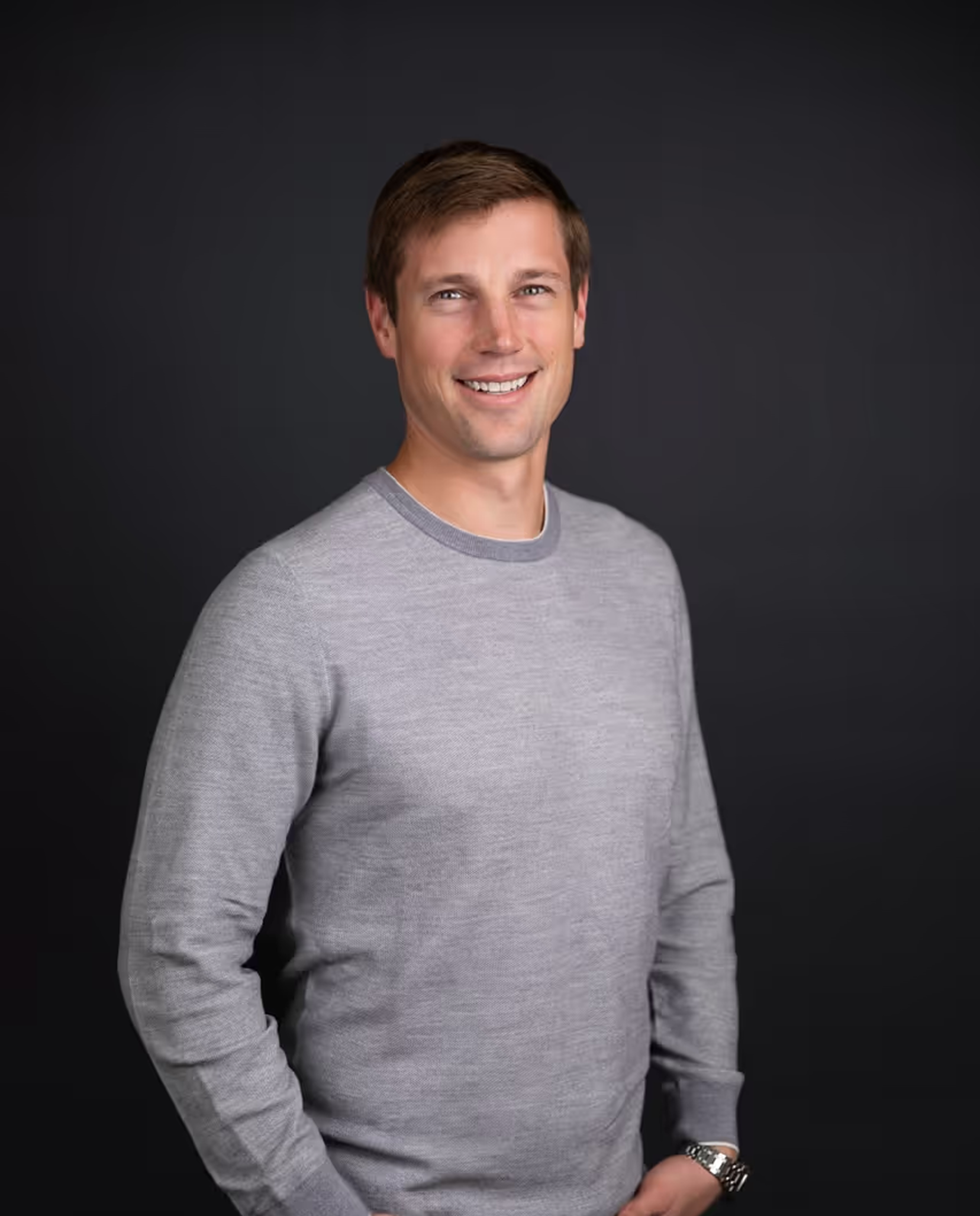
Stenmark runs the technology vertical at VMG Partners from a converted Presidio building at 39 Mesa Street in San Francisco. The firm itself is older and more famous for picking the snack on your counter than the SaaS on your laptop. Stenmark is the reason the second sentence is now a thing.
He joined in 2012, fresh out of Harvard Business School, just as VMG raised its second consumer fund. For seven or eight years he did what the firm hired him to do: invest in founder-driven consumer brands. Then he started noticing the operating layer underneath those brands - the inventory software, the booking platforms, the merchant tools, the data pipes - was where the actual margin lived. He told the LPs. They funded a new strategy. He has been building it ever since.
His portfolio reads like a tour of how a modern consumer business actually runs. Afresh: AI-powered fresh-food inventory for grocers. Boulevard: the operating system for salons and spas. FERMAT: a conversion platform for e-commerce. Claim: a social-commerce app. Nowsta: workforce management for hourly teams. Daily Harvest: the consumer brand that gave him a front-row seat to how supply chains break under growth.
The companies we partner with are founder-driven and managed by passionate people, people I genuinely enjoy and respect.
- Carle Stenmark, VMG Partners
Talk to Stenmark for ten minutes and you stop hearing about returns. You hear about wedge products, about ACV expansion by location and account, about the difference between an AI-native business and an engineering team that simply uses AI. He treats consumer technology the way a chef treats a kitchen - the customer never sees the workflow, but everything depends on it.
The discipline shows up in how he talks about AI. Most investors in 2025 are happy to bolt the letters onto any deck. Stenmark refuses. "Everything that we look at has AI as a component of the business," he told CTO Magazine, "whether it's an AI-native business or whether the engineering teams are now just using AI." He likes the second category more than the first. Software that uses AI to do real work, with humans inside the loop, beats a chat wrapper any day of the week.
Agentic, but slowly.
He is publicly skeptical of jumping straight to agentic AI. The reason is unglamorous and correct: most enterprises do not yet have the data capture or the workflow design to let an agent run free. "I'm hesitant to go straight to agentic AI solutions," he says. "It needs to start with data capture because change management is challenging." He sees the same pattern across mid-market and enterprise customers - tools get bought, workflows do not change, ROI never arrives. He invests against that gap, not into it.
His advice to founders is similarly unromantic. Spend a lot of time speaking to customers before you build. Land with an amazing wedge product. Do not expand features until your go-to-market is repeatable. Once it is repeatable, expand faster than you used to think was possible. And, for the love of pitch decks, "drop the AI buzzwords and focus on the value your product delivers - what AI allows you to do that wasn't possible before."
Where the playbook focuses
Editorial weighting of public commentary and portfolio mix, not a return chart.
From Park Hill to Presidio.
Stenmark grew up in Park Hill, a middle-class slice of Denver. His parents were both doctors. He attended an inner-city public school that, by his own telling, exposed him to a wider mix of backgrounds than the zip code suggested - a fact he still cites as formative for how he reads people across a conference table. His first business was a lawn-mowing operation in middle school, the kind of detail that sounds like a press-release flourish until you remember he then chose, twice, to bet his career on founders.
He went to Harvard for undergrad, finishing in 2007 with a degree in Government. The job market that summer launched him into Summit Partners, where he spent three years as an associate doing the deep, slow work of sourcing growth-stage companies. After that he went operational, joining OPOWER as a business development associate in 2011 - a stint short enough to fit on a resume slide but long enough to teach him what a real software company felt like from the inside. Then HBS. Then VMG. Then, eventually, the pitch to the LPs.
What is striking about Stenmark, talking to people who have worked with him, is how unforced the optimism is. He is not breathless about technology. He is genuinely curious about founders. He uses the word "enjoy" more than most investors. "Life's too short to not enjoy it," he says, "and help others enjoy it along the way." It reads, on the page, like a yearbook quote. In context, it reads like operating instructions.
You need an amazing wedge product first. Until you have a proven, repeatable go-to-market, you shouldn't expand features.
- On building consumer software that lasts
The bet underneath the bet.
VMG has always been a brand-DNA firm. Its consumer team is famous for treating brand storytelling as a defensible asset, not a marketing line item. Stenmark's tech thesis is the same idea, translated into engineering: the durable consumer companies of the next decade will be the ones whose software is as carefully crafted as their packaging. The point of FERMAT is not that it generates landing pages. The point is that the landing page is now part of the brand. The point of Boulevard is not that it books appointments. The point is that the booking flow now is the salon's customer service.
It is a quietly contrarian position. Most consumer investors still treat technology as plumbing. Most tech investors treat consumer as cyclical. Stenmark sits in the seam, which is exactly the place where VMG's brand-building muscle and his own software instincts compound. He has spent thirteen years learning the consumer side of the firm. He spent the years before that learning growth-stage investing and operations. The combination is hard to clone, which is the whole point.
His latest interviews keep circling the same idea: software that genuinely changes how a business runs, sold to operators who will actually change their workflows. He is suspicious of the buyers who do not. He is impatient with the founders who ship features before they ship a repeatable sale. He invests like someone who has already watched a few cycles burn out and has decided to be unsentimental about the ones who chase noise.
What he is watching now.
According to a November 2025 profile in CTO Magazine, Stenmark is spending real time on what he calls the change-management problem: companies buying AI tools without restructuring the work the tools were supposed to replace. He thinks the next wave of returns will not come from new models. It will come from the unglamorous middle - the integration, the data capture, the redesigned workflow, the willingness of a CHRO and a CTO to talk to each other. "Many companies aren't seeing ROI," he says, "because they implement tools but don't change workflows." It is the kind of sentence you would expect from a McKinsey deck, except he is putting capital behind it.
The other thing on his mind: vertical software that expands ACV by location or by account. Land in one salon, win the chain. Land in one warehouse, win the network. The math of vertical SaaS works only when expansion is engineered into the product, not bolted on as a sales motion. He thinks most founders underestimate how hard that engineering is. He also thinks the firms who get it right will be the consumer-economy infrastructure of the 2030s.
If that sounds like a long thesis, it is. Stenmark is a long-thesis investor. He joined VMG at 27 and is still there. He started a tech fund inside a consumer firm and is still building it. The man does not rotate. He compounds.
Personality, distilled.
People who have pitched him describe a meeting that does not feel like a meeting. He asks about customers. He asks about workflows. He asks the founder how they sleep. He is uninterested in the parts of the deck that other investors fixate on - the TAM slide, the projections, the AI buzzword bingo. He wants to know whether the operator has actually sat with the customer.
His Twitter feed, by current investor standards, is unfashionably empty. His LinkedIn is the connective tissue. His public footprint is the portfolio. The work shows up in the companies, not in the bio.
Carle Douglas Stenmark, in 2026, is the General Partner at VMG Partners most likely to be in a Zoom with a vertical-SaaS founder talking about ACV by location. He is also the one most likely to send a follow-up email that opens with a question instead of a pitch. Both facts come from the same place: the lawn-mowing kid from Park Hill, who learned early that the job is to do the work and let the work speak.