A master’s thesis has a perfectly respectable future waiting for it: a grade, a graduation and a quiet life in a university repository. Michiel Doornenbal’s acquired customers instead. His research asked whether machine learning could anticipate the moment a customer would cancel. The business that followed, Churned, brought together his former professor, Francisco Blasques, and his brother, Maarten. A question about people leaving became a reason for three people to start working together.
There is an appealing awkwardness to this origin. A cancellation looks wonderfully definite once it has happened. Someone clicks a button; a subscription ends; a line disappears from next month’s revenue. Before that click, the picture is less obliging. Doornenbal’s work concerns that earlier interval, when there may still be something useful to do. His career has developed around turning a pattern in data into a decision in somebody’s working day.
The question that survived graduation
Doornenbal studied at Vrije Universiteit Amsterdam, where his master’s research into customer churn was supervised by Blasques. The academic relationship continued into the founding team. Churned’s current history dates its Amsterdam launch to January 2020, following the work that began around the thesis. Maarten supplied the commercial counterpart to the technical partnership.
The shape of the team helps explain the shape of the business. There was a research problem, someone with experience supervising that research, and someone responsible for finding its customers. A useful answer in a thesis still needs a route into a company. Subscription businesses supplied one: they had recurring customer relationships, recurring revenue and a recurring need to understand departures before the departures became bookkeeping.
Doornenbal arrived with quantitative training. His educational background includes undergraduate study in econometrics and operational research, followed by a master’s in econometrics. His earlier work included sales and marketing support at Software Improvement Group and a student role in Deloitte’s risk advisory practice. Churned put the analytical and operational parts of that background into the same undertaking.
A brother is a colleague you already know too well
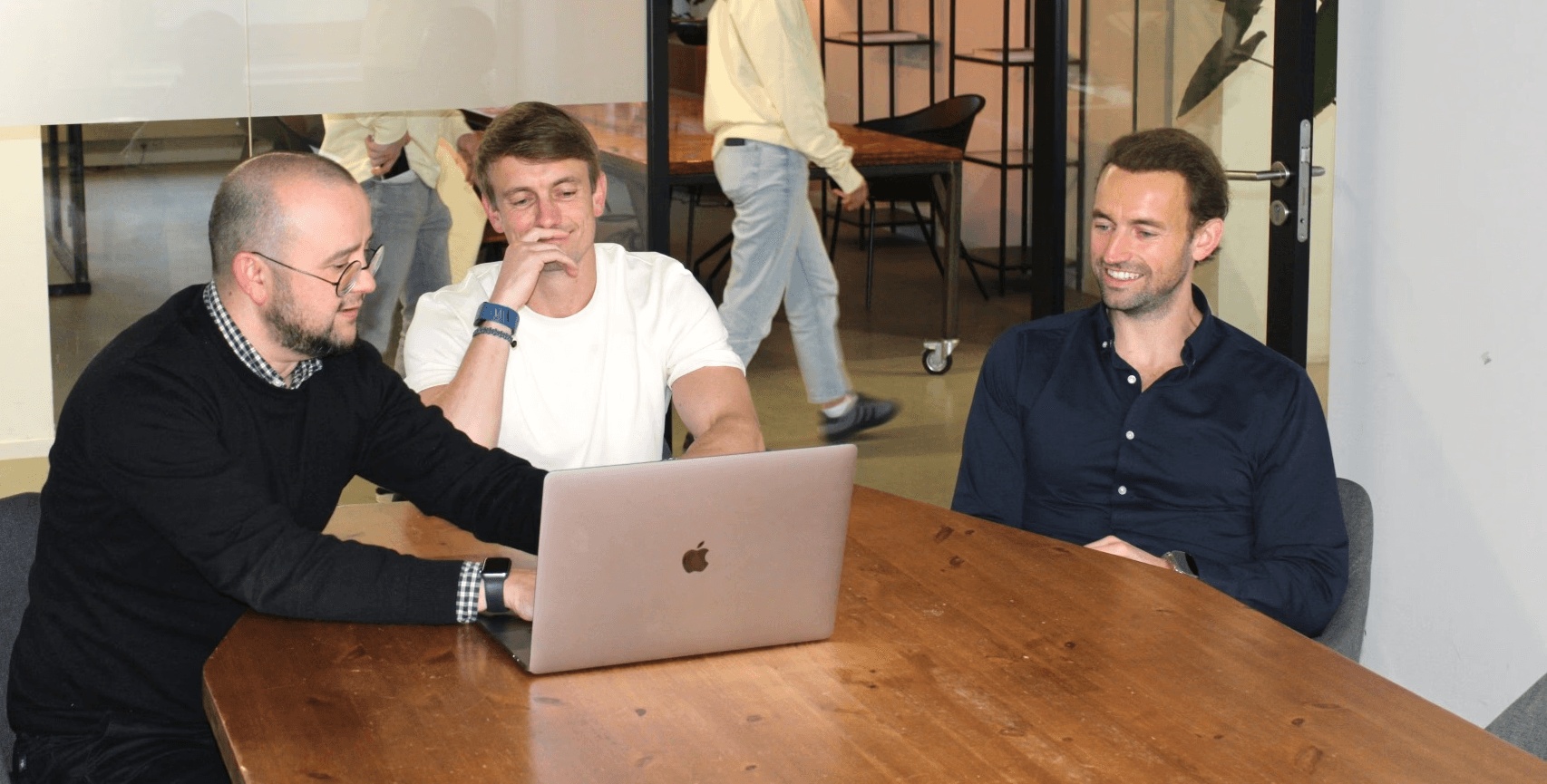
Being related settles the question of how you met. It leaves the question of how you work together wide open. Before committing to their business partnership, Michiel and Maarten tried working together one day a week. That modest trial belongs in the story alongside the more public milestones. They tested the relationship before asking it to support a company.
“We are completely different,” Michiel said when the brothers appeared together on the Digital Customer Success Podcast in April 2024. He described Maarten as the more extroverted brother, responsible for the commercial side, while he identified more with data science. His account was refreshingly specific about the benefit: different expertise gives each brother a territory in which the other has less reason to interfere.
“We are completely different.”
Michiel Doornenbal, on working with Maarten
Maarten has described the arrangement in similarly practical terms: Michiel handles data science; he handles commercial work; each trusts the other’s competence. Their friendship extends beyond the business, with a shared circle of friends. The arrangement has an obvious domestic complication. When your brother is also your colleague, a conversation can become a meeting without either person changing chairs.
Their division of work offers a useful way to understand Michiel’s place in Churned. He is the co-founder and CEO whose route into the company ran through the models. The commercial responsibility was shared from the beginning. The family connection made the partnership personal; distinct responsibilities gave it a working structure.
The trouble with a very clever report
Churned’s early proposition addressed an unglamorous gap between having customer information and being able to use it. A business could accumulate data, commission an analysis and still leave its customer team wondering what to do on Monday morning. A report can be excellent company on a shelf. It is less helpful when the customer has already gone.
The company’s September 2022 development plans paired a complex back end with a simpler front end. That pairing was consequential. In February 2023, Maarten described how simplifying the software had made it accessible to smaller customers. The same interview described a doubling of Churned’s customer count after the earlier investment. The mathematical work needed a presentation that people could use.
For Michiel, the next step is visible in his own practical writing. His contribution to a HubSpot and Oneflow guide lays out a sequence: examine earlier departures, identify current customers showing relevant patterns, choose a suitable response, then build workflows around that knowledge. The proposed responses vary. Personal contact, a discount or help with onboarding might serve different circumstances.
That sequence puts the prediction in the middle of a job. It needs information before it and an action after it. The warning has to arrive while an intervention is still possible, in a form that the team can understand. Otherwise, the software has merely arranged for the bad news to reach the office early.
There is also a distinction between spotting risk and knowing what will improve the situation. A customer who needs help using a product presents a different task from one who needs a better commercial arrangement. Treating both as the same red mark on a screen would discard much of the point of doing the analysis.
Three ways to count a goodbye
Doornenbal’s 2021 writing on churn begins with definitions. Customer churn counts the customers lost over a period against those present at its beginning. Gross revenue churn measures lost revenue. Net revenue churn also takes account of gains such as expansion and upgrades. The three calculations sit close together, but each answers a different question.
This distinction gives some texture to his work. A cancellation is a customer event and a financial event, and the totals need not move in step. Imagine several small accounts leaving while one large account expands. Customer counts and revenue will describe different aspects of the same month. The example is hypothetical; the need to keep the measurements distinct is the point.
Churned’s published Uptrends case illustrates why both measures belong in the conversation. The company reports a 20 percent year-over-year reduction in churn and a 74 percent reduction in monetary churn losses for the monitoring-software business. Those are company-reported customer outcomes, with different denominators. They should be read as separate results, rather than collapsed into one impressive-looking number.
Another application moves the story away from software subscriptions. For grocery-delivery business Thuysvers, Churned reports that retention between the first and second orders rose from roughly 30 percent to 40 percent. That is a ten-percentage-point increase. Here, the practical question is whether a first purchase becomes a second one. The setting changes, while the attention to customer behaviour remains.
These examples show the range of problems the company now addresses. They also return the story to Doornenbal’s original concern: a pattern becomes useful when someone can connect it to a particular customer decision. A number without its definition is a surprisingly efficient way to start an argument.
The next decision
Subscription businesses with many customers and relatively small margins were a particular focus of Newion’s investment case. That setting gives the workflow problem an economic edge. There is a limit to how much individual attention a team can provide across a large customer base. Decisions about where to spend that attention become part of the product’s value. For Doornenbal, a prediction has to be useful at the scale at which the customer actually operates. A process that requires a fresh manual investigation for every account can become a considerable job of its own.
In September 2024, Churned announced €2.5 million in funding led by Newion and Volta Ventures, with existing investor Goldfish participating. The stated plans were further AI development and international expansion. By then, the company had moved well beyond the question of whether the thesis could become a business.
“Many existing approaches are either too slow, too expensive or require extensive manual input,” Doornenbal said around the announcement. His criticism concerns the effort required to get from data to a useful action. It also describes the product challenge facing his own company: the analysis has to justify its place in an already crowded working day.
International customers were already part of that work. In early 2023, Maarten named customers in Sweden, Norway, Britain, Germany and Belgium alongside the Netherlands. Expansion therefore meant extending an existing international business. More markets would bring more customer circumstances to understand, while the product still had to make its conclusions usable.
Doornenbal has described a future in which AI carries more of the analytical load and customer-success teams have more room for relationships. That ambition fits the practical character of the business he helped start. A model can identify an account that deserves attention. The quality of the response still matters to the person receiving it.
Consider the ordinary experience of receiving an irrelevant retention offer. The business has contacted you, yet the message gives little indication that it understands your problem. That hypothetical exchange captures the challenge behind personalised action. Reaching someone is only one part of the task. The reason for making contact has to survive the trip from a model’s output to a customer’s inbox.
The thesis has travelled a considerable distance: into a founding partnership, a software product, customer workflows and an internationally backed company. Doornenbal’s work keeps returning to the interval before the cancellation. There is a person at the other end of that interval, weighing whether to stay. Being early is useful. Giving them a reason is the harder part.