There is a moment in the life of a research report when a crowded deck of findings must become a thought. Michele Salomon reaches that moment on foot. During her years working around 111 Fifth Avenue in New York, she would finish a chapter, leave the building and walk the block. The traffic did what traffic does; the findings jostled for rank. By the time she returned, she knew which idea belonged first.
Then came the index cards. One idea per card, arranged until the argument held. Salomon says she learned the technique in second grade and still uses it. In a profession with no shortage of dashboards, she has kept faith with stationery. It is not nostalgia. Index cards refuse to animate, auto-fill or flatter a weak conclusion. They merely ask whether the story has an order.
That small ritual explains a great deal about Salomon, an Allentown-based market researcher who runs M&A Consulting and has spent her career where evidence meets action. Her public record moves through Harris Interactive, Nielsen, Big Sofa Technologies, The Harris Poll and Temple University. She has designed research, led consumer-insight work, taught students, addressed conference rooms and written about the peculiar business of asking strangers well-formed questions.
The sentence sounds severe until one notices whom it protects: the reader. A busy person should not have to excavate a report for its point. Salomon's working rule is that an executive summary might occupy about ten percent of the document. A 40-page report should reveal its useful center within four slides. The arithmetic is only a guide. The courtesy is the principle.
First question
What must happen after the answer arrives?
Salomon has heard research teams urged to “be more consultative” for 30 years. The phrase still irritates her, chiefly because it floats free of behavior. Her translation is concrete. Design the work with its end in mind. Know the client's world. Recommend the method that fits the problem. Build a deliverable that says what the evidence means. Be willing to push back when the proposed study will not answer the real question.
The path from curiosity to consequence
She uses the same four building blocks to connect social-science research, market research and user research. Their labels and audiences vary. Their obligations do not. Decide whose input matters, determine what information is required, choose how to collect it, then explain how the result changes a decision or deepens understanding. The diagram is simple because the work is not.
There is a revealing snag at the end. Researchers are often gone before the campaign launches, the product changes or the organization acts. Their contract ends at the precise point when they could learn whether the recommendation survived contact with reality. Salomon's version of consulting tries to shorten that distance. A study should be a means, not a ceremonial object left on a conference table.
A career of connected rooms
The want ad, the mentor and the microphone
Salomon's first market-research job came from that antique matchmaking service known as a newspaper want ad. Nearly every professional job after it, she has written, came through a personal connection. The contrast is tidy enough for a keynote slide, but its meaning is richer than “network more.” Her career has been an accumulation of rooms: a polling office, a client meeting, a classroom, a Toastmasters gathering, a conference panel. In each, someone notices how another person thinks.
At Harris Interactive she learned polling in the company of experienced researchers. Humphrey Taylor, the firm's former chairman, became a mentor and the imagined audience for those report-writing walks. What would she tell him were the interesting, surprising and important findings? It is a bracing editorial test. A mentor does not need to be standing beside you to improve a paragraph.
Her formal education crossed two disciplines built around evidence and people: a bachelor's degree in psychology from Hunter College and a law degree from Cardozo. Much later, in 2020, she completed Temple's graduate certificate in Teaching in Higher Education. The chronology is apt. First learn how people think and how arguments work; then learn how to help other people learn.
Senior research work at Harris Interactive and a peer-reviewed study on how Americans' giving and volunteering can be measured.
Seven years with Sunrise Toastmasters Lehigh Valley, including two terms as club president.
Consumer-insight leadership, Temple teaching and the public emergence of M&A Consulting.
AAPOR conference work, modern opinion-leadership research and national retail research at The Harris Poll.
Independent consulting and a steady public notebook on research craft, methodology and use.
Teaching and speaking did not arrive as decorative side projects. Salomon has described an earlier stretch of her career as learning almost by osmosis, quietly absorbing the habits of people who knew more. Toastmasters helped her give that knowledge a public voice. She joined the Lehigh Valley club in 2013, completed its communication and leadership programs, served on its board and held two terms as president. The club received President's Distinguished recognition in both.
By 2021, she was teaching marketing research and consumer buyer behavior to undergraduate and graduate students at Temple's Fox School of Business. Her subject and her method had converged. Good research requires clear explanation; good teaching is a daily experiment in whether an explanation worked.
Experiment, with conditions
Consumers can forgive a stumble. They dislike a costume.
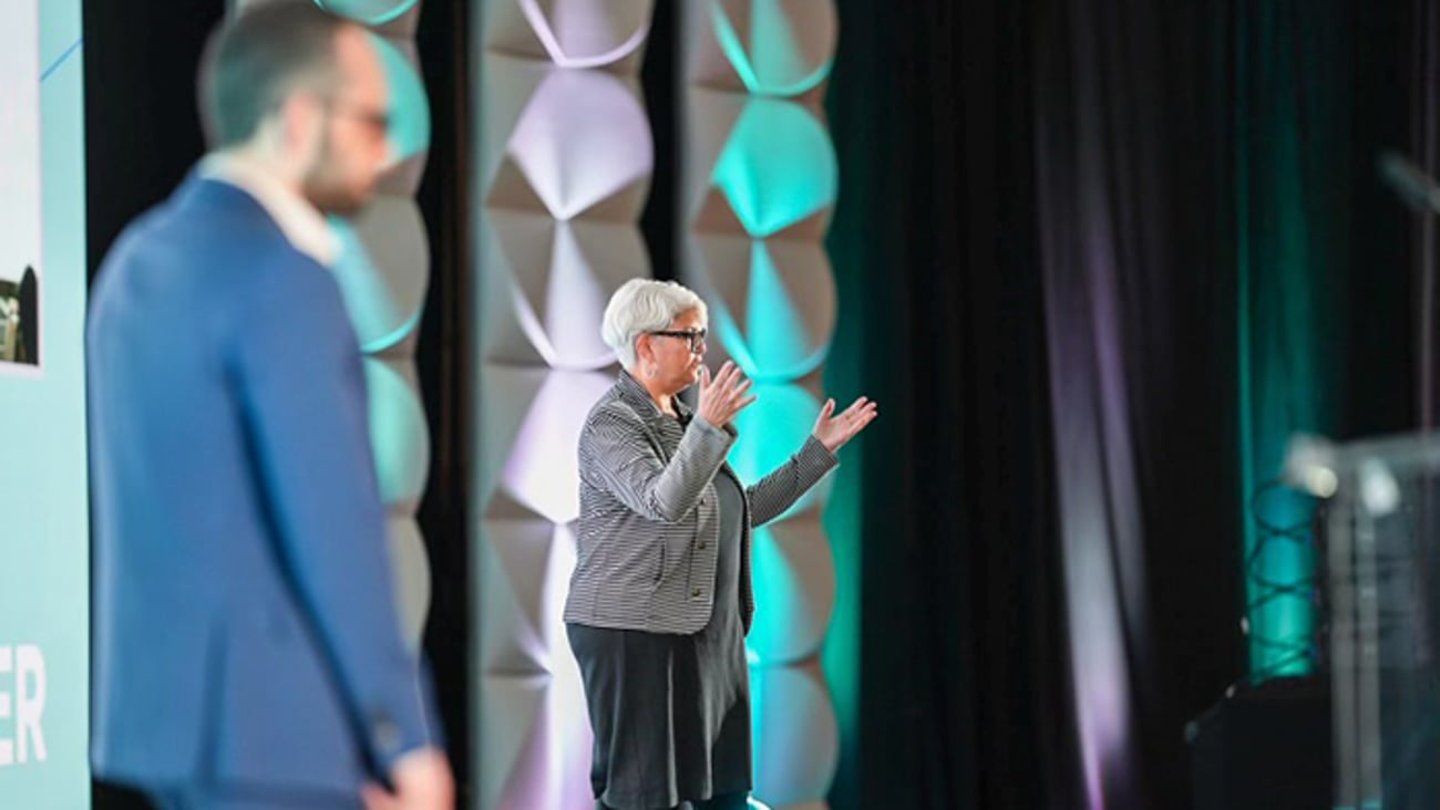
At P2PI Live in 2024, Salomon and Harris colleague Gabriel Rozenwasser brought an unusually tolerant consumer into view. Sixty-seven percent of surveyed consumers said they appreciated brands that tried new technologies even if an attempt failed. Sixty percent felt more positively toward brands trying to improve shopping experiences. Experimentation had permission.
But permission was not enthusiasm for labels. Seventy percent said companies overestimated their interest in AI-infused products and services. Seventy-two percent viewed AI as another marketing ploy. Salomon's advice was compact: “You really need to make AI matter.” The product must still work. The experience must still satisfy. Artificial intelligence sprinkled over an indifferent service is less innovation than garnish.
This is the Salomon pattern again: begin with what the audience needs, not with the tool available. A flashy technology and a sprawling questionnaire share a temptation. Both can make the maker feel industrious while making the user's life no better. Curiosity opens the door; discipline decides what gets invited inside.
The modern opinion leader
Influence escaped the old address book
Her 2024 work with Edward “Paul” Johnson examined another tool whose definition had aged: the opinion leader. Traditional frameworks emphasized civic behaviors and a person's capacity to influence others. Digital platforms complicated the picture. Expertise could be narrow. Audiences could be dispersed. Influence could belong to a specialist unknown outside one subject.
Their proposed update considered digital behavior, sphere of influence and subject knowledge alongside the older measures. Using a representative sample of 2,000 American adults and a split-sample design, the research compared who appeared, who disappeared and how the picture changed by topic. It is methodological work with a social observation inside it: the person who shapes an opinion may no longer look like the person who once occupied the role.
Salomon's own professional path has a similar refusal of tidy categories. Lawyer by degree, psychologist by undergraduate training, researcher by trade, teacher by practice, consultant by current vocation. She has worked with corporate, nonprofit, academic and government clients. The variety is not drift. It is a long experiment in how evidence travels among different people.
Her latest public writing returns to first principles. Public-opinion research, public-relations research and public-affairs research overlap, but their purposes change the study. The intended audience changes the sample. The eventual use changes the questions. A thought-leadership study might describe what people believe, build evidence for a decision-maker or tell a story only one organization can credibly tell. The researcher must know which job has been ordered.
She also writes about curiosity, curation and connectivity. In a team exercise, asked which animal represented her, Salomon chose a cat because curiosity felt like the honest association. She also reported drawing an awful cat. This is a useful detail. A person can be serious about inquiry without becoming solemn about herself.
The aspiration running through her work is plain enough to fit on one of those cards: help people make informed decisions. Primary research can raise awareness, illuminate a cause, build an evidence base and give an organization a story worth telling. But only if the researcher resists the vanity of complexity.
So the report is written. The block awaits. Somewhere between the office door and the next corner, forty pages become four slides, four slides become one argument, and one argument becomes a decision. The walk is not an escape from the work. It is where the work finally admits what it is about.