An insurance policy can be perfectly designed and still never reach the person it was intended to protect. Michele Grosso built Democrance around that awkward distance. The obstacle might be the cost of selling a small policy, the paperwork required to issue it, or a distribution channel that simply does not pass through a customer’s life. For a founder, it is a less glamorous problem than inventing a new financial product. It is also a problem with consequences.
Grosso had seen insurance from inside AXA and MetLife before starting his own business in Dubai in 2015. His interest was in people whom conventional insurance arrangements struggled to serve. Over time, that interest became a company selling software to insurers and brokers. The ambition had a social purpose; the work involved getting institutions, technology and distribution partners to cooperate. Quite a lot of entrepreneurship, it turns out, happens between organisations.
A corporate education, put to work
Italian by birth, Grosso studied management at ESCP Europe in Paris and economics at the University of Turin. His educational background also includes Carlos III University in Madrid and City University in London. His subsequent insurance work took him through France, Egypt and the UAE, in strategy and distribution roles. That geography matters: he encountered both mature insurance businesses and markets where reaching customers required different arrangements.
When he moved into entrepreneurship, he resisted a familiar temptation: treating his corporate years as an unfortunate preamble. He credited established businesses with teaching skills that founders need when growing their own ventures. There is a pleasing lack of theatre in that position. His former employers had given him knowledge of the very industry he now wanted to change.
The transition still demanded adjustment. Building Democrance meant taking responsibility for keeping colleagues, clients, partners and investors moving towards the same objective. A corporate job had prepared him to understand institutions. Running a startup required him to supply much of the momentum himself.
A coffee, a coworking space, a company
Dubai’s AstroLabs became part of the company’s origin story. Grosso met Alberto Pérez and Damian Dimmich there while they were working on other projects. Democrance’s account places Pérez’s encounter with Grosso over coffee in 2016. Pérez brought experience that included work in African markets; Dimmich brought financial technology experience. Their capabilities gave the venture a broader foundation than one insurance specialist could provide alone.
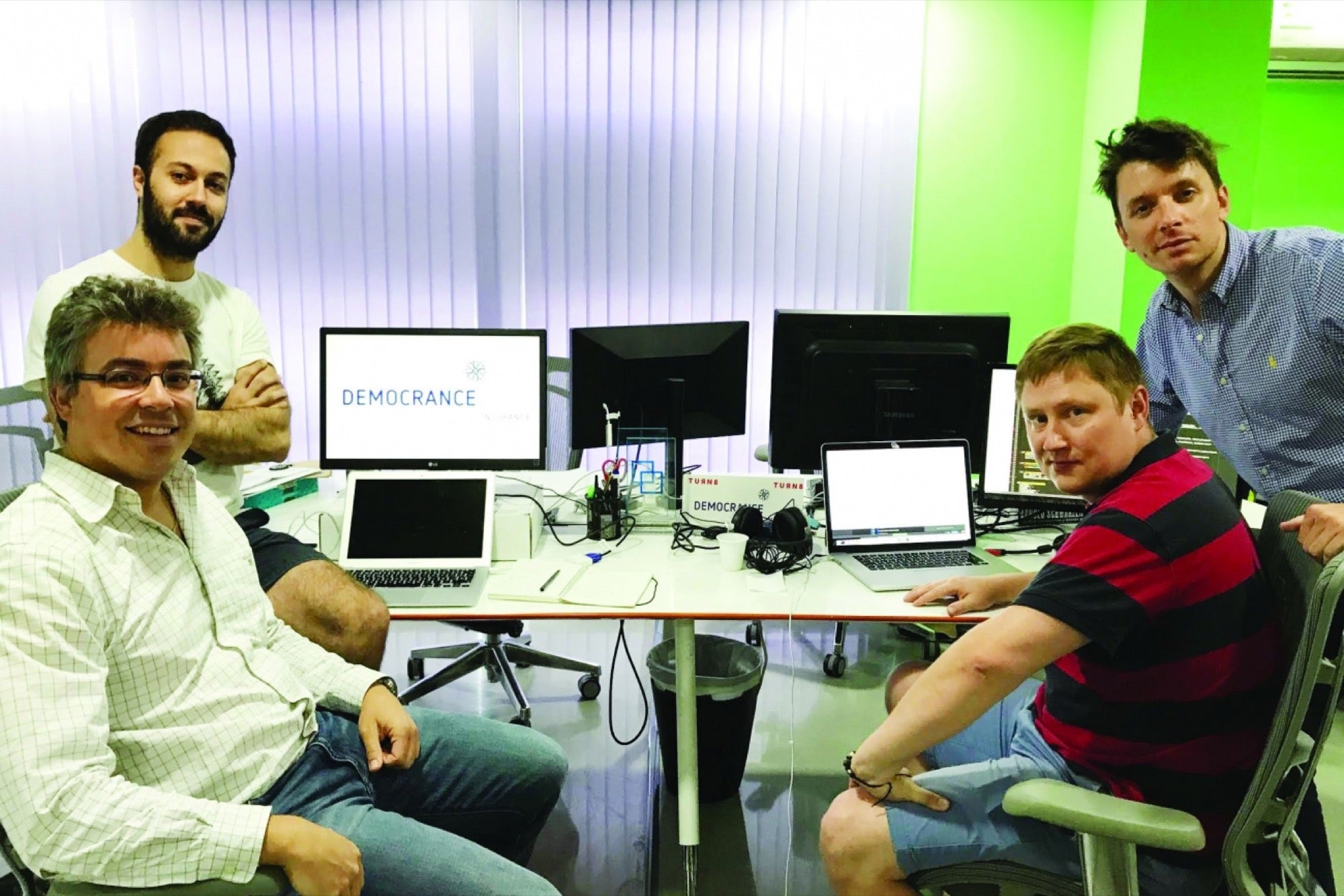
There were early signs of outside interest. In 2017, Democrance reached the final eight of MetLife LumenLab’s inaugural Collab programme, drawn from more than 135 applications across 34 countries. For Grosso, whose previous career included MetLife, it offered another encounter with a large insurer, this time from the startup side of the table.
That October, Democrance announced its first funding round: $800,000. Jabbar Internet Group and Eos Venture Partners were among the backers, alongside Turn8, F-Horizon Group, Seedstars and individual investors. The early model connected insurance companies with telecommunications companies, allowing customers to access insurance through a mobile phone without needing a bank account. The phone was already in the customer’s life. A bank branch did not have to be.
Backing for a platform connecting insurers with new routes to customers.
Meet people where the money moves
By December 2017, another route was taking shape. Democrance announced a $500,000 project involving inclusive finance organisation ADA and the International Fund for Agricultural Development, with contributions from several partners including the European Commission. It would explore money-transfer operators as channels for insurance, focusing on migrants working in the UAE and remittance corridors to India and the Philippines.
The practical idea was to attach access to an existing financial activity. People already used remittance services to send money home. Those services offered a place to reach them. Democrance would contribute technology and implementation; ADA would bring its inclusive finance expertise. The arrangement reveals something characteristic of Grosso’s approach: a useful distribution partnership could matter as much as the software connecting its participants.
It also gives his language about access a physical setting. A customer does not encounter an industry’s strategy presentation. They encounter a phone, a service counter, a transaction. Each can become the point where a complicated product becomes available, provided the institutions behind it have done their work.
A simplified view of the partnership model, rather than a customer count or performance claim.
Learning to work on two clocks
Grosso was candid about the mismatch between a startup’s urgency and a corporate partner’s timetable. The organisations Democrance needed were large. His own company was small. They operated on different schedules, and understanding that difference was part of the job. Experience inside insurance helped him recognise the problem, even when it could not make a decision arrive any sooner.
Other lessons were more personal. Asked in 2018 what launching a business had taught him, he singled out people skills: understanding individual motivations and directing people’s energy towards a common goal. He also emphasised resilience when setbacks arrived. These are revealing priorities for a founder whose company depends on cooperation across several businesses.
He had a dryly decisive answer to another question: which successful startup did he wish he had founded?
“Democrance was and remains the start-up I am most passionate about.”Michele Grosso · 2018
The answer neatly saved him the trouble of envying somebody else’s company. More seriously, it connected his advice about commitment to the business he was actually running. His stated dream was to keep extending insurance protection through technology and stronger partnerships, including a large Gulf telecommunications operator.
The route gets longer
In July 2021, Global Ventures led a new funding round, with Veridian Ventures and existing investors participating. Democrance reported that it had expanded to 12 countries. Its offering had become a business-to-business software platform that could connect with an insurer’s existing core systems and digitise the steps around selling and servicing a policy.
That architecture is an important part of Grosso’s story. An insurer could add digital capabilities while retaining its core system. The proposition acknowledged an institution’s history: years of infrastructure and processes would continue to exist. Democrance needed to make new channels work within that reality. A founder trying to sell change had to understand what the customer was already carrying.
In March 2023, Grosso joined the Microinsurance Network’s board. The appointment put him among practitioners, development organisations and other participants concerned with inclusive insurance. It gave his technology work another institutional setting, beyond the commercial relationships of his own company.
- 2015Democrance begins in Dubai.
- 202112-country footprint reported with new investment.
- 2023Saudi expansion backed by Wa’ed Ventures and Global Ventures.
By October 2023, Democrance had announced a Riyadh headquarters and a Saudi expansion supported by Wa’ed Ventures, the venture capital arm of Saudi Aramco, and Global Ventures. Its announcement described activity in 15 other markets across the Middle East, Africa, Southeast Asia and Latin America. Those were milestones attached to a particular moment, marking how far the business had travelled from its Dubai beginnings.
Help the buyer finish the job
Grosso’s writing offers a useful view of the customer he wants that technology to serve. In an essay on insurance brokerage, he argues for helping customers buy. He points to quotation portals, comparison tools and self-service administration. Entering the same information repeatedly is nobody’s treasured financial ritual. Removing that repetition is a modest improvement with an obvious beneficiary.
His examples leave room for human advice. Brokers can help with complicated requirements, explain choices and advocate during claims. Software can make routine work easier and give customers more control. The appeal lies in assigning the work sensibly: a person should spend time where judgment is valuable, while systems handle the tasks they can reliably simplify.
In another essay, written nine years after founding Democrance, Grosso described meeting thousands of insurance executives. He admired leaders who looked outside insurance for ideas, experimented with technology and kept pressing when told a change was impossible. After years of selling to institutions, he had become interested in the people inside them who could make a new approach happen.
New tools, the same question
In January 2026, he was still arguing that microinsurance needed digital distribution to become commercially sustainable. Reducing the cost of selling and servicing smaller policies would give insurers a reason to invest in reaching more people. He highlighted wallets, online retailers and telecommunications companies as emerging distribution partners. Access, in this account, depends on making the economics work repeatedly.
On 20 January, Democrance introduced AI Teams, built on its Pulse platform. The launch described agents supporting sales, underwriting and operations, with specified responsibilities, approved tools and human supervision. Grosso’s statement stressed that AI must be governed, explainable and suited to insurers’ actual operations. The new technology arrived with an old institutional concern: who is responsible for what happens?
Across these chapters, the continuity is unusually clear. Grosso started with a concern about people insurance failed to reach. He built relationships with the organisations that could reach them, then software to connect those organisations. Mobile distribution, remittance partnerships and AI belong to different phases of that work. At the end of each route sits a person trying to obtain something useful. The distance to that person remains his business.