The pitch that started Democrance was simple enough to fit on a napkin, and it was wrong. In 2015, Michele Grosso - a former AXA and MetLife executive who had spent years inside the strategy departments of very large insurers - looked at the Gulf’s migrant workforce and did the arithmetic. Millions of people, most of them earning modest wages far from home, most of them with dependants, almost none of them covered by anything. The company he founded in a Dubai coworking space would sell them small, cheap policies over a mobile phone. Insurance for the people insurance had skipped.
The demand was real. The problem was on the other side of the transaction. When Democrance took the idea to carriers, it kept running into the same wall: the insurers wanted the business and could not physically process it. A policy costing five cents to the customer required roughly the same underwriting workflow, the same document generation, the same regulatory paperwork and the same core-system entry as a policy costing five figures. Their software had been designed decades earlier for brokers, wet signatures and quarterly batch runs. It could not be economically pointed at a $2 premium, no matter how much anyone wanted it to be.
So Democrance changed what it sold. Rather than compete with insurers for customers it could not profitably reach, it started selling insurers the technology to reach them. That decision - unglamorous, made under commercial pressure, and now more than a decade old - is the reason a company of roughly thirty people in Dubai today counts AXA, MetLife, AIG, Manulife, Zurich, Tokio Marine and Mapfre among its clients.
What the company actually sells
The product is called Democrance Pulse, and the most important thing about it is what it does not do. It does not replace an insurer’s core system. It sits on top of one.
This sounds like a technical footnote. It is the commercial strategy. Every insurtech that has walked into a hundred-year-old carrier and proposed replacing the policy administration system has discovered that the project takes four years, costs eight figures, and ends the career of whoever signed it. Democrance’s approach avoids the conversation entirely: connect through APIs, run the new digital product line alongside the old book, leave the legacy system undisturbed. The buyer risks a product launch, not an institution.
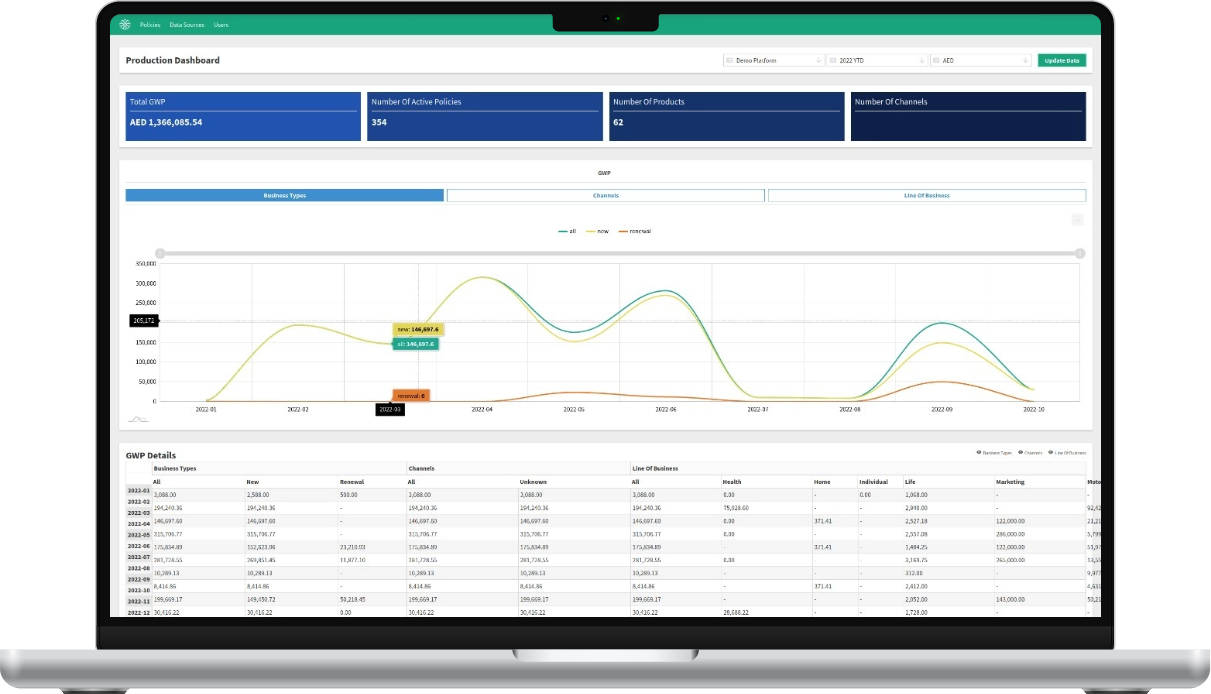
Underneath that positioning is a fairly conventional set of modules, assembled in an unconventional order. Pulse handles quoting, issuance, endorsements, billing, renewals and first notice of loss. Around it sit distribution portals cut by channel - direct-to-consumer, brokers, agents, bancassurance - plus embedded journeys for partners who are not insurers at all: telcos, lenders, e-commerce platforms. A third-party API library carries the plumbing nobody demos: payments, KYC and AML checks, health and transport authority lookups, third-party administrators, connectors back into the legacy core.
The piece the company talks about most is the no-code product configurator, which its team has described as the Lego of insurance technology. A product manager defines the data points a product collects, the workflows it follows, the underwriting rules it applies, the computation logic that prices it, and the documents it generates - without an engineer. Democrance’s claim is that this compresses launch from months to days or weeks. It is the kind of claim that is impossible to verify from outside, and easy to test from inside on a single product line, which is rather the point.
Five cents to $250,000
Here is the detail that explains the architecture better than any product page. Premiums running through Democrance’s platform span from five US cents to $250,000. That is more than six orders of magnitude, on one codebase.
Almost no other insurance software attempts this. Enterprise core systems assume large premiums, human underwriters and long sales cycles. Microinsurance apps assume tiny premiums, thin margins and almost no complexity. Democrance had to serve both, because - as the company has publicly described - the big policies are what pay for the small ones.
Logarithmic scale. The same configurator, underwriting engine and policy administration layer handles both ends.
Source: Swiss Re Foundation project documentation on Democrance, 2022. Intermediate markers illustrative.
“Insurance companies sell policies in a traditional way where you need to talk to a broker, review and sign pages of a contract that’s hard to understand and pay with a credit card; these are all barriers to entry for the low-income population.”
Michele Grosso, Co-Founder & CEO, 2018
Read that quote again and notice what is absent. Price is not on the list. A broker you have to find, a contract you cannot parse, a payment instrument you may not own - the industry spent decades treating the protection gap as an affordability problem, and Grosso’s argument is that it was substantially a friction problem. That framing is what the entire product is built around: fewer steps, fewer forms, fewer humans in the middle.
The cross-subsidy nobody mentions in the pitch deck
Democrance is one of the more interesting attempts to solve a problem that defeats most social enterprises: how do you keep the mission from being cut in the first bad quarter?
The company’s answer is structural rather than rhetorical. In documentation produced with the Swiss Re Foundation in 2022, Democrance described a split in which roughly 80% of revenue came from mainstream insurance contracts - covering only about 4% of the lives on the platform - while the microinsurance book generated the remaining 20% of revenue and the overwhelming majority of people covered. The commercial business is not a distraction from the mission. It is the funding mechanism for it.
The mainstream book is small in people and large in money. The microinsurance book is the reverse.
Source: Swiss Re Foundation, Democratising insurance digitally, 2022 figures. Approximate.
It is worth being precise about what Democrance is and is not in this arrangement. It does not underwrite. It carries no risk. It does not own the end customer, whose relationship stays with the carrier or the distribution partner whose brand appears on the policy. Democrance licenses software, white-labelled, and disappears behind whoever is selling. Millions of people have bought insurance running on its infrastructure without ever encountering the name.
Who buys it, and where
The client list divides into three groups. There are the global carriers using Democrance to open specific markets or channels: AXA has run deployments across Mexico, Egypt, Belgium, Thailand, the Philippines and Senegal; MetLife Gulf partnered in 2021 to distribute critical illness, accident and health cover via SMS and mobile web. There are regional incumbents digitising a line of business - Sukoon Insurance in the UAE launched a digital accident and health product on the platform in February 2025, and Dai-ichi Life brought its first digital life product to Cambodia the same way. And there are the greenfield digital insurers, the most notable being Tawuniya’s “Tree” in Saudi Arabia, described as the Kingdom’s first fully digital insurer.
By mid-2022 the platform had digitised approximately 1.1 million active policies - around 2.5 million including lapsed ones - for fifteen insurers and one broker across sixteen markets. AstroLabs put the client count at roughly twenty insurance companies by late 2023. The company’s own site now says 15+ countries, with offices in Dubai, Riyadh, the UK, India, Pakistan and Argentina.

The money, and what it did not buy
Democrance has not raised the kind of capital that generates headlines, and that appears to be deliberate. The seed round in October 2017 was $800,000, co-led by Jabbar Internet Group and Eos Venture Partners with Turn8, F-Horizon Group, Seedstars and a spread of angels. Roughly $500,000 in grants followed, including from the UN’s IFAD. Global Ventures led an undisclosed round in July 2021 alongside Veridian Ventures.
The Series A, announced 24 October 2023, was co-led by Global Ventures and Wa’ed Ventures - the corporate venture arm of Saudi Aramco - with Veridian participating. Democrance never disclosed the size; secondary reports put it near $3 million, and public databases estimate total funding somewhere between $4.5m and $5.6m. Whichever figure is right, it is a fraction of what comparable platform companies have consumed. CoverGo, the closest direct comparison in the digital insurance core category, has raised roughly three times as much.
Democrance’s named peers include CoverGo, Zelros, Vymo, Simplesurance and Finvolv. The traditional alternative is a legacy core vendor of the Sapiens or Guidewire class, or an insurer’s own in-house build.
In practice the competitor that wins most often is neither. It is inertia - the policy administration system already installed, already depreciated, and already someone’s responsibility to defend.
The AI question, answered carefully
In January 2026 Democrance launched AI Teams, its agentic AI layer. Two products: AI Sales Co-Workers aimed at brokers, agents and bancassurance partners, and an AI Underwriter that reads medical reports autonomously, identifies conditions, re-quotes and binds. The company claims 9x partner productivity and 12x underwriting throughput. Those are vendor numbers and should be read as such.
More telling is how Grosso framed the launch: “AI in insurance only works when it is governed, explainable, and aligned with how insurers actually operate.” In an industry where an underwriting decision may have to be justified to a regulator years after it was made, explainability is not a nice-to-have bolted on for comfort. It is a shipping requirement. The company holds ISO certification and SOC 2 Type II compliance, which is the sort of thing you acquire when your buyers’ procurement departments demand it rather than because it looks good on a slide.
“Some of the largest insurance groups in the world count themselves among our clients because they have seen the value in our mission to digitize insurance processes.”
Michele Grosso, on the 2023 Series A
Where it sits in the market
Democrance occupies a narrow and defensible position: modern digital insurance infrastructure for emerging markets, sold to incumbents rather than around them, priced and scoped so that a first deployment is a small decision. Its expertise is not primarily technical - the stack is Python, Django, Vue.js, Celery and AWS, which is to say ordinary - but domain-specific. The founding team came out of AXA and MetLife. They know what an insurer’s procurement cycle looks like, which integrations actually block a launch, and why a carrier says no.
The risks are equally clear. Revenue is estimated at under $10 million annually by third-party data providers, meaning the company remains small relative to the logos on its wall - concentration risk in plain sight. The AI claims are unaudited. And the same layer-on-top architecture that makes Democrance easy to buy also makes it, in principle, easier to displace than a core system nobody dares touch.
Still, the direction is consistent. In February 2026 the company took Insurtech of the Year for Personal Lines at the MENA Insurance Industry Awards, and Highly Commended in Commercial Lines. Grosso sits on the board of the Microinsurance Network. Saudi Arabia, where Vision 2030 has made insurance digitisation an explicit policy objective, is described as its fastest-growing market. For a company that began by trying to sell five-cent policies and failing, ending up as the invoice line item inside AXA’s Senegal launch is an unusual sort of success - quieter than the original plan, and considerably more durable.
Democrance - Official
- Websitedemocrance.com
- Platformdemocrance.com/our-platform
- Our Storydemocrance.com/our-story
- Newsroomdemocrance.com/news
- LinkedInlinkedin.com/company/democrance
- X / Twitter@democrance
- Facebookfacebook.com/democrance
- CEOMichele Grosso on LinkedIn
Video & Audio
- Product filmDemocrance platform explainer (YouTube)
- PodcastAsia InsurTech Podcast, Ep. 69 - Michele Grosso
- Podcast indexAll Democrance episodes
Press & Reference
- The NationalGeneration Start-up: helping the region’s poorest access insurance
- WamdaGlobal Ventures invests in Democrance (2021)
- MENAbytesDemocrance raises $800,000 seed (2017)
- UKBAASeries A from Veridian, Global Ventures and Wa’ed
- Swiss Re FdnDemocratising insurance digitally - project data
- AstroLabsDemocrance’s expansion in the Gulf
- Fintech TimesDemocrance and MetLife partnership
- Khmer TimesDai-ichi Life Cambodia digital launch
- MiNGrosso joins Microinsurance Network board
- AwardsMENA Insurance Industry Awards 2026 winners
- CrunchbaseDemocrance funding profile