Michael McNeilly began Applied Materials with $7,500 borrowed from his father-in-law and a room in Mountain View measuring 750 square feet. The lease ran month to month. For the first three months, he was the only employee. There are more comfortable ways to enter the equipment business. Most involve already possessing some equipment, a few colleagues, and money that does not have to be discussed at family gatherings.
The modest beginning is appealing, but the room alone explains very little. Lots of small businesses begin in small rooms. The consequential detail was what McNeilly thought belonged inside it: a business that would turn knowledge of chemicals into equipment for other companies to manufacture semiconductors. He was asking customers to trust an outside supplier with a part of production they had reasons to guard closely.
Applied was founded in 1967. Its opportunity lay behind the integrated circuit, among the processes required to manufacture it. McNeilly’s story belongs to that less visible part of computing: the apparatus, materials and accumulated practical knowledge that make a clever design manufacturable. A chip might fit on a fingertip. The business of producing one has never been so conveniently sized.
He had come from Whitefish, Montana, where he was born on March 7, 1939. He finished Whitefish High School in 1957 and earned a chemistry degree at Gonzaga University in 1964. Union Carbide followed, then Apogee Chemical, before Applied. Chemistry supplied both his training and the particular vantage point from which he saw the opening.
An industry learns to shop
Early semiconductor manufacturers often made their own production equipment. That arrangement made sense when processes were changing rapidly and expertise was scarce. A manufacturer could keep the machine, the method and the knowledge of why it worked inside the same organization. Buying from outside meant deciding which of those capabilities could be entrusted to somebody else.
By the time Applied arrived, independent suppliers were already developing specialized equipment. Thermco supplied diffusion furnaces; Electroglas made wafer probing equipment; Varian worked in several equipment fields. Applied entered this developing division of labor with chemical vapor deposition systems for epitaxial films. There was no single inventor of the equipment industry. There were different companies making different parts of the manufacturing problem their business.
McNeilly’s early connections included Robert Noyce, whose funding helped establish Applied. The company sits within the network of businesses associated with Fairchild, even though McNeilly’s own previous employers were Union Carbide and Apogee. The distinction matters. An industrial community can transmit opportunities through customers, investors and colleagues as well as through employees leaving to set up next door.
For a customer, the question was practical: could a specialist deliver something worth buying? Equipment had to earn its place on the production floor. The commercial proposition joined two kinds of confidence: confidence that the process worked, and confidence that its supplier could keep supporting it. A demonstration might open the conversation. A functioning relationship had to carry it further.
The useful trick of heating selectively
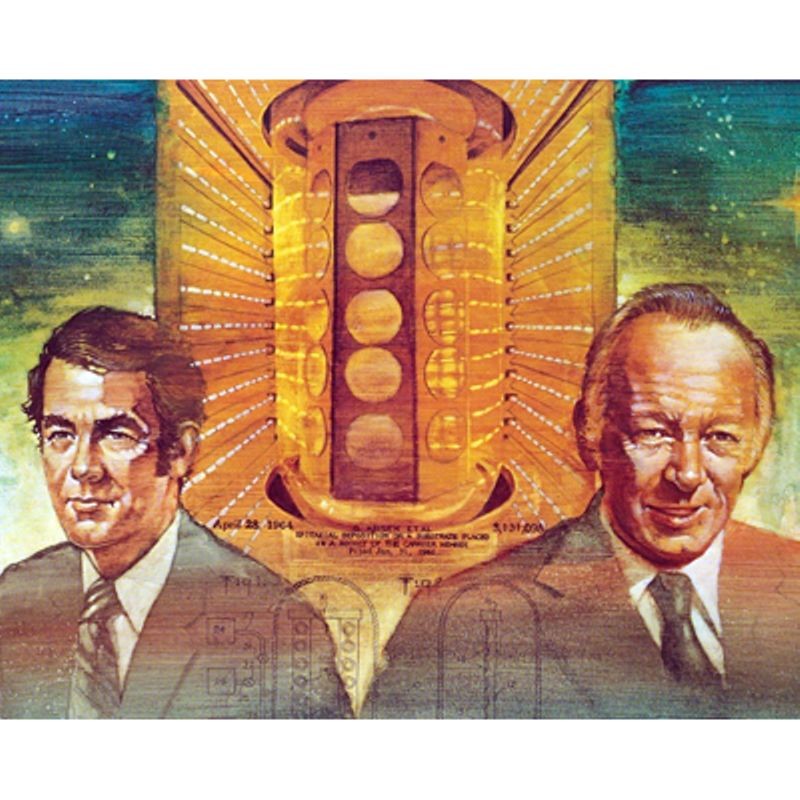
One concrete answer survives in U.S. patent 3,623,712, granted on November 30, 1971, to Michael A. McNeilly and Walter C. Benzing. Filed in October 1969, it describes a radiation-heated epitaxial reactor and process. Its central arrangement sends radiant energy through a transparent chamber wall to heat the material supporting the wafers inside.
The preferred chamber material is quartz. A graphite support absorbs the incoming radiation, while the chamber walls remain comparatively cool. Reactant gases pass through the chamber; the heated substrates receive the deposited film. The point is selective heating: get energy where the process needs it, while discouraging unwanted deposits on the walls.
The patent includes arrangements for moving the support relative to the heat source to improve heating uniformity. Its preferred source uses banks of high-intensity lamps. These are specific engineering choices, each addressing an aspect of how to make the reaction behave. The invention is easier to appreciate when seen as an arrangement of cooperating parts rather than as an isolated flash of inspiration.
There is a pleasing economy to that arrangement. Quartz, graphite, lamps, gas and motion each have a job. The scientific idea becomes commercially meaningful through the relationships between them. For McNeilly and Benzing, a better way to deliver heat offered a way to deliver a better process. Their names share the patent, a small but necessary correction to the habit of telling every company history through one founder.
When the balance sheet enters the laboratory
Applied went public in 1972. A public listing introduced another audience alongside the customers: shareholders evaluating the business as a financial enterprise. A process could perform well while the company selling it struggled. Orders, inventory, spending and debt obeyed their own demands. Technical credibility did not settle those accounts.
The mid-1970s exposed that distinction. Jim Morgan’s account describes revenue falling to roughly $16 million and debt accumulating to about $9 million. Applied had expanded into too many businesses, stretching its resources during an industry downturn. The difficulty combined a cyclical market with decisions made inside the company. It would be too convenient to blame only one of them.
Morgan joined in 1976 and became chief executive. In his recollection, the first approach had failed because the proposed position did not provide enough authority. When the company returned to him, responsibility for the business came with the offer. McNeilly and the board brought him in, and McNeilly agreed to transition out of the executive role.
That episode gives the founder’s story an unusually useful complication. Creating a market opportunity and organizing a company to survive it are related tasks, but they can call for different judgments. The record contains both McNeilly’s technical and commercial imagination and a business that needed a turnaround. Keeping both in view makes his contribution more intelligible.
Morgan later described McNeilly as a “dynamic and smart marketing visionary.” He also credited him with establishing a product base in chemical vapor deposition reactors. Recognition of that foundation did not prevent a change in management. A company can owe its existence to a founder and still need somebody else to take responsibility for its next difficult chapter.
“dynamic and smart marketing visionary”Jim Morgan on Michael McNeilly
A fan, a pair of goggles, and another kind of clarity
McNeilly’s inventions also escaped the semiconductor factory. On April 24, 1979, he received U.S. patent 4,150,443 for an anti-fogging sports goggle. The named inventor was living near Ketchum, Idaho; the assignee was Robert E. Smith of Ketchum. The document takes a familiar annoyance seriously enough to design a mechanism around it.
A miniature electric fan circulates air within the space between the goggle and the wearer’s face. Passages allow humid air to leave and replacement air to enter while limiting the admission of snow or other precipitation. The wearer can switch the fan on. The invention also considers the problem of eyeglasses worn underneath the goggles.
The scale changes considerably from semiconductor production, but the patent is equally interested in managing a small environment. Air needs to move; moisture needs a route out; a useful view needs to stay clear. The connection is an observation about the two designs, rather than evidence that McNeilly followed a declared philosophy. Neither patent requires one to be interesting.
His family’s account supplies the outdoor context. After his years leading Applied, he moved to Sun Valley and enjoyed skiing, climbing, tennis, flying and cycling. In that setting, a goggle patent feels less like a decorative entry on an inventor’s résumé. It concerns an object used in the sort of life he liked to lead. Even an afternoon outside can arrive with a design problem attached.
What a supplier makes possible
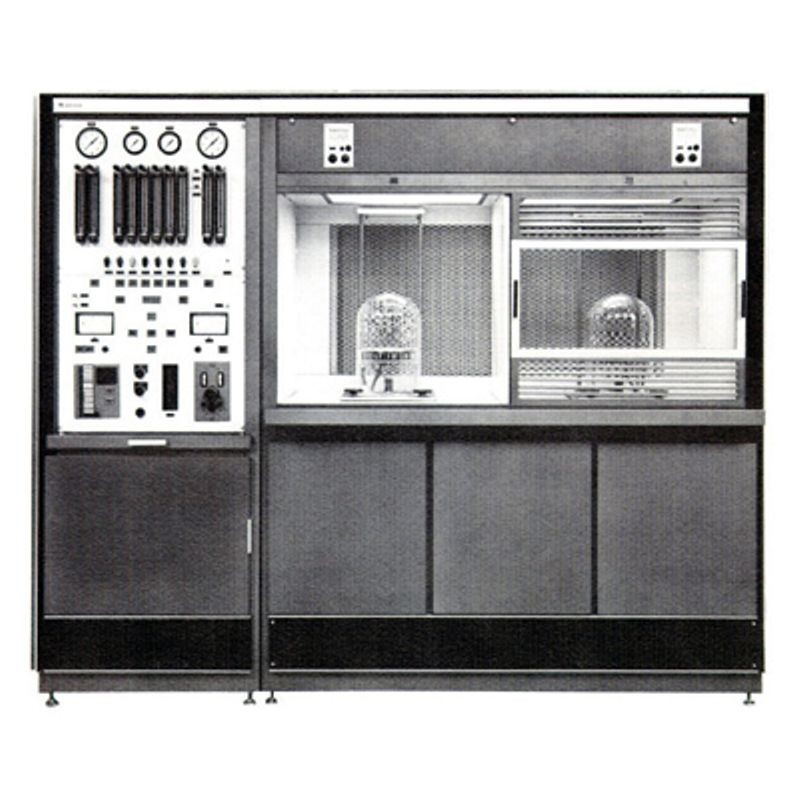
In 1979, McNeilly and Benzing shared SEMI recognition for their work on infrared epitaxy. Years later, he was still starting companies: in July 2004, he was leading TwinStar Systems, working on inspection technology. “I’m a scientist really, not an engineer,” he said. He credited the engineering team at Applied with turning scientific ideas into production hardware.
McNeilly died in 2005, aged 66. His later place in semiconductor history rests partly on the shift Applied helped advance: manufacturers could obtain process technology from specialized suppliers. Over time, that wider division of labor supported an industry in which designing chips, manufacturing them and building the equipment could become distinct businesses.
It is tempting to make that outcome sound inevitable once the original idea is described. The difficult management transition argues against such tidiness. So does the need to build hardware that customers would actually accept. McNeilly’s contribution involved perceiving an opening, assembling people around it and getting a company into the market. What followed required other people’s work and decisions, too.
An equipment supplier also acquires an unusual kind of intimacy with its customers. Its product enters the place where their plans must become physical objects. That is why this history rewards attention to the machinery itself, alongside the financing and changes of leadership. Each gives a different view of what the company had to accomplish. The small Mountain View room is worth remembering for that reason. It marks the beginning of a proposal about how an industry might organize itself. Someone who understood the chemistry could build a business serving people who needed to use it. Inside that proposal was a durable commercial question: which difficult part of someone else’s work could you learn to do well enough that they would buy it from you?