Tibor Juhasz works with a unit of time so small that writing it out feels like an administrative error: a femtosecond is one quadrillionth of a second. His career has moved at a more human pace. It includes years in university laboratories, repeated collaborations, two companies that found buyers, and a third where the founder has changed jobs without leaving the work.
In July 2025, Juhasz moved from chief executive of ViaLase to president and chief technology officer. Shawn O’Neil took the CEO position. On an organizational chart, it was a change of boxes. In the longer account of Juhasz’s life, it placed him beside the thing that had connected the chapters all along: the technology. The company assigned him responsibility for its innovation roadmap. After decades of learning what precisely controlled light could do, he still had further questions for it.
There is something pleasing about a physicist whose career can be read through the names of companies. IntraLase. LenSx. ViaLase. Each name marks an effort to give research a practical address. Each also implies the less photogenic necessities of building an organization: colleagues, money, manufacturing, decisions. Light travels quickly. The paperwork has other ambitions.
A physicist’s route west
Juhasz was born and educated in Hungary. He earned his physics degrees at the University of Szeged, then worked with Gérard Mourou at the University of Rochester in New York. He subsequently spent years in Southern California, including postdoctoral training at UC Irvine from 1987 to 1990. The geography matters because the relationships crossed it. A former colleague could become a future collaborator; an earlier laboratory could open the door to the next one.
Mourou’s work with Donna Strickland supplied an essential part of the technological background. In 1985, they developed chirped pulse amplification, a method of stretching, amplifying, and recompressing laser pulses. It allowed very short pulses to reach high intensity. The sequence is a lovely piece of engineering logic: temporarily change the shape of a problem so that the next operation becomes possible. Mourou and Strickland received the 2018 Nobel Prize in Physics for that work.
Juhasz’s place in this history belongs to the work of applying and developing the technology. A scientific method can create possibilities long before anyone has a usable machine. Someone must choose among those possibilities, build equipment, and discover which constraints are negotiable. His eventual companies emerged from that territory between what an experiment permits and what an organization can actually deliver.
The partnership in the photograph
At an optics conference in Toronto in 1994, Juhasz encountered Ron Kurtz and Detao Du. Kurtz and Du were presenting findings connected with the University of Michigan’s laser research. Juhasz already knew Mourou. Soon afterward, an invitation brought him to Michigan, where the different strands of experience could be put to work together.
Conference encounters are usually remembered through their most disposable products: a name badge, a programme, perhaps a tote bag with unfortunate typography. This one acquired a corporate history. In 1997, Juhasz and Kurtz founded IntraLase to commercialize their work. They would later collaborate again on LenSx. The partnership lasted beyond a single research project and beyond the first company it produced.
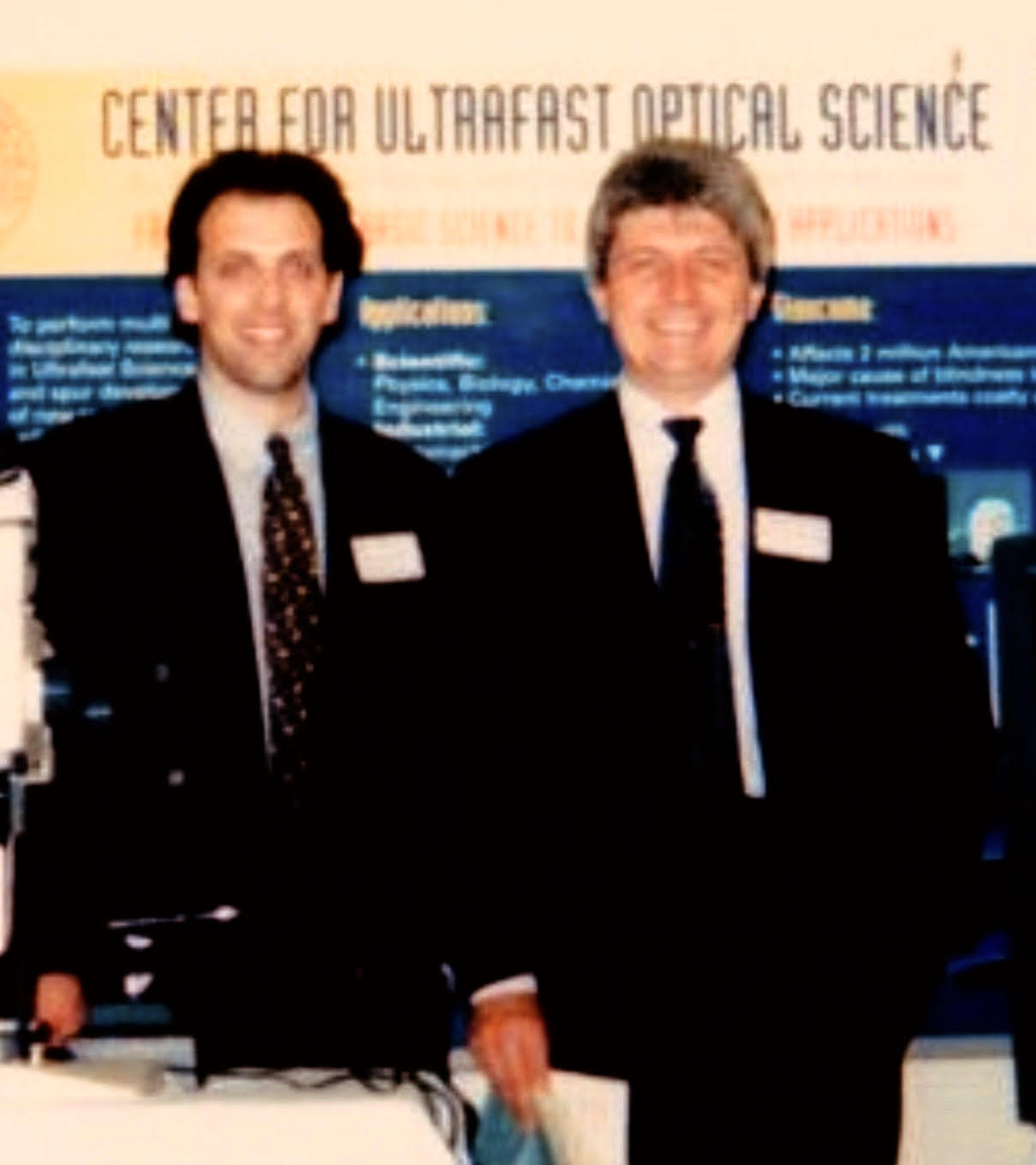
In the photograph, the two stand in suits beneath the Center for Ultrafast Optical Science sign. Juhasz is on the right. The image has the softness of an older photograph and the formality of people being asked to pause their working day. A company founder’s biography usually arrives with a polished portrait. This picture preserves a partnership before its later milestones had become a familiar list.
It also gives the story its proper scale. Juhasz’s career contains his decisions and achievements, but the work repeatedly involved people bringing different knowledge to the same problem. Mourou, Kurtz, Du, and Strickland belong in the account. So do the colleagues who helped build organizations around the equipment. A useful machine has room for more than one kind of expertise.
A machine that could leave the lab
Juhasz has described the early lasers as occupying an entire laboratory. Keeping them operating required graduate students to make adjustments throughout the day. That is an arrangement a research group can understand: the machine and the people who know its habits share the same room. A product has to survive a less intimate relationship with its operator.
The engineering demands were plain. The system needed to fit into a smaller space, operate more stably, and cost less to run. Those requirements sound ordinary beside the physics. They are also the requirements that decide whether the physics gets to leave home. A demonstration can tolerate an expert hovering beside it. A practical machine must carry more of that expertise inside its own design.
It is easy to celebrate the moment when an idea works. The longer job is making it work repeatedly under conditions its inventors do not personally supervise. Size, stability, and cost become characters in the story. They are difficult dinner guests, always returning to the same subjects. Juhasz’s early company building required him and his colleagues to keep answering them.
“It was extremely discouraging, but we kept going.”
Tibor Juhasz, recalling early industry skepticism
IntraLase introduced its product commercially in 2001. Four years had passed since the company’s founding. The interval is a reminder that creating a corporate name and creating a workable product happen on different calendars. The company went public in 2004. By the end of 2006, it had sold or leased 577 lasers, and its products were being marketed in the United States and 33 other countries.
Those figures describe equipment crossing a threshold. A laboratory machine becomes something another organization can acquire, install, and use. The distance between the two includes engineering, commercial judgment, and the work of people who can support a product once it is elsewhere. Juhasz’s scientific biography had acquired the obligations of a business.
Two companies, then another
In January 2007, Advanced Medical Optics announced an agreement to acquire IntraLase for approximately $808 million in cash. It was a company transaction with shareholders, options, financing, and approvals. The headline number belongs to that transaction. Its biographical importance is that a venture Juhasz helped found had grown into an organization another company wanted to own.
LenSx followed as another company co-founded by Juhasz. In July 2010, Alcon announced an agreement to acquire it. The stated terms were $361.5 million in cash at closing, with potential additional payments linked to future revenue milestones. The terms show how an acquisition can attach a value to work already done while preserving a financial interest in what may happen next.
Two ventures had now passed into larger organizations. Juhasz subsequently founded ViaLase. The sequence gives his career a rhythm: research becomes a system, the system requires a company, and the experience accumulated along the way becomes useful again. Repetition in this setting includes new colleagues and new constraints. Having built something before does not relieve the next team of having to build its own version.
His university work continued alongside company building. Juhasz holds joint professorships at UC Irvine, and his professional record includes both research and entrepreneurship. That combination keeps two environments in the same biography. A university can pursue a question over many years. A company must also work out who will make the equipment and how it will reach people beyond the research group.
Five names on the prize
Recognition arrived through several doors. In 2002, Juhasz and Ronald Kurtz shared second prize in the Berthold Leibinger Innovation Prize. The award places their collaboration in a wider history of applied laser technology. It also supplies an early date for external recognition, well before the acquisition announcements that would later make the companies easy to summarize financially.
The 2022 Golden Goose Award honored five people together: Juhasz, Kurtz, Du, Mourou, and Strickland. Its purpose includes recognizing unexpected practical results from federally funded research. The list of recipients preserves a chain of contributions. It lets the underlying physics and the later work remain part of the same history, even when those contributions came at different times.
Juhasz was also named UC Irvine’s Entrepreneurial Leader of the Year in 2022 and inducted as an AIMBE fellow in 2024. In December 2025, the university announced his election to the National Academy of Inventors’ 2025 class of fellows. His record then included 46 U.S. and international patents. The count is a dated snapshot of a continuing record.
As of December 2025, when Juhasz was named a National Academy of Inventors fellow.
A different chair, the same work
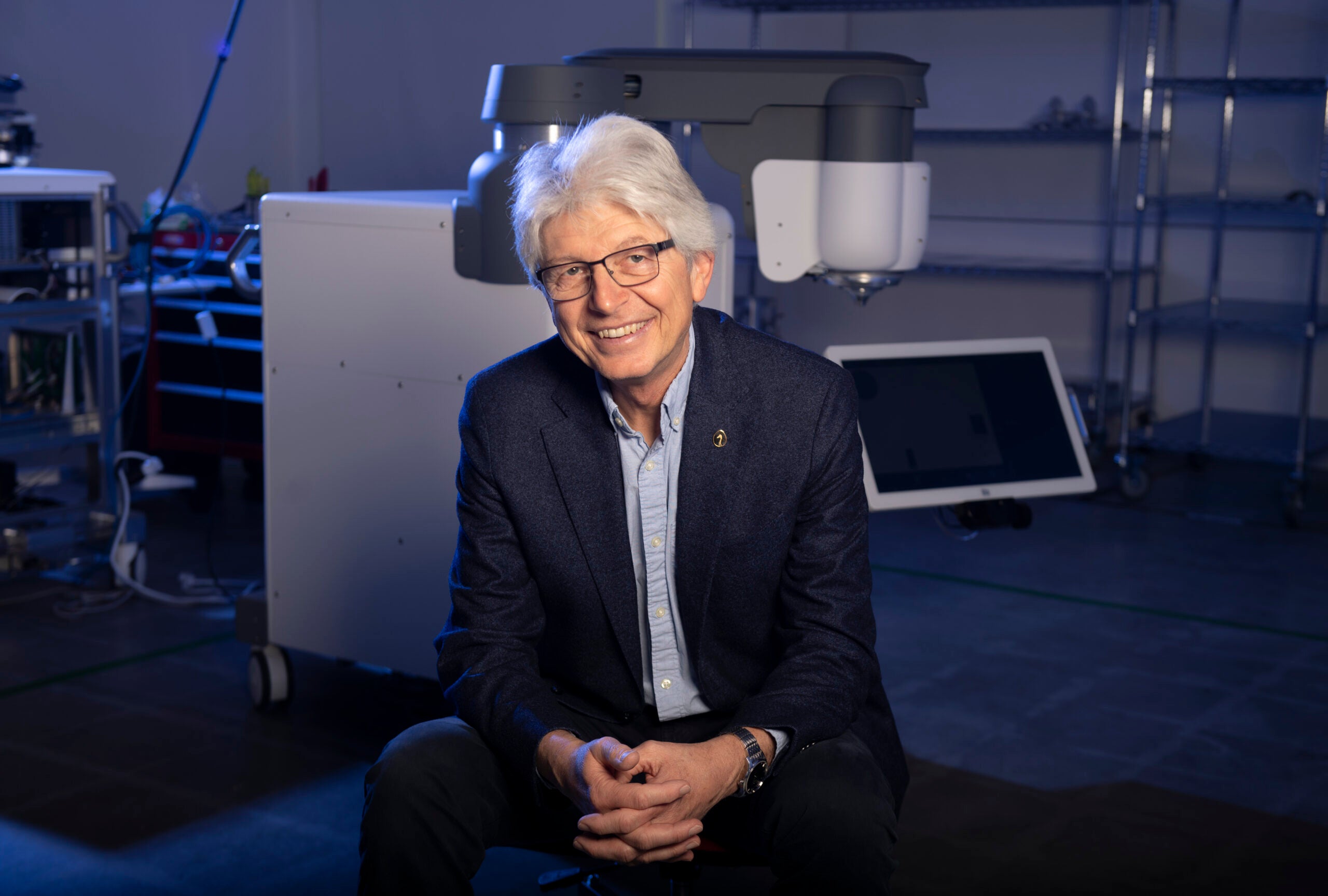
The ViaLase leadership change in July 2025 put an explicit division of responsibilities around the next stage. O’Neil became CEO, Pete England became chief commercial officer, and Juhasz became president and CTO. A founder’s job can change as the organization’s requirements change. In this case, the announcement kept Juhasz responsible for the technological roadmap.
That is a fitting place to leave him: inside the company he founded, still occupied with the technology that brought it into existence. His career has crossed countries and institutions, and it has acquired prizes and transaction values. The continuous thread is practical work with light, carried forward through people who knew how to collaborate. A pulse disappears almost as soon as it arrives. The work around it can keep someone busy for a lifetime.