A toilet seat is an awkward thing to bring to a conversation about ambition. It offers few of the usual props. No rocket on a launchpad. No sleek car rounding a bend. Nicholas Conn built his company around one anyway. The object makes an easy joke; the years he spent turning it into a product make a rather more interesting story.
Conn had wanted to be an electrical engineer and an entrepreneur since he was eleven. Those are compatible ambitions, though they ask different things of a person. Engineering rewards the ability to locate a problem precisely. Starting a company can require explaining that problem to someone who has never considered it, persuading them to care, and then finding enough people to do the work.
His route brought those ambitions together at Rochester Institute of Technology, where he developed the invention that became the Heart Seat during his doctoral research. He founded Casana in 2018. Later, he passed the chief executive's responsibilities to another RIT graduate and concentrated on the technology. A childhood plan had acquired colleagues, investors, and a division of labor.
A familiar object, an unfamiliar assignment
There is a particular pleasure in an invention whose outline needs no explanation. Everyone recognizes a toilet seat. Explaining why anyone would build a company around one takes longer. Conn's project put sensors and software inside a familiar fixture, making the ordinary object the starting point for a substantial engineering effort.
The interesting design decision was to begin with something already present in daily life. So much consumer technology asks for another action: put this on, open that, learn a new sequence. A fixture offers a different starting condition. Its place in the room and its place in a routine are already established. The engineering has to accommodate that familiarity.
By 2021, Conn was publicly describing his work in terms of refining the design and improving the underlying technology. That is a less cinematic description than the word invention usually receives. It is also useful. An idea can be explained once. A physical product must keep making sense when the explanation is over and someone actually uses it.
Three degrees, one continuing question
RIT runs through Conn's career like a continuous thread. He earned his bachelor's degree in electrical engineering in 2011 and his master's in 2013, followed by doctoral work in microsystems engineering. His education moved from electrical systems toward the smaller components and interconnected disciplines needed to make a complicated device behave as a single object.
Professor David Borkholder helped him develop the project at RIT. Their collaboration matters to the story because the finished company can make the earlier work look inevitable. It was a research project first, developed with an academic collaborator, before it became a business with people to hire and a product to bring to market.
Conn also worked as a research scientist at the university before founding Casana. That sequence gave him experience on both sides of a difficult crossing: investigating whether something could work and organizing a company around getting it to work beyond the laboratory. The questions overlap. The calendars, obligations, and audiences change.
The first yes needed company
In his account of working with Launch NY, Conn described securing an initial investor commitment that attracted the attention of a major toilet-seat manufacturer. That manufacturer then led a $2 million seed round. There is a welcome practicality in that detail. For all the technical work inside the invention, somebody with experience of making the surrounding object belonged in the conversation.
Bemis Manufacturing participated in Casana's financing, alongside venture investors. The partnership joined two kinds of knowledge: how to develop an unfamiliar capability and how to manufacture a very familiar thing. A toilet seat is a modest object until one has to design, build, and sell it. Then its apparent simplicity becomes a demanding specification.
Conn's recollection also gives the first investor commitment its proper scale. It was an opening that helped make another opening possible. Fundraising stories often arrive as a single number, already rounded and ready for a headline. Here, the useful detail is the connection between decisions: one person commits, another pays attention, and a project gains room to proceed.
Sharing the controls
Austin McChord, who founded the data-backup company Datto, met Conn during a visit to RIT in 2018. They stayed in touch. McChord subsequently joined Casana as chief executive, bringing experience of building a technology company. The inventor and the operator now had different responsibilities within the same undertaking.
For a founder, a new chief executive changes the meaning of a working day. There is a company to lead, a product to refine, and only so much attention available. Conn described concentrating on “where I can provide the most value.” It is a useful phrase because it makes the decision about work rather than ceremony.
“We all complement each other so well.”
Nicholas Conn, 2021
That sentence carries more personality than a list of executive titles. Conn sounded pleased to have people around him whose abilities gave his own work more room. The inventor's satisfaction included the team. Whatever romance attaches to the solitary founder, Conn's account of this period is full of other people and the things they enabled him to do.
It offers a practical way to think about continuity. Remaining committed to an invention does not require doing every job attached to it. A founder can preserve the thread of a project while changing his place within the organization. Conn's move from founding CEO to chief scientific officer made that distinction visible.
The code behind the calling card
His personal website introduces him through five descriptions: scientist, leader, entrepreneur, inventor, and coder. The final word keeps the others pleasantly grounded. It suggests a person whose public identity still includes the act of making software, even after the board appointments and company-building experience have arrived.
There is a small, concrete trace of that work in his public GitHub gists. A June 2012 entry preserves a printf() implementation for the MSP430 microcontroller, credits its original author, and points readers toward the discussion where it appeared. It is a narrow technical artifact, well removed from the broad language of an executive biography.
Such an entry cannot explain a whole career. It can put one in proportion. Long before a product launch becomes a public milestone, engineering involves specific tools, limitations, and borrowed knowledge. A useful function, a reference, a bit of credit: these are ordinary materials out of which more ambitious work gets assembled.
A founder with a wider workbench
Today, Conn's work extends beyond the company he founded. His professional network profile identifies him as a Casana board member and founder. The responsibilities have changed since his period as chief scientific officer, while his current work continues to include algorithms and product development.
Through Conn Castle Consulting, he offers custom algorithms, software architecture, embedded systems, and advice for founders. The scope is revealing. It reaches from the instructions running inside a device to the decisions facing the people financing and managing a business. He now offers other teams experience gathered across those levels.
His consulting practice also includes agentic AI systems and software development workflows. Alongside that newer work are familiar engineering concerns: data infrastructure, testing, connectivity, and production deployment. New tools enter the workshop; the obligation to make a system work in practice remains.
Based in the greater Rochester area, with Fairport listed for his consulting practice, Conn works with clients worldwide. He also mentors founders through Upstate Venture Connect and university programs. The geographic center of his career has stayed recognizable even as the range of people and projects around it has expanded.
There is a directness to that offering: bring the technical problem, work through the system, and decide what a team needs next. It fits a career that has repeatedly crossed the boundary between building an object and building an organization around it.
Eight years after the company began
Casana brought its Smart Seat to market in July 2026, eight years after Conn founded the company and more than a decade after the underlying research began. By then, he was serving on its board. The milestone puts some useful distance between the appeal of an original idea and the time required to deliver a physical product.
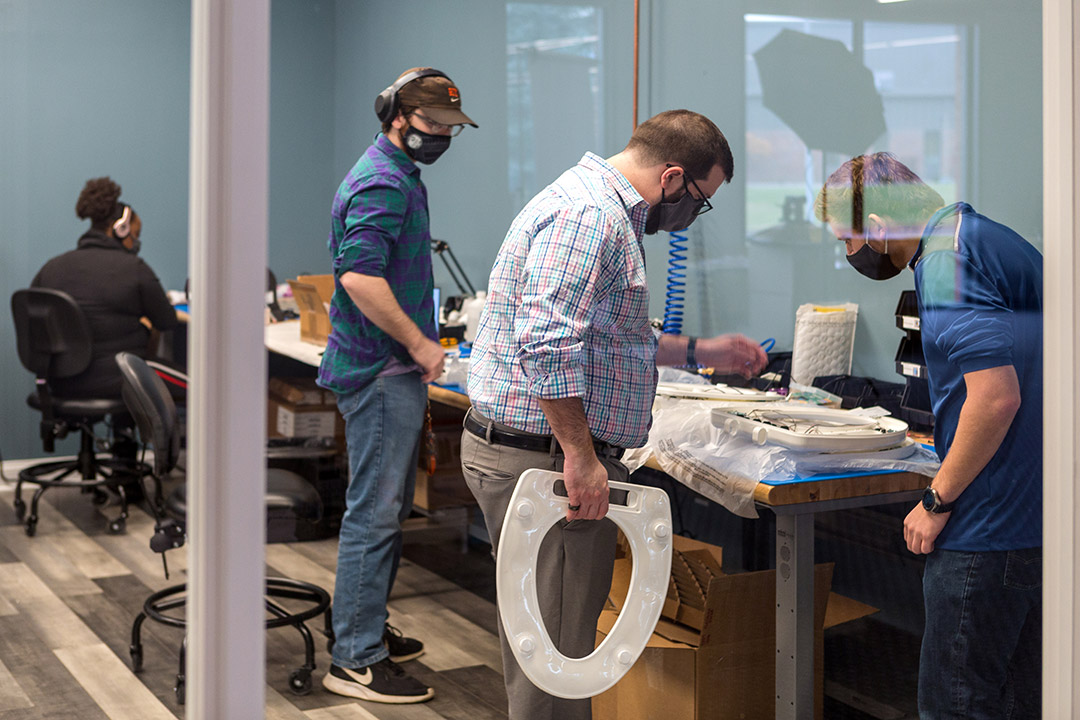
It also changes how the earlier photograph reads. The prototypes on the bench belong to a period when the public outcome was still ahead. In retrospect, it is tempting to treat them as props in a success story. At the time, they were work in progress. The distinction is where much of an inventor's career actually happens.
Conn's story began with two ambitions and eventually required a willingness to let other people take responsibility for parts of them. Engineering, entrepreneurship, collaboration, and governance have each had their turn. The toilet seat has remained an unusually good reminder that a serious working life can begin with an object that makes people smile.