David Tian stands at a lectern in Penang, wearing a dark jacket and an open-collar white shirt. Behind him, a blue backdrop carries the date: 12 June 2026. A microphone, some flowers, a company name. The furniture of a factory opening is familiar. The question beneath the ceremony is more interesting: how do you get a precision machine from the place that can build it to the place that will trust it?
Tian, Galatek’s Singapore-based CEO and founder, is working on that distance. His company sells equipment that measures, inspects and cuts semiconductor wafers. Bringing such equipment to an overseas customer involves a machine, certainly, but also a supplier network, installation, technical support and people close enough to answer questions. An export strategy has a surprisingly large cast.
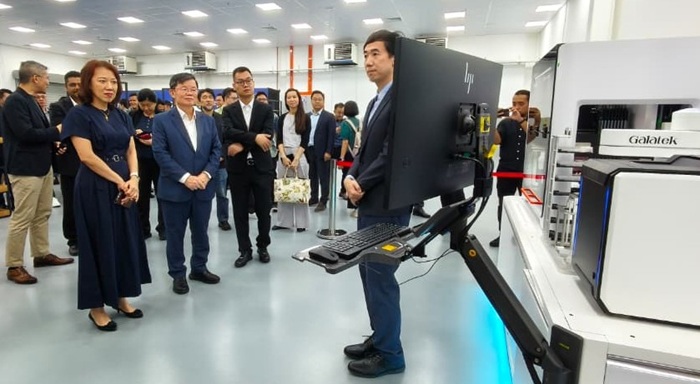
In the factory tour photograph, Tian stands with Penang Chief Minister Chow Kon Yeow and InvestPenang CEO Loo Lee Lian beside a demonstration. A monitor occupies the foreground. Machinery takes up the right side of the frame. This is a useful setting for his story: the executive among the equipment, with public officials looking on, and a substantial amount of work still ahead.
Singapore on the profile. Penang in the plan.
Tian’s professional profile places him in Singapore and lists Shandong Normal University from 2003 to 2007. It also lists a patent-agent credential associated with the All-China Patent Attorneys Association. Those are concrete details in a career now concerned with equipment and international operations. They give his professional record a connection to the formal machinery around technology, as well as the physical machinery on a factory floor.
A patent credential concerns rights and definitions. A factory concerns parts and tolerances. A company operating internationally has to pay attention to both. It would be too tidy to turn one credential into an explanation for every subsequent decision. Still, it belongs in this portrait of Tian: his publicly documented background includes the administrative side of invention, an area where small distinctions can have substantial consequences.
His current job carries another set of distinctions. Galatek is headquartered in Singapore. Its new Malaysian facility is in Penang. Its customers and operations extend beyond either location. A headquarters, a manufacturing site and a service team each perform a different task. Tian’s expansion plan puts considerable weight on making these places work together.
The money arrived before the opening
On 19 December 2025, Galatek announced approximately US$30 million in Series A funding. The stated uses included product development, its global supply chain and local expertise in Europe, North America and Southeast Asia. This was a financing announcement with an operational itinerary attached. The company was describing where it wanted to build capacity, alongside what it wanted to build.
Tian put the aim this way: “Galatek’s mission is to be a reliable infrastructure partner.” The word reliable does a great deal of work. It suggests a relationship that continues after a sale. For a customer buying production equipment, the useful promise is that the system can become part of everyday work. Reliability has to survive the ordinary Tuesday.
Funding gives that promise resources. It does not settle the practical questions. A customer still needs to know how equipment will fit a process, how the team will support it and how problems will be handled. Read in that light, Tian’s December statement describes a task to be carried out over time. The Penang opening six months later gives that task a visible location.
Approximately, for product development, supply chain capacity and local expertise.
The machines make the argument specific
Galatek’s catalogue helps explain the kind of business Tian leads. Its InspiraMetrix range measures overlay, the alignment of patterned layers used in semiconductor manufacturing. The DUO system supports visible-light and infrared measurement; other models address single-sided measurement on different wafer sizes. These are narrowly defined jobs. The usefulness of a measurement tool depends on the particular thing a customer needs to measure.
That specificity matters to the commercial story. An executive can describe a market in broad terms, while an engineer needs to discuss imaging, autofocus and compatibility. Tian’s company has to move between these registers. Selling across borders adds another layer of translation: the technical description must become a working installation, understood by the team that will use it.
The InspiraInspect range has a separate assignment: finding defects on wafers. Galatek describes systems for patterned surfaces, three-dimensional structures and inspection after dicing. Its product descriptions include automated handling and defect classification. Inspection is a good reminder that industrial AI often has a very particular brief. It may be asked to identify an unwanted feature on a surface, rather than produce something anyone would wish to read.
Then there is cutting. The InspiraSlice laser-dicing range includes systems intended for silicon, silicon carbide and sapphire wafers. Galatek describes automated alignment, focusing, barcode reading and production-data recording. The catalogue’s recurring theme is coordination: a physical operation sits beside measurement and software. For Tian, this makes the delivery and service network part of the product’s practical usefulness.
InspiraMetrix
InspiraInspect
InspiraSlice
A factory, with the future still in the future
The June opening established Galatek’s first manufacturing footprint in Malaysia. Initial investment was approximately US$2 million. The announced plan is to reach US$60 million over three years and US$100 million within five. These figures describe different stages. The opening marks a beginning; the larger numbers remain commitments to pursue as capacity expands.
The distinction makes Tian’s story more interesting. A small initial operation can carry a large intended role, provided the work that follows supports it. A ceremony offers a date for the calendar. Supplier development, equipment validation and recruitment proceed on schedules of their own. There is no ribbon long enough to tie those tasks together in one afternoon.
The staffing plan is similarly staged. Galatek said the facility was expected to create 20 to 30 jobs during 2026, with a Malaysian workforce of approximately 100 intended over five years. The functions include engineering, procurement, operations, sales and technical support. The list puts people around the equipment at each point where a customer might need them.
The financing and the Malaysian investment roadmap also answer different questions. The Series A describes capital raised by the company. The Penang figures describe investment in a particular operation, with future stages attached. Adding the amounts together would obscure their meaning. Reading them separately keeps the expansion in proportion: there is a funded company, a new facility and an intended sequence of further commitments.
The suppliers are part of the story
Galatek’s R&D head, Sammi Ng, described a strategic partnership with MegaRobo covering procurement, manufacturing and commercial support. She also described a push to increase sourcing from Malaysia and Southeast Asia: below 10 percent at the June opening, with 25 percent targeted by 2027 and 40 percent as a longer-term ambition. Localisation is therefore a project with intermediate steps.
For Tian, that adds a second kind of construction to the new facility. One task is assembling equipment. Another is developing the relationships that supply it. Ng described the Singapore team sharing technology roadmaps and working with Malaysian suppliers on new products. A supplier becomes part of the operating plan through repeated technical work, rather than through a line on a map.
The company’s connections also put Tian among colleagues and backers with different responsibilities. COO Jian Shen handles operations; Ng speaks to development; Granite Asia is an investor. At the opening, Granite Asia’s Jenny Lee joined Malaysian officials and Galatek leaders. The photograph records a gathering around a company whose expansion depends on more than its chief executive.
The promise he chose to make
“we aim to build local engineering capabilities”David Tian · Penang, June 2026
Tian’s choice of words at Penang makes a compact statement of ambition. The verb leaves room for the work ahead; the object names something more enduring than an opening event. Engineering capability resides in people who can understand a system, test it and help put it to use.
His publicly stated aspiration connects AI, automation and advanced equipment with service to global customers from Malaysia. The emphasis on place is revealing in his business strategy. A company can think internationally while building capability in particular rooms, with particular teams. Tian’s plan asks Penang to become one of those places.
The next chapter will be written in the work described at the opening: more local engineering, deeper supplier participation and expanded production capacity. Those are observable commitments. For now, the image of Tian beside the demonstration offers a fair closing scene. The monitor is waiting, the equipment is there, and the people have gathered to see what it does. A machine earns its place in a market through use.