The goods have left the warehouse. The invoice has gone to the buyer. For a supplier, this ought to be the satisfying part. Instead, the sale can introduce another problem: how to pay for the next order while waiting for the last one. Olea has built its business around that interval. An unpaid invoice is a cash-flow headache for one company and a potential investment for somebody else.
- The job: turn eligible trade receivables into working capital.
- The audience: suppliers, international buyers and institutional funders.
- The scale: more than $3 billion in financing reported by December 2025.
Based in Singapore, Olea connects those parties through a digital trade finance platform. Its customers include smaller exporters and larger companies managing international suppliers. Its funders want exposure to short-duration corporate credit. The interesting work happens where their requirements meet: checking the asset, arranging suitable financing and keeping everyone informed about what happens next.
A bank’s problem, outside the bank
Olea began with an unusual advantage. In August 2021, Standard Chartered and Chinese supply chain technology company Linklogis announced the joint venture. They already had a working relationship, including supply chain financing transactions. Olea would combine trade and risk expertise with digital infrastructure, bringing institutional investors into a market where businesses needed working capital.

Amelia Ng was named CEO. Her background included leading strategy for Standard Chartered’s Corporate and Investment Bank. The leadership team today includes experience in credit analytics, fixed income distribution, technology and securitisation law. That combination helps explain the product. Moving an invoice onto a screen is straightforward compared with deciding whether an institution should finance it.
There is a regulatory piece, too. Olea Global Markets, its wholly owned subsidiary, obtained a Singapore Capital Markets Services licence to deal in capital markets products. Olea announced the licence in September 2024, alongside passing $1 billion in processed trade and supply chain assets. The subsidiary’s securities-dealing status appears in the Monetary Authority of Singapore’s directory. For institutional distribution, legal permission belongs in the product discussion.
The company dates its operational launch to 2022. By December 2025, it reported more than 30 institutional funders and over 1,000 supplier and buyer clients across more than 70 trade corridors. Those are company-reported financing and participation figures. They describe a network connecting capital with commercial transactions; the $3 billion figure measures financing facilitated.
Three people. One unpaid invoice.
Start with the supplier. Olea offers limited recourse receivables financing, allowing eligible businesses to bring forward cash tied up in invoices. Its Flexi offering adds a revolving line, flexible drawdowns and financing across a pool of buyers. The attraction is practical: the supplier can seek funding against trade receivables without putting up traditional collateral.
- 01SupplierSubmits invoice and documents
- 02OleaReviews risk and arranges funding
- 03FunderProvides suitable capital
Olea advertises in-principle financing approval within 48 hours. That phrase deserves careful reading. Applicants submit company information and financial statements; due diligence and onboarding follow. Accessing funds against submitted invoices is another step. A quick initial decision helps, but a business planning payroll needs to distinguish approval from money arriving.
Now take the buyer. Olea’s buyer-led program lets a company onboard suppliers across markets, coordinate payments and manage working capital. Its Buyer Portal supports maturity tracking, paperless processing and ERP data integration. In an anonymized case study, Olea describes helping a Hong Kong apparel sourcing business replace some traditional banking facilities with a tailored payable solution.
Finally, the funder gets a different view of the same activity. Olea’s Investor Portal shows utilisation, yield and income, with portfolio breakdowns by jurisdiction, obligor and credit rating. Monitoring includes reconciliation, adverse-news screening and daily reports. Origination and distribution, supported by structuring and risk work, sit at the centre of this B2B model.
Bank facilities and factoring remain alternatives. Platforms such as PrimeRevenue also connect supply chains with multiple funders. Olea’s particular combination is its bank-incubated origins, international origination network and institutional distribution capability, alongside newer digital settlement options. Its partnership with BBVA makes the competitive picture more interesting: a bank can also be a route to customers and capital.
Two cheques, two jobs
In November 2024, Olea secured a $100 million warehouse financing facility from HSBC and Manulife | CQS Investment Management. In December 2025 came a $30 million Series A led by BBVA, with XDC Network, theDOCK and SC Ventures participating. These sums perform different jobs. Warehouse financing supplies liquidity for financing activity; equity supports the company developing and expanding that activity.
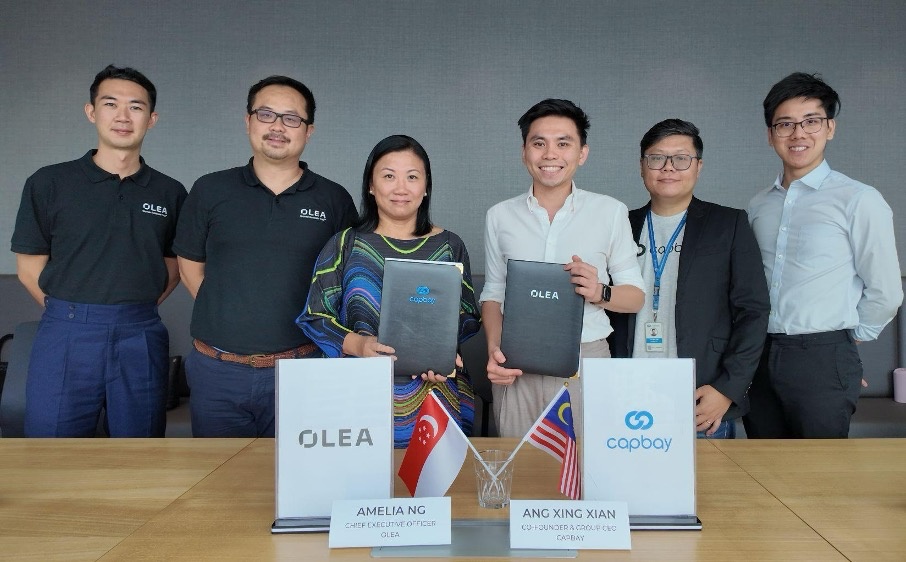
The Series A announcement earmarked investment for AI analytics, Web3 readiness, embedded finance and origination in growth markets. Commercial partnerships supply another ingredient. CapBay contributes Malaysian SME relationships and local financing expertise. Riverchain brings construction-sector origination knowledge. The lesson for another founder is useful: reaching a borrower can require a partner who already understands the business.
The invoice still has to be true
In March 2026, Olea executed its first live trade finance disbursement using Circle’s USDC. Verified receivables for a commodities client supported a payment directly to an Asian supplier. Olea reported settlement in minutes, outside the constraints of banking hours. Suppliers could hold USDC or convert through regulated providers. The improvement concerned settlement after the financing checks.
“We are focused on optimizing parts of the workflow where it makes a meaningful difference for our clients.”Amelia Ng · April 2026
In August, Olea announced a transaction with POSCO International America and Intain. Intain reconciled invoices, purchase orders, credit notes and shipment documents before receivables were verified and registered on-chain. The record tracked ownership and asset status. This gives the technology a concrete job: preserve and share information about an asset whose supporting documents have already been examined.
That sequence is the part readers can copy. Find the awkward handoff. Make its information usable. Match it with capital that accepts the risk. Faster settlement remains useful only when the receivable can be verified, the financing terms suit the business and the payment route works for the recipient. An invoice still needs a buyer able to pay it. Olea’s opportunity lies in making the journey between those facts less cumbersome.
Keep following the money
Explore Olea, its LinkedIn and X. Read more about USDC settlement, the POSCO and Intain transaction and company news.