A company called Kashya has set itself a fairly demanding entrance examination. Its name, drawn from Aramaic, refers to a difficult question. For Michael Lewin, who co-founded the business, the question involved information: how to keep an organization’s data recoverable while its computers continued doing the ordinary, inconvenient work of changing it.
The subject sounds remote until a business needs its records back. Then it becomes rather personal. Lewin’s early enterprise software venture worked in that space between the reassuring word “backup” and the complicated machinery required to make recovery possible. Later, at Istra, he would help build a business around another demanding relationship between information and time: automated trading.
Put those two chapters next to each other and a career takes shape. The industries change. The recurring materials are computers, mathematical methods and teams capable of making them useful outside a demonstration. A sales announcement supplies one kind of milestone. The engineering leaves a more detailed trail.
A backup plan becomes a business
Lewin co-founded Kashya in 2001 with Yair Heller and Ziv Kedem. He served as its CEO. Before that, his experience included an algorithmic software engineering role at Compugen and leadership in an intelligence research division of the Israel Defense Forces. The combination placed technical work close to the center of his professional life before the acquisition headlines arrived.
At Kashya, the commercial problem was data replication and protection. Businesses needed information copied across their storage environments without turning every difference between systems into a separate engineering project. A financial institution could have several kinds of storage, numerous databases and very little enthusiasm for stopping its services while someone improved the backup arrangements.
In November 2005, Kashya and Cisco announced work with Nationwide Building Society. The deployment involved Kashya’s KBX5000 data-protection appliance and Cisco storage-network technology. Nationwide wanted a common approach to protecting information across different tiers of storage. The announcement described replication of production data and an evaluation of integration into its existing switch infrastructure.
“Data protection is no longer an option, it is a necessity.”
Michael Lewin, Kashya announcement, November 2005
That customer example gives the venture a useful scale. A product had to live alongside systems already in service. Cost, recovery time and compatibility mattered together. Nobody buys disaster-recovery software hoping for a fascinating afternoon using it. Its purpose is to make an otherwise dreadful afternoon shorter.
The sale, and the work underneath it
On May 9, 2006, EMC announced that it had acquired Kashya in a cash transaction valued at approximately $153 million. Kashya would join the EMC Software Group. Its Israeli research and development operation would become the core of a new EMC software development center in Israel.
Approximate cash value of EMC’s 2006 acquisition of Kashya.
COMPANY TRANSACTION VALUE · NOT PERSONAL WEALTHThe purchase also came with a specific technical itinerary. Kashya’s replication capabilities would augment EMC’s storage-virtualization offering, while its continuous data protection technology would be used in future RecoverPoint releases. For Lewin, the announced benefit was the opportunity to get the technology into use at a larger scale.
It is tempting to make the price the whole story. The patents complicate that tidy ending. Lewin appears among the inventors on work concerning consistent data recovery, point-in-time access and compression. These are records of particular technical contributions, with collaborators named alongside him. They put more substance behind the otherwise spacious word “founder.”
One patent, granted in 2009, concerns keeping recovery consistent across groups of stored data. Another, granted in 2010, describes access to data at a specified earlier point using a history of write transactions. In everyday terms, the latter addresses how a system can present an earlier state of information even though later changes have occurred.
The names recur: Heller, Kedem, Shlomo Ahal and other technical colleagues appear in these records. A company sale can be dated to a single day. The associated work, and the people who know how to do it, have a less obedient calendar.
A further patent application names Lewin with Heller, Kedem and Shay Mannor on continuous compression of large volumes of data. Filed in 2003, it describes dividing information into smaller segments, calculating compact signatures and comparing them with signatures already stored. When a segment is new or has changed, the system sends it to the remote site. The practical concern is how much information must cross the connection. A full copy and a useful update are different quantities. That distinction makes the technical work easier to picture: the system needs to recognize what has changed before deciding what needs to travel.
From a difficult question to a coin
Istra was founded in 2008. Lewin’s fellow founders included Jonathan Lewin, Shlomo Ahal and Alon Wasserman. The new business developed proprietary automated trading algorithms for financial markets. Its name, like Kashya’s, came from Aramaic: this time, a coin. The vocabulary had become rather more directly connected to the revenue model.
The move brought familiar collaborators into a different commercial setting. Ahal had worked at Kashya. Jonathan is Michael’s brother. The connection is part of the company’s documented beginnings, rather than a decorative detail added to make a founder story feel more intimate.

In 2010, Istra’s financing became public through reporting of an investment round of about $10 million. Battery Ventures, which had backed Kashya, was among the investors associated with the new company; company databases also identify Chalkstream Capital Group. That gives the second venture another connection to the first: an existing professional relationship continued across the change of industry.
Istra’s own account of its business is direct. It develops and deploys trading algorithms, combining statistical methods with low-latency processing and network technology. The company’s Israeli research operation is based in Lod. Its work participates in financial markets internationally, so the physical office and the arena of competition occupy very different scales.
An algorithm needs colleagues
For a reader arriving through Lewin’s name, Istra’s team descriptions make the business easier to understand. Data scientists investigate patterns in financial markets. Algorithm developers turn research into trading logic. Software specialists work on communication and performance. Hardware engineers design systems including field-programmable gate arrays, or FPGAs.
Infrastructure specialists maintain the computing environment, including backtesting resources and storage. Operations teams monitor running systems. Those are separate responsibilities with a shared destination: an automated trading system that works in practice. An algorithm, for all its mathematical dignity, still has to get through a network.
- ResearchInvestigate market data
- AlgorithmsImplement trading logic
- TechnologyRun software and hardware
- OperationsMonitor live systems
This is also where the comparison with Kashya becomes useful as a way of reading the career. In both settings, a technical idea has to fit into a larger operating environment. In one, the concern was recoverable business information. In the other, the firm applies data and computing to market decisions. The connection lies in the engineering demands; it does not establish Lewin’s private reason for changing fields.
The company also advertises a recruitment process involving mathematical problems, algorithm questions and riddles. Its stated values include intellectual curiosity and collaboration. Those choices describe the organization’s public invitation to prospective colleagues. A candidate attracted by the puzzles will still, eventually, have to attend meetings.
When the rules enter the room
Lewin’s work in financial markets also appears in a less photographic setting: the discussion of market rules. In January 2019, he signed a joint letter supporting changes to the Limit Up-Limit Down system, a mechanism intended to address extraordinary price volatility in US equities.
The signatories came from asset managers, trading firms and other market participants. Lewin was identified as CEO of Istra LLC. The proposals included making the mechanism permanent, adding periodic review and changing certain trading-band parameters. It places him in a documented industry conversation about how the market itself should operate.
In May 2021, he signed a separate Istra letter concerning funding for the Consolidated Audit Trail. The company supported the modernization of regulatory data while challenging the proposed costs, transparency and allocation of fees. It asked for a clearer relationship between how charges were calculated and the activity being funded.
Read beside the earlier technical record, that intervention adds another dimension to the professional story. Computing happens within institutions as well as machines. A trading firm has to understand the rules of the environment in which its systems run, and it sometimes makes its objections in a six-page letter rather than a line of code.
Time, put to work
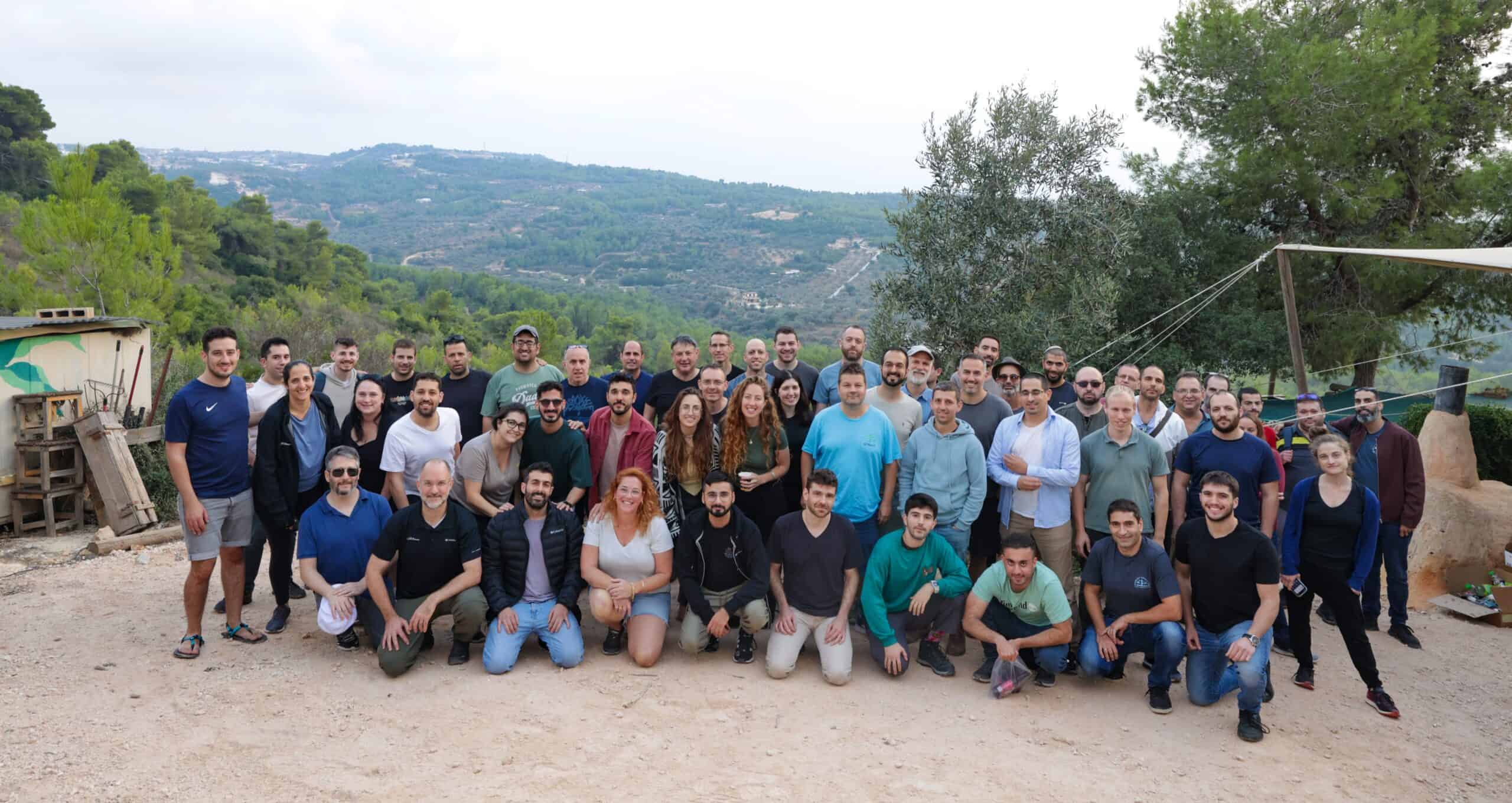
Outside those formal settings, Istra’s public company life includes conferences, lectures and gatherings. A 2023 meeting began with a visit to the Lod Mosaic before the business review. A 2025 company conference took the team into the desert. Lewin was tagged in the company’s accounts of both occasions.
These are modest details, but useful ones. A business associated with fast computing is still made of people who leave the office, look at something together and return to the next problem. The mosaic offers a particularly agreeable interruption: a piece of work that can afford to be examined slowly.
Lewin’s professional path can be followed through concrete things: a customer deployment, an acquisition, named inventions, a new company and signed positions on market structure. Together they give the story more texture than the transaction price alone. Kashya dealt with information a business might need again. Istra works with information whose usefulness depends on acting in time. Between them sits a founder with a long acquaintance with difficult questions.