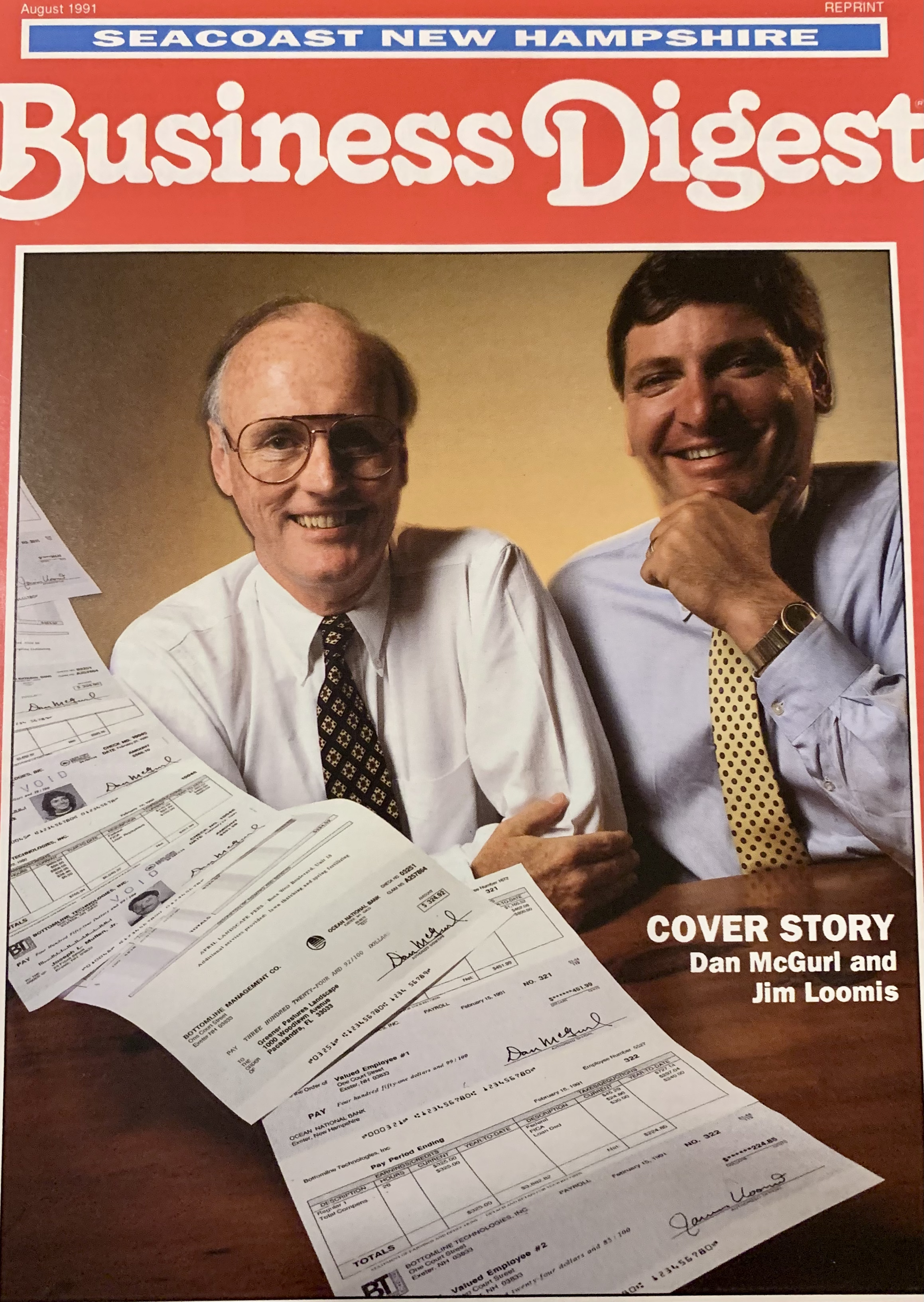
The checks are practically tumbling out of the photograph. On an August 1991 magazine cover, Daniel McGurl and Jim Loomis sit behind a cascade of payment forms, smiling in shirts and patterned ties. McGurl is on the left, in glasses. Loomis is on the right. Between them and the reader lies a modest mountain of office business. The picture has the pleasing confidence of two people whose product can be photographed on a desk.
Their company, Bottomline Technologies, was two years old. Its opening proposition concerned something almost offensively ordinary: the paper check. Businesses needed to pay people. Did they also need the preprinted stationery, the separate steps, the machinery surrounding that payment? McGurl and Loomis had built a business around making that routine easier. A bill could be familiar and still contain an opportunity.
McGurl arrived at this problem with a long corporate career behind him. He had spent 26 years at IBM and served as a senior vice president at State Street Bank and Trust Company. In May 1989, he became a co-founder and chief executive of a new company in New Hampshire. The experience preceded the startup. So did a considerable acquaintance with the institutions whose money his software would help move.
A long apprenticeship, then a new company
A U.S. Naval Academy graduate, McGurl held IBM posts that included director of marketing planning and director of Far East operations. Those titles describe a working life extending beyond the computer itself: markets, customers, operations, geography. His move to State Street placed him inside banking. He served there from 1987 to 1989, immediately before Bottomline's founding.
That sequence matters. A career described simply as former IBM executive, then entrepreneur, misses the banking chapter between them. Bottomline would sell into the space where corporate accounting met financial institutions. McGurl had worked on both sides of that boundary. The chronology gives the venture a more specific beginning than the usual tale of someone discovering that computers might be useful.
He founded Bottomline with Loomis, whose own earlier career included Nashua Corporation. Their company began in Exeter, New Hampshire, and later became associated with Portsmouth. McGurl was president as well as CEO, retaining the presidency until September 2000. Loomis helped shape product strategy and the company's approach to customers. There were two founders in that magazine photograph for a reason.
By 1996, McGurl had received an Entrepreneur of the Year award from the New Hampshire High Technology Council. The honor placed an executive working on corporate payments among the state's technology entrepreneurs. Paper checks were unlikely dinner-party material. They were, however, something a customer could identify, count, and want to handle with less effort.
Start with the blank sheet
Bottomline's LaserCheck software supplied a wonderfully literal improvement. It could produce a completed check on blank paper using the magnetic ink character information required for processing. The check remained recognizable. The preparation changed. Instead of treating a preprinted form as the necessary starting point, software could assemble the information that made the document useful.
There is an appealing lack of ceremony to this idea. A check's purpose was to authorize payment; its stationery was an implementation detail. Making the form part of the software loosened that relationship. Bottomline could improve an existing payment routine while the customer continued to issue something its bank and recipient already understood.
The technical work extended beyond printing. On July 25, 1995, an application was filed for a patent titled Disbursement system and method. McGurl was one of four named inventors, alongside Margaret O'Toole, Helmar Herman, and Loomis. The patent was granted on April 6, 1999, as U.S. Patent 5,893,080. The founder's name belonged on a technical document as well as the executive roster.
- 01 / DefineStore payment rules by transaction type.
- 02 / RequestReceive the payee, amount and payment details.
- 03 / MatchSelect the corresponding rules automatically.
- 04 / DisburseGenerate the payment using those criteria.
The mechanism is easier to follow than its title suggests. A business stores rules for different types of payments. A request comes in. The system determines which type of transaction it is and selects the appropriate criteria. It can then generate a disbursement using both the stored rules and the individual request. The routine becomes something a computer can apply consistently.
The patent also describes controls for monitoring proper operation and preventing improper disbursements. That concern belongs at the center of the story. A faster payment system still has to send the right payment. Much of the work concerns the unglamorous questions: which account, which recipient, which method, which permission? The software has to keep those details together.
The browser arrives at accounts payable
By December 1998, Bottomline was introducing PayBase-Secure WebPay, bringing payment requests and information into a standard browser. Its scope included electronic and paper payments, remittance advice, and access to transaction information. Payroll, suppliers, and claims could all enter the discussion. The office check had become part of a broader set of decisions about how money left an organization.
Electronic requests could go to an authorized manager for approval, then onward to the bank in the applicable automated clearing house format. For paper payments, instructions could go to a laser printer to produce a check on blank stock. A customer could use browser technology without requiring every payment recipient to abandon paper at once.
That coexistence gives McGurl's business a useful texture. The transition from paper to electronic payment contained intermediate arrangements. An organization could change how a payment was requested and approved while continuing to print a check. Browser access and paper output could inhabit the same product. An office could move forward without reorganizing every relationship on the same morning.
Bottomline's work with UPS supplied another example. By late 2001, it was providing electronic invoice delivery that allowed UPS customers to register online, inspect billing information, and pay electronically. McGurl described the arrangement as a deal worth multiple millions of dollars. The earlier concern with producing a payment now extended to presenting the bill that prompted it.
Thirteen years in the chief executive's chair
Bottomline went public on Nasdaq in 1999, a decade after its founding. Its ticker was EPAY, an economical explanation of the business. McGurl was still CEO. Loomis helped guide the company through the offering. The two people pictured with their checks in 1991 had reached a different kind of paperwork, with public shareholders and the reporting obligations that followed.
By May 2001, Bottomline's software was used by more than 5,500 client companies around the world. That dated figure offers a useful view of the business during McGurl's leadership. Its customers had multiplied beyond the scale suggested by the early cover photograph. The company was also named a 2001 Business of the Year by Business NH Magazine.
In August 2002, Joseph Mullen succeeded McGurl as chief executive. McGurl remained chairman until May 2007 and continued as a director afterward. The succession unfolded in stages: first the operating leadership, then the chairmanship, then the board seat. His association with the company extended well beyond his time running it day to day.
McGurl and Loomis both left the board in 2016 as part of a board refresh. Their directorships had begun with the business in 1989. Twenty-seven years separated those moments. A startup partnership had lasted through product development, a public offering, changes in leadership, and the company's expansion into international payments technology.
The partner in the other chair
When McGurl spoke about Loomis in 2025, he put the emphasis on their partnership and Loomis’s contribution to building the business. He also credited Loomis's contribution to taking the company public. The language was direct and affectionate, with the work itself supplying the compliment.
“Jim was a great partner, and was key in developing the business.”
Daniel McGurl, speaking about co-founder Jim Loomis in 2025
The comment brings the story back to the two chairs in the photograph. McGurl had the chief executive's title, but his recollection made room for the person beside him. Product strategy, customers, financing, and management had to come together. A company could begin with a clear idea about a check and still need years of shared work to turn that idea into an institution.
In May 2022, six years after the founders' board departure, Thoma Bravo completed its acquisition of Bottomline in an all-cash transaction valued at approximately $2.6 billion. By then, later leaders and teams had carried the company much further. The sale belongs to that longer corporate history, with McGurl's founding years at its beginning.
Return to the checks spread across the desk. They explain why this particular beginning deserves attention. A payment form carried instructions, permissions, account information, and the expectation that money would arrive correctly. McGurl and his colleagues made those requirements material for software. The ordinary office task proved capable of sustaining a company long after the patterned ties in its first cover photograph had gone out of fashion.