Chris Dean was considering retirement when a friend persuaded him to take another technology job. It was 2014. Dan Kimerling had a young company called Standard Treasury and needed help with its engineering. Dean joined as chief technology officer. Within a year, Silicon Valley Bank had bought the business. Retirement would have to make its own arrangements.
That detour put an experienced software builder inside a bank. It also set up the question that has occupied him since: how do you give a financial institution the flexibility of software without losing the responsibilities that make it a bank? Treasury Prime, which he founded with Jim Brusstar in 2017, is his continuing answer. The answer has involved code, patient partnerships and a painful change of direction.
A physicist finds a different kind of experiment
Dean studied physics at the California Institute of Technology. His early work was in the Machine Learning Systems Group at NASA’s Jet Propulsion Laboratory. Long before artificial intelligence became a standing item on every corporate agenda, it was part of his working life. Enterprise software followed, including founding or co-founding Merced Systems and the consulting firm Kyluka.
There is a useful clue to his temperament in his public founder biography: he credits writing Lisp with paying for his first house. It is an unusually concrete way to describe a programming career. Plenty of executive biographies offer a list of competencies. Dean’s offers a roof.
The programmer remains visible. His public GitHub projects include a background job processor built with Clojure and Postgres, an iteration construct for Clojure, and examples for working with Amazon’s infrastructure. They are the sorts of things software builders leave for other software builders. An executive title has not erased that earlier vocabulary.
“Stand on the shoulders of giants.”
Chris Dean’s chosen life lesson
The appeal of a problem that refuses to behave
Dean’s route into startups was less calculated than an orderly résumé might suggest. After moving to San Francisco for family reasons, he took a startup job without even knowing what the term meant. The company supplied a brisk education in organizational drama. He liked the product work enough to stay in the business.
What appealed to him was the feedback. Research had its measures of success; products had customers who either used what you made or did not. He later spent two years at Silicon Valley Bank, repeatedly encountering manual processes he believed software could improve. Each discovery offered another problem to solve, and another reason to wonder about the whole system.
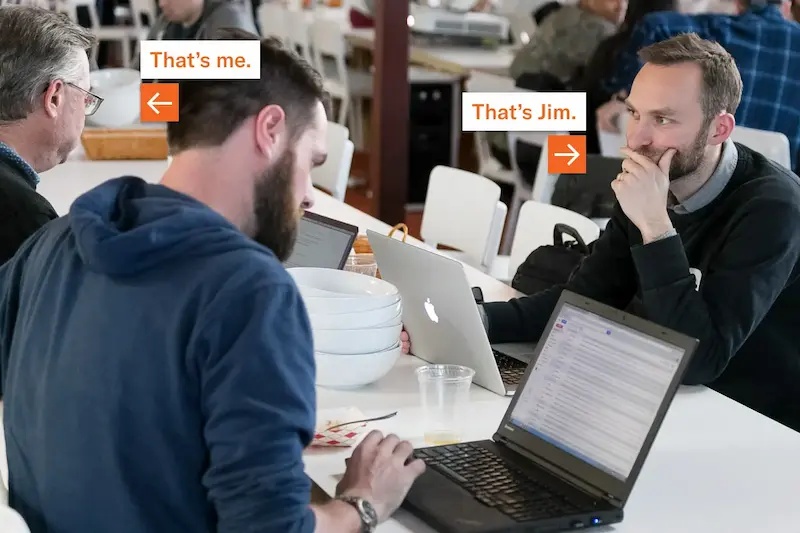
Brusstar had also worked at Standard Treasury and Silicon Valley Bank. Their shared experience gave Treasury Prime a specific starting point: connect banks and technology companies through software that lets developers work with banking functions. Opening accounts and moving money would become programmable, while the bank continued to do the banking.
Two interviews, one working bank connection
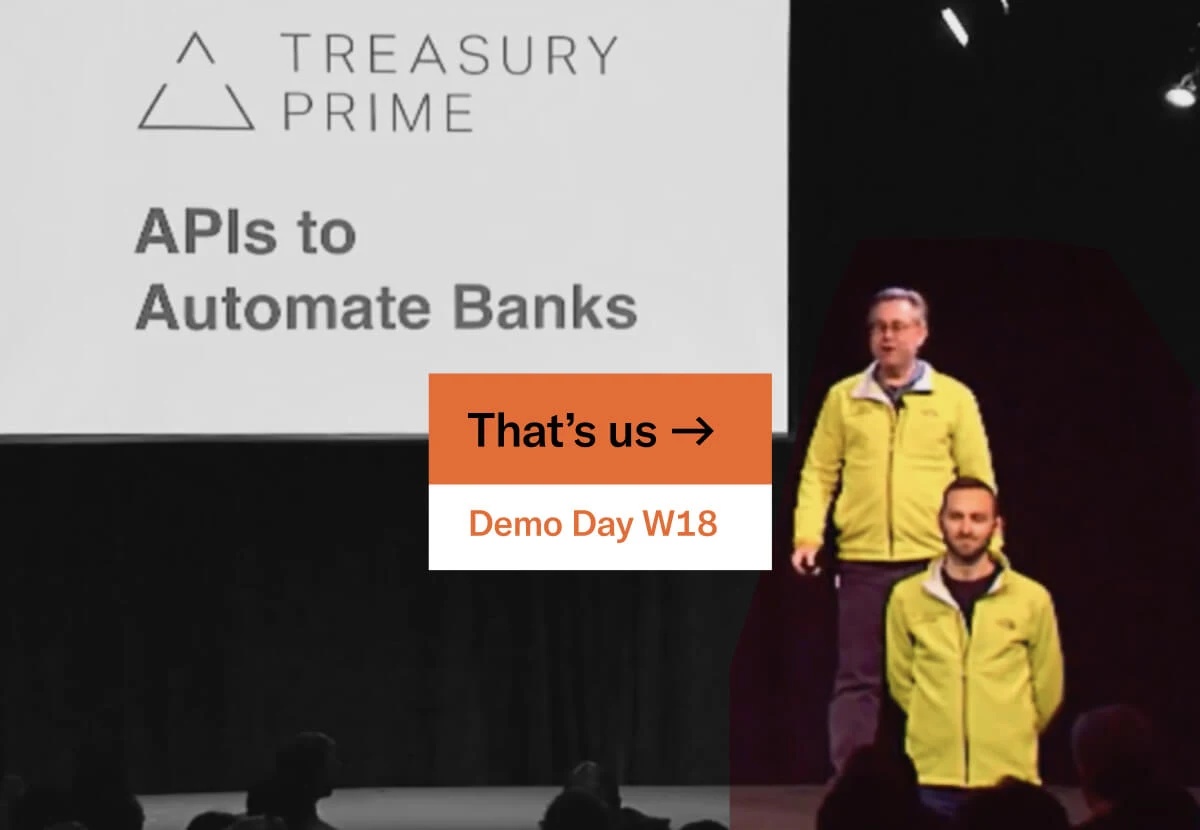
Y Combinator made the founders defend that idea twice. After an initial interview, the partners brought in someone with more banking expertise for another round. Hours of waiting separated the two examinations. Later, at a San Francisco bar, Aaron Harris called with an offer to join the Winter 2018 batch. Banking software had acquired an accelerator schedule.
The founders chose deposits as their starting problem. Their first customer wanted commercial account opening, so that was what they built. By Demo Day, Dean wanted something firmer than a promise: a customer running in production. Getting there meant several days of very little sleep. The resulting pitch could point to a working service.
His subsequent advice to founders carries the marks of that experience. Start with something a customer actually needs. Stay close enough to learn. Resist the temptation to automate before you understand the work. These are modest instructions for a business with a large ambition, which is precisely their attraction. A bank account that opens successfully is a useful rebuttal to a slide full of possibilities.
What happens behind the pleasant little button
A customer taps a button to send money. Behind it sit questions about the account, the payment route, the transaction record and the institution responsible. Dean’s business lives in that gap between the apparent simplicity of an app and the work required to make the transaction happen.
When answering founders’ questions in 2022, he pointed to the difficulty of moving money as a place to find business opportunities. His practical counsel was to locate an actual problem that customers needed solved. He also warned that banking practices vary across geographies. A product builder accustomed to one country’s systems cannot assume the next country works the same way.
That attention to the underlying operation helps explain his interest in community and regional banks. They bring banking capabilities; technology companies bring products and customers. The connection has to accommodate reconciliation, settlement and oversight. The attractive interface is only the part the customer gets to see. Someone still has to account for what happened after the button was pressed.
Product & customersBank
Accounts & oversight
Treasury Prime supplies the software connection.
Simplified model • not a transaction flowThe expensive part of changing your mind
In February 2024, Dean made a consequential choice about that relationship. Treasury Prime would concentrate its sales efforts on banks, helping them manage direct relationships with fintechs. It had previously built a team to help connect fintech demand with bank partners. Now it was pulling back from that intermediary role.
The change cost jobs. Roughly half of a workforce of nearly 100 people was laid off. Dean described the decision as a response to what banks wanted and to the direction of regulatory expectations. The commercial explanation did not remove the human consequence. A strategy can fit a diagram elegantly and still land very badly in somebody’s Tuesday.
The episode belongs in any account of his career because it tests the comfortable founder language about adaptation. Changing direction means deciding which work the company will keep doing and which people it will keep employing. In Treasury Prime’s case, the bank would own the fintech relationship. Dean was making the organization follow that decision.
He continued discussing the operational detail in public conversations that year: direct integrations with bank systems, real-time reconciliation and the balance between new products and compliance. The preoccupation was consistent. Making banking programmable also means deciding who can see, reconcile and supervise what the software is doing.
More banks, fewer single points of failure
A network of banks gives that philosophy another dimension. In a 2023 video, Dean explained how technology companies could use one interface to work across multiple institutions. That could let a business choose different capabilities and avoid concentrating its entire banking arrangement in one place. The company’s current network lists more than 20 banks.
For a product team, another bank can mean another integration project, another set of conventions and another operational relationship. A shared software connection is meant to reduce that burden. The relationships still have to be built. Dean’s proposition gives the technology company room to work with several institutions while each bank retains its own responsibilities.
By July 2026, Treasury Prime reported $170 billion in trailing annual money movement, more than 100 million transactions and over four million accounts. Those are platform figures, rather than revenue or a measure of Dean’s personal wealth. His accompanying argument emphasized the mix of payment methods, the capacity for oversight and the benefits of multiple banking relationships.
Company-reported operating metrics. Money movement is not company revenue.
Artificial intelligence, with a job description
In December 2025, Treasury Prime launched an AI Marketplace for matching banks with fintech partners. The launch described a curated pool of more than 3,600 fintechs, with tools to assess fit using criteria such as industry, funding stage and risk appetite. It applies Dean’s earlier technical interests to a stubbornly practical task: finding a suitable business partner.
The fit matters because a bank does not want every possible customer. A fintech does not want to spend months courting an institution whose requirements it cannot meet. Matching the two is work before an account is opened or a payment is sent. The marketplace puts software into that preliminary conversation, where a poor match can be expensive for everyone.
Another 2026 product brought the story back to physical cash. Prime Cash, powered by Green Dot’s Arc platform and retail network, lets participating fintechs offer cash funding through more than 90,000 retail locations. Customers generate a barcode in an app and present it at a participating store. A digital banking product still needs a way to accept the money in somebody’s pocket.
The beekeeper’s other occupation
Away from the business, Dean keeps bees. He has described the California coast as a challenging place for the hobby and the honey harvest as its reward. It is a welcome detail in a career otherwise populated by banking systems and programming languages. Bees bring their own operational requirements and show limited interest in a founder’s presentation skills.
He calls himself a software engineer and a lapsed scientist who developed an unexpected affection for banking. That description leaves room for curiosity, and for the peculiar sequence of decisions that brought him here. A research job led to startups. A supposed approach to retirement led to a bank. Looking closely at that bank led to another company.
Dean’s work now turns on whether banks and software companies can build relationships that last beyond the first launch. The account must keep working after the pitch, after the next product and after somebody changes the plan. For a founder whose Demo Day objective was a live customer, that remains a recognizable test.