In February 2024, Treasury Prime did something that sounds more like a retreat than a product launch. It announced a new bank-direct strategy, shifted its sales effort toward banks, and, according to Banking Dive, laid off roughly 40 to 50 people - about half its staff. A year earlier it had raised $40 million. This was no neat march from funding announcement to victory lap. It was a choice about who should hold the steering wheel when a fintech puts a bank account inside an app.
In brief
- Treasury Prime makes software and APIs that let banks offer accounts, payments and other financial services through fintech and enterprise partners.
- Its 2024 reset put banks in charge of selling, contracting with and supervising those partners.
- BankOS, OneKey and a newer AI Marketplace address three different jobs: operating programs, working across banks and finding suitable partners.
- The lesson for builders: decide who owns the customer relationship before you design the dashboard.
The company was founded in San Francisco in 2017 by Chris Dean and Jim Brusstar. Both had worked on banking APIs before; Treasury Prime says they helped build Standard Treasury and Silicon Valley Bank's API banking platform. Their original insight was practical. Fintechs could dream up financial products quickly, but a chartered bank still had to open accounts, move money, monitor activity and explain the whole arrangement to examiners. A clean API could connect the two worlds. A clean API alone could not run the marriage.
The awkward third chair
For years Treasury Prime sold the appealing version of banking as a service: one software layer connecting banks and fintechs. A company building an investing app, payroll tool or digital wallet could use Treasury Prime's APIs for account opening, ACH transfers, wires and cards while a partner bank supplied the regulated services. Banks gained new distribution without building every interface from scratch. Fintechs got a route into banking infrastructure that did not begin with a custom integration to every core system.
But there were three parties at the table, and only one carried the banking charter. As banks developed their own fintech sales teams and regulators paid closer attention to third-party programs, Treasury Prime heard a different request: give the institution direct command of the relationship. Dean told Banking Dive that the most interesting activity had shifted to the bank-direct side. His line was crisp: “If that's where the puck is going, let's just go there right now.”

The cost was immediate and human. Banking Dive reported the company shed about half of a nearly 100-person team, including people who had sold to fintechs. Treasury Prime's release used the cooler language of “reorienting” personnel and infrastructure. The point was the same: a software company cannot merely rename a product when its buyer changes. It has to change its sales motion, contracts, onboarding and support around that buyer.
“The most successful fintechs are forging direct partnerships with banks.”Chris Dean, announcing Bank-Direct in 2024
What the bank actually buys
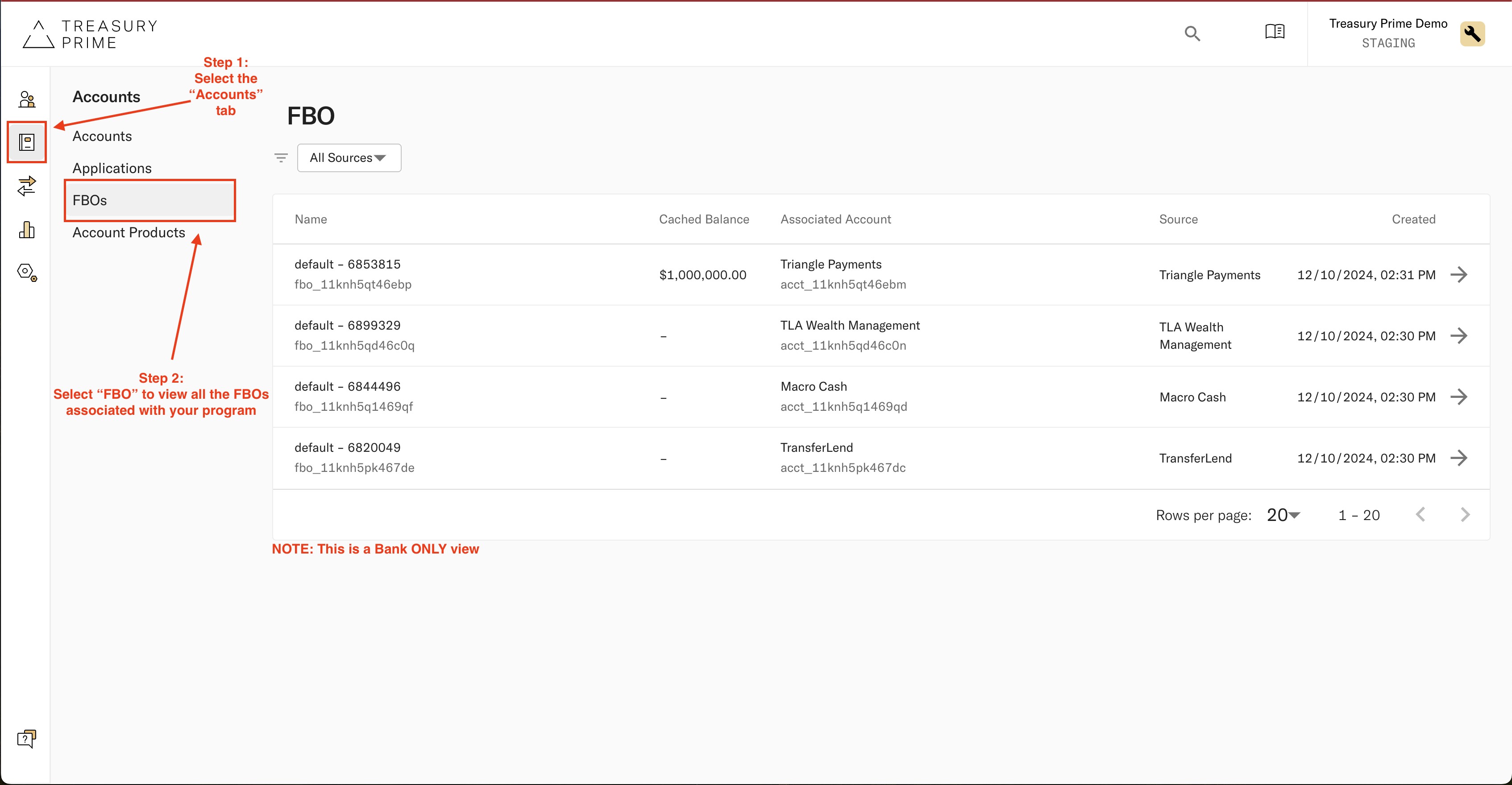
The bank-direct product gives a bank tools to find, onboard, manage and service fintech customers itself. BankOS is the larger package: embedded banking software, digital banking, open banking interfaces, reporting and controls. The important architectural claim is a direct integration with the bank's core system and a bank-facing view of accounts and transactions. Treasury Prime describes a “side core” that can sit beside a legacy bank core, so an institution can add capabilities without replacing the old one on day one.
This is less glamorous than an app screenshot and more consequential. If a payment is disputed or balances need reconciling, the bank needs to see the account structure and the movement of funds. Treasury Prime argues that a bank's oversight should be part of the operating software, visible in a console and reflected in the data, rather than an occasional report from a vendor. Its own product materials claim one-to-one transaction entries between its ledger and the bank core. That is a design claim, not a guarantee against every operational failure, but it says where the company believes the control belongs.
customer experience
APIs + Console
accounts + oversight
One bank is a start, not a plan
A fintech can outgrow a single bank's capacity, risk appetite or product range. Treasury Prime's OneKey Banking is meant to let a company work across more than one partner bank through a common ledger and technical interface. The company introduced it before the 2024 reset, and the logic survived: scaling a financial program should not require rebuilding the whole experience each time another bank joins. Its separate enhanced deposit insurance offering uses bank partners and deposit sweep networks; the two products should not be confused.
The bank network has grown. Treasury Prime said it had 16 banks when it announced its Series C in 2023. KeyBank joined in 2025. In January 2026, Treasury Prime announced i3 Bank and Coastal and described a network of more than 20 financial institutions. Its site cites more than $10 billion in new deposits across partners. In July 2026, Dean reported $170 billion in trailing annual money movement across more than 100 million transactions and 4 million-plus accounts. Those are company-reported measures, useful as scale markers rather than audited proof that any one bank program will succeed.
There is a real customer behind the infrastructure. In June 2026 Treasury Prime also introduced Prime Cash with Green Dot, letting fintech users add cash to digital accounts at participating retail locations. Sydecar, which automates parts of private investing, launched with Treasury Prime and Grasshopper Bank in 2023. It uses commercial checking, ACH and wires to move investment money through a workflow that would otherwise involve more manual coordination. Sydecar says the integration helped lower investor transaction fees while preserving its margins. The interesting result is not that banking disappeared; it is that account opening and payments became ordinary parts of the investing product.
A marketplace with a gatekeeper
In December 2025, Treasury Prime added an AI Marketplace. It says banks can screen a curated pool of more than 3,600 fintechs by industry, stage, location and risk appetite. There are 13 industry verticals, including payments, real estate and health care. The software can suggest a match, but a bank still decides which prospects fit its strategy and which contracts to sign. The new product makes the company's old matchmaking work more structured and keeps the decision with the institution.
That is also where Treasury Prime differs from a generic API gateway. Its wager is that the valuable customer is the bank with a balance sheet, a compliance team and a long memory. Other BaaS providers, direct bank integrations and in-house builds remain alternatives. Treasury Prime's pitch is specific: the bank should own the fintech relationship and have the operating tools to prove it. This approach works best when a bank actually wants to run an embedded program, has people who can supervise it and is prepared to choose partners deliberately. Software cannot substitute for those judgments.
The business model has shifted with the buyer. An older public FAQ described usage-based API pricing and interchange sharing for fintech programs. Treasury Prime does not publish a current bank-direct price schedule. Its financing is clearer: a $9 million Series A in 2020, a $20 million Series B in 2021 and a $40 million Series C in 2023. The 2024 layoffs show that capital did not spare it from changing course. They also make the pivot a more useful case study than a frictionless growth tale.
There is something almost comical about the obviousness of the conclusion. The bank was in the diagram all along. It held the charter, the accounts and the obligation to answer for them. Treasury Prime's most interesting move was to rebuild its business around that fact. Anyone designing a partnership platform can copy the principle: identify the party that bears the durable risk, give that party real visibility and control, and let the interface serve the relationship instead of hiding it.