A bar at full tilt does not care about your title. Someone wants a drink, someone else wants the check, a server is waiting, the kitchen is improvising, and every small delay becomes public theater. Michael Klozotsky spent years behind that counter. Long before he became Chief Marketing Officer at IMO Health, he learned to watch the whole room while still paying attention to the person in front of him.
He now talks about the bar as a working system. Line cooks and dishwashers serve internal customers. Servers face external ones. The bartender makes things, manages traffic, reads people, and keeps the machinery moving. Replace the glasses with dashboards and the resemblance to an executive meeting becomes difficult to miss. A CMO serves buyers, certainly, but also sales, product, finance, the chief executive, and the board. Everyone arrives with a different order. Everyone believes theirs should be next.
It is an unusually earthy model of leadership. No baton. No podium. Plenty of cleanup. It also explains why Klozotsky's résumé makes more sense as a collection of rooms than a corporate ladder: English classrooms, academic hallways, bar shifts, a financial-services newsroom, healthcare companies large and small, IBM, and finally the company now known as IMO Health.
The teacher never left
Klozotsky grew up around teachers and expected to become one. He studied English, earned a bachelor's degree from the University of Evansville, then a master's from the University of Illinois Urbana-Champaign. He spent years in academia. The life looked like a calling until its economics and changing structure forced a practical reconsideration.
The career changed. The central verb did not. When Klozotsky describes the move from individual contributor to leader, he reaches for the language of teaching: remove roadblocks, share experience, help people solve complicated problems. Showing someone how to operate a tool is a tutorial. Helping someone understand the choice in front of them is teaching. The distinction matters in marketing, where software can produce an impressive quantity of activity without producing much judgment.
His affection for “weird” has a precise meaning. It is not random behavior in colorful socks. It is the instinct to find another frame. At a fork, most people debate left or right. The useful eccentric turns around, makes a U-turn, or asks why the road was built there. Klozotsky worries that companies often hire a role-shaped candidate rather than the human being who will think inside the role. His own career is the exhibit for the defense.
academia
finance
imaging
CMO
A byline before the brand line
In 2008, Klozotsky appeared in trade coverage as an analyst at Kaulkin Ginsberg, discussing what web-based personal records could mean for accounts-receivable strategy. By 2011 he was managing editor of insideARM, writing through the publication's Forbes contributor channel. He covered debt collection, consumer finance, business, and politics with a habit of letting the odd detail carry the argument.
A column about the bankruptcy of former NFL quarterback Charlie Batch detoured through Super Bowl rings, Dorothy's ruby slippers, Bob Dylan, and Klozotsky's lifelong loyalty to the Green Bay Packers. Another, about Verizon billing a deceased customer, came dressed as a zombie story. The jokes did not erase the systems underneath. They made those systems visible.
His 2013 piece about a hospital program that allowed pet visits moved from healthcare economics to his own household census: two cats, a Whippet, an Italian Greyhound, a mutt named Flannery, and Carl the goldfish. When he asked his partner whether the perk would affect her choice of hospital, the answer was a succinct “duh.” It is difficult to make revenue-cycle strategy feel inhabited. A dog scheduling a visit managed it.
That period supplied two assets a technical marketer needs: an ear for the sentence and a tolerance for unglamorous complexity. Klozotsky became chief content officer of insidePatientFinance.com and insideARM, then moved through marketing leadership at Accretive Health, now R1. At Merge Healthcare, he handled communications in the period surrounding IBM's 2015 acquisition. He later led global marketing for medical imaging inside IBM Watson Health, working with an integrated team on artificial intelligence and enterprise imaging for provider organizations.
The business of making complexity legible
Klozotsky joined IMO Health in February 2019. The company's raw material is clinical language: the terms, codes, mappings, and data structures that allow information to move through healthcare systems with its meaning intact. This is a category where a marketer can drown an audience in nouns before reaching a verb.
His response is to pull the conversation up a level. What problem are we solving? What outcome should change? What does the customer need to understand? In a 2020 article about the time physicians spend in electronic records, he refused the easy argument over whether the tool itself was good or bad. His “essential question” was how health-information-technology companies could continually improve what they build to enable the outcomes people actually want.
That question has followed him as clinical data and artificial intelligence have become inseparable boardroom subjects. Features change quickly. The teacher's problem remains stable: turn mechanisms into choices without pretending the mechanisms are simple.
A practical division of labor
Conceptual, not quantitative: people frame the worthwhile problem; technology accelerates execution and distribution; undifferentiated volume earns little space.
Klozotsky sees genuine efficiency in AI, particularly in execution and distribution. He is more guarded about handing ideation to the machine. When everyone uses similar systems to make similar material, the result starts to converge. The useful arrangement gives each participant a job: humans bring judgment and original perspective, technology provides leverage, and outside partners contribute reach or expertise the internal team does not possess.
Skip the dating game
His test for agencies begins with fluency. A partner should already understand the market, its vocabulary, and its important relationships. Klozotsky does not want to spend the opening months playing what he calls the “dating game.” A capable specialist can drink from the fire hose, absorb the context, and begin helping. A generalist spread “five miles wide and one inch deep” may be intelligent and still wrong for the problem.
This is not merely a procurement preference. It belongs to the same philosophy as his hiring. A press release is easy to produce. Access, judgment, and a clear reading of the market are harder. The value of a partner lies in the parts that cannot be summoned by asking for more output: trusted relationships, precise context, and the ability to simplify without sanding away what matters.
A larger room
Klozotsky's leadership extends beyond the company. From May 2018 through May 2024, he served on the executive board of Arts of Life, a Chicago organization built around artists with intellectual and developmental disabilities. He was president of its board from March 2023 to May 2024. Public filings record the role as unpaid. The organization describes its work in terms Klozotsky might appreciate: artistic practice, leadership, equality, and collective space.
There is a satisfying symmetry here. In business, he argues for seeing the human inside the prescribed role. In civic life, he supported a community designed to expand who gets to be recognized as an artist and leader. His long board tenure suggests more than a ceremonial attachment. It occupied six years alongside an expanding executive job.
The sequence also complicates the familiar idea that a leader becomes interesting only after reaching the large office. Klozotsky's public voice was already present in the early bylines, complete with pets, football, and jokes that knew when to get out of the way. The later titles added scope, not a replacement personality. That continuity matters. Plenty of executives learn to speak in approved paragraphs. His work suggests the reverse discipline: keep enough of the writer, teacher, and bartender alive that an approved paragraph still sounds as if a person noticed something.
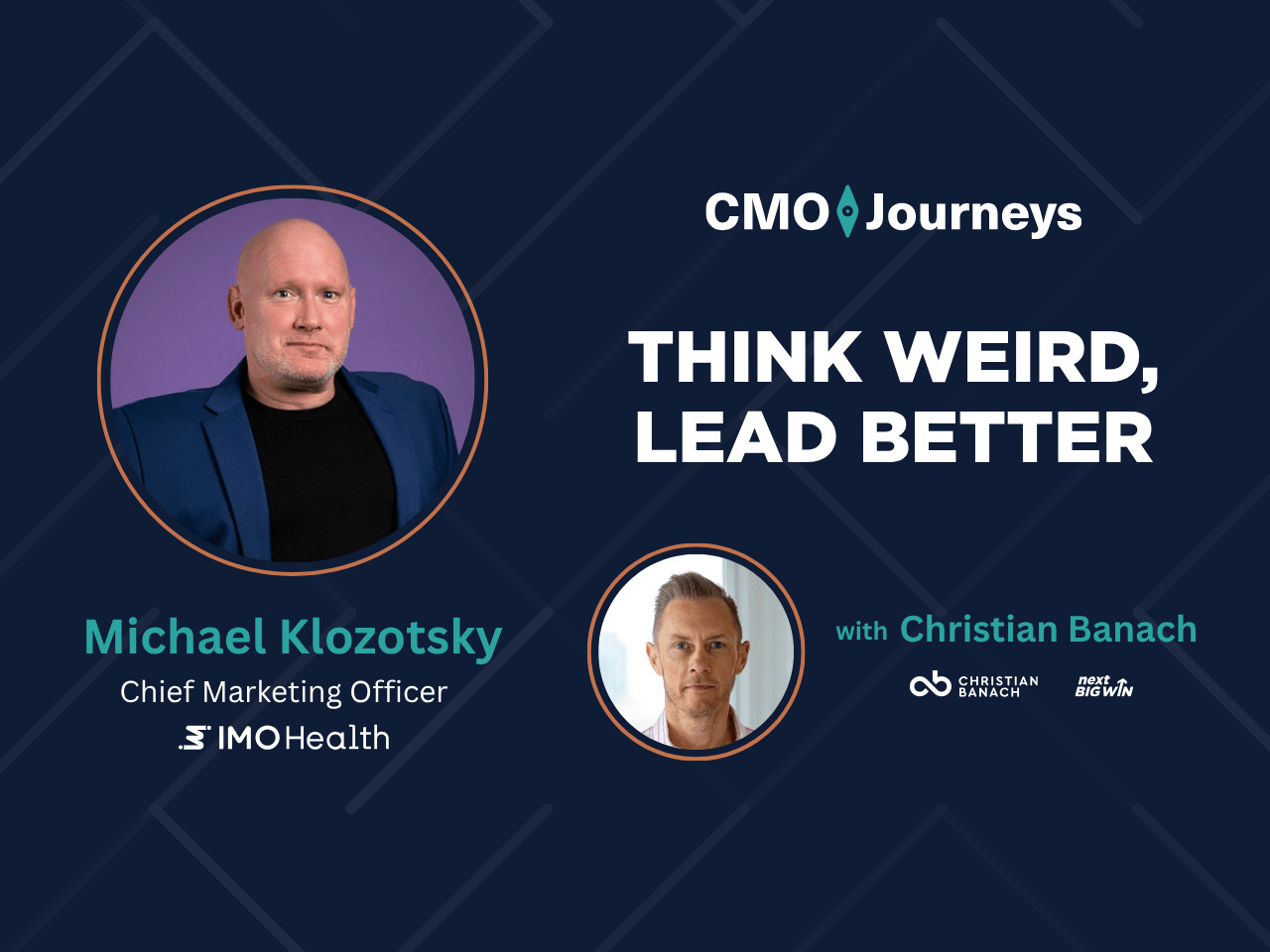
By the time Klozotsky sat for a CMO Journeys interview in June 2026, the pieces of the résumé had stopped looking like detours. Teaching trained him to clarify choices. Bartending taught him to scan the system. Editing sharpened his voice. Startups exposed the whole machine; IBM exposed scale. Arts of Life widened the definition of leadership. IMO Health gave those habits a dense technical subject worth translating.
The attractive lesson is not that every odd job secretly guarantees an executive office. Careers do not distribute morals so neatly. It is that experience transfers when someone takes it seriously enough to name what was learned. Klozotsky carried the classroom into the meeting and the bar into the operating model. He kept the humor from the newsroom and the appetite for the stranger question.
A straight line can be efficient. A side door offers a different education: you enter the room knowing it has more than one way in. Then, if you are doing the job well, you remember to hold it open.