Marisa Johnson has spent her career in a part of business where the nouns arrive already wearing lanyards: demand generation, clinical communications, revenue integrity, documentation improvement. At SmarterDx, where she is Chief Marketing Officer, the vocabulary gets denser still. The company builds clinical AI that reviews hospital records and surfaces details that may matter to coding, quality, or claims. The work lives among physicians, data scientists, finance teams, and software engineers. Johnson's job is to make that crowded room intelligible without pretending it is empty.
Her public test for good writing is almost comically direct. In a 2024 recruiting post for a content marketing manager, one requirement read: “writes like a human not a bot.” The rest of the list was serious - B2B experience, ownership of a content function, and useful fluency in healthcare technology and analytics. Then she tossed in custom Slack emoji skills as a joke. It was a small piece of hiring copy, but it showed the operating system: standards can be exacting and the prose can still have a pulse.
Johnson works from the Greater Minneapolis-St. Paul area, far from the generic glass-tower image of enterprise software. Her official biography lists the outdoors of Minnesota, reading, and travel among her interests. She has a husband and two daughters. In her own writing, the scene gets more specific: a late hour, too much caffeine, a Taylor album, and an unruly stack of Slack messages, email, and Asana tasks. The details do not dilute her authority. They explain the person doing the translating.
A journalist enters the machine room
The shape of Johnson's career makes sense once you notice where it began. She earned a Bachelor of Science from Concordia College, then a Master of Science in Journalism from Northwestern University's Medill School. Journalism trains a person to ask the embarrassing useful question, find the active verb, and notice when an expert has answered something adjacent to the thing that was asked. Those habits travel well in healthcare technology, a field where precision is essential and shorthand can quietly exclude everyone outside the specialty.
Her early professional path crossed several sides of healthcare communication. She spent time at the American College of Healthcare Executives, an organization built around the people who run care institutions. She worked at Spok, whose clinical communication products sit inside the daily choreography of hospitals. Later, she helped grow healthcare startups within UnitedHealth Group Ventures and Optum Labs. Each stop added a different audience: executives, clinical teams, venture builders, technologists, and customers trying to decide whether a new tool belongs in an old workflow.
This is useful preparation for marketing a product that does not live alone. Clinical AI arrives inside existing responsibilities, software, review processes, and financial constraints. A buyer does not merely ask whether the model works. The buyer asks what data it sees, where it enters the sequence, what the team must validate, how a recommendation is defended, and how the investment shows up in operations. The marketer who ignores those questions produces fog. Johnson's background points toward the opposite impulse: put the mechanism on the page.
The art of opening a technical door
SmarterDx describes an average discharge as a record containing roughly 30,000 data points. The platform is designed to review that record after coding and documentation work but before billing, then present findings with supporting evidence for a human team to validate. That sequence is the story. It gives a reader a beginning, a handoff, and a consequence. Acronyms become less intimidating when they are attached to motion.
The translator's route
Johnson once wrote that her first reaction to SmarterDx was a fork: either the product was not real, or it was healthcare's best kept secret. She chose the secret, then later observed that the secret had begun to travel. The line is playful, but the situation is familiar to anyone building in a technical category. A product may have evidence and enthusiastic users while remaining difficult to explain. Marketing does not manufacture the evidence. It builds the path by which evidence reaches another person.
There is a portable lesson here for B2B marketers. Start with the actual work. Show where the product enters, who touches it, and what changes after it leaves. Numbers help, but only when their unit and context remain attached. Humor helps, but only when it does not trivialize the stakes. Above all, let the people closest to the work remain visible. Johnson's public communication repeatedly brings clinicians, provider organizations, product colleagues, and customers into frame.
Her team-building language follows the same pattern. When Johnson advertised a remote content role, she did not ask for generic passion. She asked for prior ownership of a B2B content function and experience writing for a business audience. Familiarity with health information technology and AI counted as an advantage. So did comfort with GA4, Asana, and Figma. The list connected craft to instruments: the writer would need judgment, but also a working relationship with measurement, production, and the people moving a campaign through the company.
That combination is easy to underrate. In enterprise healthcare, content can be expected to educate a reader, support a sales conversation, withstand an expert's scrutiny, and survive review by several internal constituencies. A lively sentence alone cannot do all that. Neither can a spreadsheet. Johnson's career sits at their junction. Journalism supplies the instinct to clarify. Demand generation supplies the obligation to produce a result. Communications supplies the patience to keep a message coherent as it passes between teams.
The scale around her has changed. SmarterDx now describes a fully remote group of more than 500 people serving over 85 health systems. Growth turns communication into organizational plumbing. A message must travel across functions as well as out to the market. Johnson's public posts about hiring, product openings, gatherings, and colleagues show that the marketing voice is also a culture voice. It tells prospective employees what the company notices, what it rewards, and how seriously it takes itself.
Credit as a leadership practice
In 2025, Slice of Healthcare named Johnson one of its Unsung Heroes in Digital Health. Her response began with surprise and quickly moved the spotlight. She called clinicians and provider teams the real heroes, praised colleagues at SmarterDx, and joked that she was trying to keep up with them. She also celebrated being recognized alongside Amber Bullis, a marketer she had admired since their paths crossed a decade earlier.
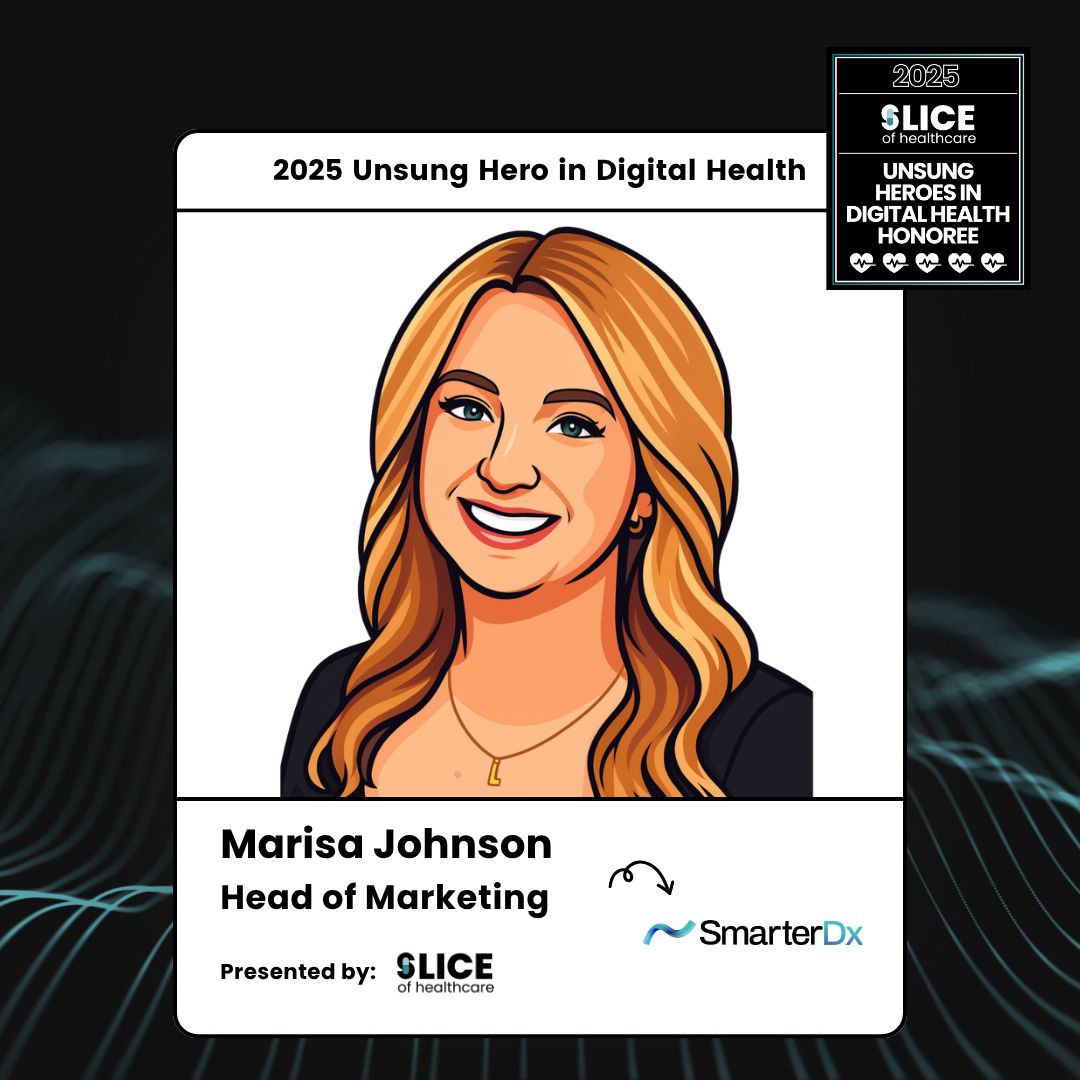
The response did more than perform modesty. It revealed how she thinks a story should distribute agency. The marketer may frame the narrative, but the subject is the work and the people doing it. That matters inside a company, too. Publicly, Johnson has recruited marketers, amplified product openings, and cheered colleagues. A recommendation on her professional profile describes a leader who aligns marketing with business priorities while creating room for fun, creativity, and accountability.
Her own recognitions stretch back further. Her profile lists Spok President's Club recognition in 2017 and a Mobile Growth Award for Best Covid Adaptation in 2021. Yet the more revealing achievement may be continuity. Across an association, a clinical communication company, venture-backed healthcare businesses, a research and innovation environment, and an AI company, she stayed with the same difficult subject long enough to understand its dialects.
The person left in the prose
Executive writing often gets polished until no fingerprints remain. Johnson's voice keeps a few. There are astronaut jokes tied to the company's space motif, a wink about a supposedly secret product, emojis that behave like stage directions, and admissions that the task list is winning. Her professional posts still carry commercial intent, but they do not pretend to have floated down from a committee.
That voice is particularly useful in healthcare AI. The category attracts grand abstractions and anxious questions in equal measure. Johnson's approach, at least in public, is smaller and sturdier: explain the workflow, show a number, name the team, make a joke that only a colleague would make. She does not need to personify the algorithm. She keeps the people around it from disappearing.
Her stated passion is advancing accessibility, efficiency, and quality in healthcare by telling stories about work aimed at those goals. It is an aspiration well matched to journalism training. The journalist searches for what happened. The marketer asks why it matters. The executive decides how a team will keep doing both at scale.
In Minneapolis, the outdoors waits beyond the laptop. There are books to read, places to travel, two daughters growing up, and presumably another Taylor track queued somewhere after dinner. Then there is the work: 30,000 data points, a skeptical buyer, an expert with five acronyms, and a blank page. Johnson's advantage is not that she makes the machinery vanish. She gives it a door, labels the handle, and invites a human being through.