At four in the morning, Michael Karnjanaprakorn was awake and building again. He had spent years trying to decide what should follow two startups, an acquisition and a sabbatical. Now an AI agent had given him a reason to get out of bed. He called it Igor. In a career that had involved recruiting teams and raising capital, his new chief of staff required neither an interview nor a corner office.
“I woke up at 4am to tinker and build,” he wrote in February 2026. He described the attraction as excitement rather than an exercise in getting ahead of the day. By May, he reported 425 GitHub commits in a month. By October, he had introduced Slash, a productivity app he had made for himself. The former CEO was enjoying being the person who could simply make the thing.
There is a particular comedy in this return. Karnjanaprakorn helped start Skillshare to make practical learning available beyond the classroom. His next company, Otis, let people buy fractions of cultural objects they could rarely afford outright. Now he was testing a newly accessible skill himself: building software. The question following him had become more personal. What size of success would he actually want to live inside?
A classroom with no instructions
He was born in Virginia and raised in Korea, with a Korean mother and a father from Thailand who served in the military. He returned to Virginia while growing up. His formal education included economics at the University of Virginia and a master's in advertising at VCU Brandcenter. The future advocate for alternative education had collected a fairly conventional set of qualifications.
One classroom experience stayed with him. A creative-thinking teacher arrived, announced an assignment about “gum,” and left. The students had a prompt and almost no instructions. They responded with sculptures, an invented product and a short video. Presentations lasted a minute; the criticism could be equally brisk. Karnjanaprakorn remembered learning to revise an idea without treating it as a treasured family heirloom.
His early working life also involved finding ways into rooms. In New Orleans, he worked at advertising agency Trumpet and volunteered with Idea Village. In New York, he worked with Scott Belsky at Behance and helped launch its 99% initiative. In 2008, he and Jerri Chou started The Feast conference after he found TED tickets beyond his budget. If admission was too expensive, apparently another option was to organize the event.
The teacher was already in the room
Skillshare began in November 2010 and went live in April 2011. Karnjanaprakorn and co-founder Malcolm Ong were proposing a marketplace in which ordinary practitioners could teach what they knew. Early classes brought people together in person. Someone with a useful skill could become an instructor; someone curious could buy a place. A classroom no longer needed an institution attached to it.
The proposition sounds familiar now. At the time, he pitched investors an education equivalent of Etsy. The early offering included affordable, practical classes rather than another expensive credential. Its challenge was to make a market: find enough teachers to attract students, then enough students to make teaching worthwhile. A convincing educational philosophy still needed somebody to show up on Tuesday.
At Behance, Karnjanaprakorn had watched network effects operate close up. He later described carrying that lesson into Skillshare by concentrating on engaged teachers. Teachers who committed to the platform attracted students and had reasons to return. In his account, that working experience mattered more than studying a diagram of how a marketplace ought to behave. A flywheel is a handsome object on a slide; somebody still has to push it.
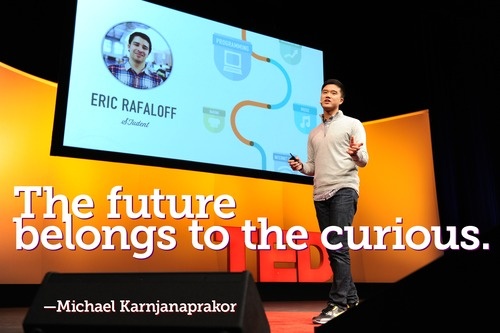
In 2012, he became a TED Fellow and appeared on Fast Company's Most Creative People list. But the teaching idea was more interesting than the distinctions. He described students meeting in study groups around an online class, working through ideas together. Watching was only part of learning. The work happened when people tried something and could see what they had made.
A small piece of something expensive
Otis moved the access question from education to ownership. Founded in 2018, it offered fractional interests in art and collectibles. A person who could not buy an entire sought-after work could participate in owning part of one. Sneakers, comics and other cultural objects could be approached through the machinery of an investment platform.
His original ambition included a physical gathering place. He imagined a community-owned museum and planned to display objects in New York's East Village. He wanted works to be seen rather than disappear into storage. The cultural attachment mattered alongside the financial interest: people could have a relationship with an object without being its sole, extraordinarily well-funded custodian.
The idea also contained an awkward question. Would someone prefer a fraction of an expensive work they could visit, or a less expensive picture they could hang at home? Karnjanaprakorn considered those desires compatible. Otis occupied the space between collecting, investing and belonging to a community. It asked people to care about the object while giving them a very different kind of ownership.
Public acquired Otis in March 2022. That puts a definite event on the career timeline, but it does not settle the more interesting question of what the second company meant to its founder. An acquisition can conclude a transaction. Deciding what to do with the experience takes longer, especially when the next opportunity arrives before the previous one has been properly considered.
The applause problem
In a 2024 conversation with investor Rob Go, Karnjanaprakorn considered an uncomfortable motivation behind building again: proving the first company had been more than luck. The desire for repeat success had encouraged him to move ahead without enough time to explore and evaluate his next idea. Experience had brought confidence, along with another audience to satisfy.
Go acknowledged his own part in the problem. Wanting to work with a founder he admired had affected his objectivity about Otis. Supportive feedback could make the next decision harder to judge. The room was full of encouragement precisely when a less agreeable response might have been useful. Reputation, for all its conveniences, can become a rather expensive soundproofing material.
Karnjanaprakorn's essay “Repeat Founder Cycle” treated the post-company years with a dry eye. Freedom, travel, investing, hobbies, advising and the thought of a podcast could eventually lead back to another company. He placed himself near the end of that loop, oscillating between a calm business and an ambitious one. He had recognized the pattern while still being susceptible to it.
“I derive energy from thinking, not necessarily doing.”
Michael Karnjanaprakorn, January 2026
A life with more than one tab open
His response included experimenting with a personal holding company. In 2025, he described Choop as a home for unusual ideas. The model offered room for different activities rather than another all-consuming bet. His proposed possibilities included content, investing, acquired software businesses, incubation, creative work, philanthropy, property and local projects. It was an exploration list, with an explicit expectation that he would pursue only a few.
The attraction was control over allocation: time, capital and attention could move between projects. A small core team could support several activities, and profits might fund future work. He had spent years concentrated in individual companies. This structure offered a way to remain entrepreneurial while allowing his interests to change. Diversification could apply to a working day as well as a portfolio.
His stated ambitions became wonderfully specific. He wanted meaningful work, time with family and summers in Europe. He launched The Karnjanaprakorn Show in October 2023 to explore the next phase after his startup career. His newsletter, Tings, gave him another place to think in public without having to turn every thought into a company.
The personal details keep the business vocabulary in proportion. He likes Magic: The Gathering, UFC, The Wire and Land Rover Defenders. He dislikes brioche buns and people who play audio in public without headphones. The latter is a modest civic platform on which an astonishing number of people could agree. Curiosity can be expansive while one's tolerance for somebody else's speakerphone remains admirably small.
Back to making, with fewer meetings
Magic has also supplied him with a way to think about work. In “Rate of Learning,” he described competitive play as practice in adaptation: experienced players see patterns and consequences that beginners miss. He applied that observation to his own apprenticeship inside startups. Being involved in decisions gave him feedback he could use. Learning required exposure to what actually happened next.
His 2026 experiments put that preference into practice. In May, he described making Ideal Day for his wife, with travel itineraries, saved places and shared recommendations. He also acknowledged the less photogenic part of building with AI tools: spending substantial time repairing what broke. The enjoyment survived the troubleshooting. An experienced product founder had found a new way to be a beginner.
Slash followed in October. He had been juggling dictation, snippets, notes and AI commands across separate tools, and built an application around his own workflow. Its initial approach kept data on the user's computer. He presented it as an experiment, without a predetermined business model, and said continued investment would depend on whether people found it useful. Making something he wanted was already a return.
Three days later, his essay “Dead Zone” argued that small software businesses could bootstrap while technically demanding ventures needed substantial capital. Trouble came from financing an ordinary software business as though it needed venture-scale outcomes. He was still interested in ambition. He was asking founders to choose a financial structure that matched the work.
That brings the story back to the early classroom: a prompt, an experiment, an opportunity to revise. Karnjanaprakorn has spent much of his career widening the circle of people allowed to participate. His latest work lets him participate more directly himself. For now, the useful measure is unusually close at hand: an app he opens, an idea he can try, and a morning when he wants to get up and build.
Keep following the experiment
Essays, conversations and places to find Michael.