A sushi restaurant is an unlikely sequel to a group messaging app. Yet for Jared Hecht, the distance between the two was a family conversation. His wife’s cousin had a growing restaurant business in Ohio and wanted money to expand. Hecht wanted to invest. The cousin wanted to keep his ownership. A bank loan ought to have settled the matter. The banks had other ideas.
By then, Hecht had already experienced the sort of startup ending that tends to obscure everything before it: GroupMe, the messaging company he co-founded with Steve Martocci in 2010, was acquired by Skype in August 2011. An app for getting friends together had become an acquisition story in roughly fourteen months. The restaurant presented a less glamorous puzzle. People wanted sushi. The business wanted another location. Why was financing so difficult?
That question became Fundera. More than a decade later, Hecht is a venture partner at Union Square Ventures, and he is building products about friendship and family stories. His career has crossed messaging, lending and investing. Look closely, though, and the starting points stay remarkably domestic: a concert, a relative’s restaurant, a conversation with your parents. The problems arrive without a pitch deck.
A concert needs a better reply-all
GroupMe began with a complaint from Carrie Weprin, then Hecht’s fiancée. Keeping track of friends at concerts was awkward. The solution Hecht and Martocci pursued worked through ordinary text messaging, allowing a group to talk together even when its members had different kinds of phones. In 2010, that last detail mattered. A friendship group could hardly be expected to agree on a handset before agreeing on a bar.
Hecht had studied political science at Columbia, graduating in 2009. While there, he ran the student-written city guide Inside New York as publisher and managing director. He also managed touring bands and ran a marketing and production business between classes. The combination put audiences, logistics and getting people’s attention into his working life before venture financing entered the picture.
His publishing work helped catch the attention of Tumblr president John Maloney, who recruited him. At Tumblr, Hecht worked in business development, including partnerships and international expansion. He later described himself as employee number eight. The move from a student guidebook to a young internet company looks less surprising when both involve persuading people that something is worth returning to.
Hecht and Martocci built GroupMe at the first TechCrunch Disrupt hackathon in New York. They took the working product to investors in a pleasingly literal fashion: put the investors into a group, start sending messages, then use the conference-call feature. The demonstration was also the distribution mechanism. To appreciate it, another person had to join you.
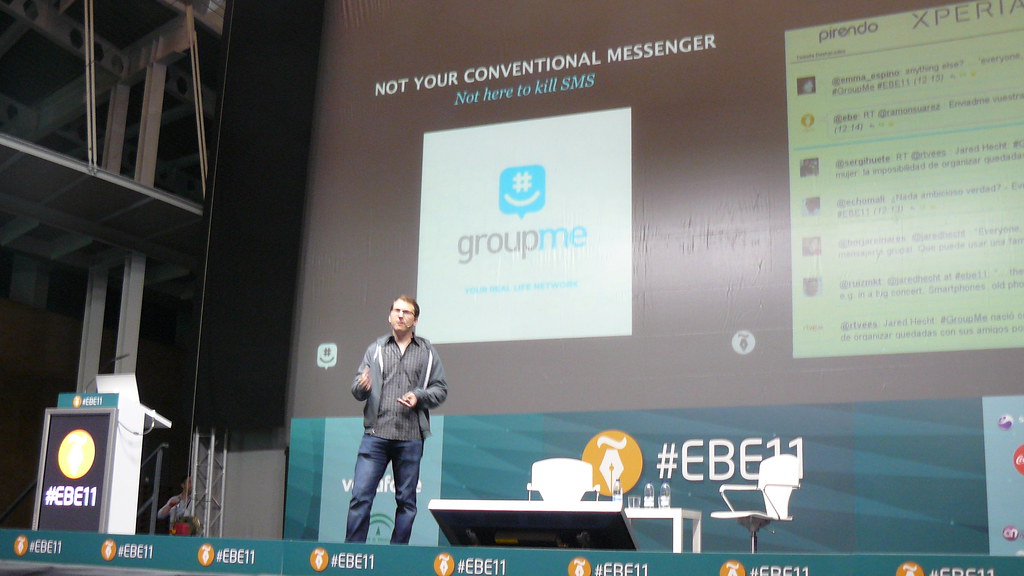
The demo that demonstrated too much
A working group chat also had a disadvantage: it contained what the group had actually said. During an early fundraising trip, Hecht and Martocci met Sequoia investors and came away feeling certain the firm wanted to lead their next round. They reported their enthusiasm to colleagues in the team chat, with the swagger of founders receiving more attention than they had yet learned to handle.
Two hours later, a teammate opened that chat during a live conference demonstration. The boast about Sequoia appeared on the screen. Hecht has since retold the episode as a lesson in how young founders can get ahead of themselves. The team asked for the demonstration video to be taken down. Sequoia eventually passed on GroupMe and invested in WhatsApp. Time supplied a rather expensive punchline.
There was more to GroupMe’s growth than memorable demos. Hecht described an average group of six people, with members forming further groups of their own. Partnerships with festivals including Coachella and Bonnaroo placed the service where its original use case was already happening. A festival could leave a visible patch of new users behind it. The product traveled home with the audience.
In August 2011, Skype acquired GroupMe. Microsoft’s acquisition of Skype followed that October. The sequence matters: GroupMe’s buyer was Skype, with Microsoft becoming the parent afterward. For Hecht, the speed of the outcome left a surprisingly unfinished feeling about the kind of business he wanted to build next.
Sushi, ownership and a longer clock
The restaurant chain was Fusian. Hecht’s relative wanted financing without selling equity, a reasonable preference that exposed a gap between the venture-backed world Hecht knew and the options available to an ordinary business owner. Searching online introduced another problem: a thicket of lenders whose legitimacy, prices and terms were difficult to compare.
Hecht left GroupMe in September 2013. Fundera, co-founded with Andres Moran and Rohan Deshpande, launched in February 2014. Its proposition was practical: let an owner submit a common application, compare potential financing and receive help choosing among offers. A business owner already had a business to run. Becoming an amateur lending analyst was an unwelcome second occupation.
By 2017, Hecht described a network of thirty lenders, software that matched applicants to suitable products, and a customer team that helped borrowers compare offers. Fundera earned fees from lenders when loans were funded. It also published explanations and tools for owners navigating unfamiliar financial decisions. The comparison service and the educational material addressed different parts of the same confusion.
Hecht had been thinking about duration as much as distribution. After GroupMe, he admired entrepreneurs who stayed with demanding, unglamorous businesses over years. In 2014, he wrote that he wanted Fundera to endure. A quick sale had given him the freedom to attempt something slower; it had also given him a reason to want the slower work.
A sale with work still attached
NerdWallet announced its acquisition of Fundera on October 30, 2020. By the announcement, Fundera had helped more than 85,000 small and medium-sized businesses secure financial products. NerdWallet brought a larger consumer-finance audience and an established comparison business. Fundera brought relationships with lenders, business owners and the people who helped translate between them.
The acquisition also carried a less tidy financial structure than a single headline number suggests. NerdWallet disclosed $29.2 million in closing consideration and the possibility of up to $66 million more, tied to later performance. Those were transaction terms for the company. They describe how the deal was structured, with part of the consideration dependent on what happened after the signatures.
For a founder who had wanted a longer undertaking, the chronology is telling. The interval from Fundera’s public launch to the acquisition was more than six years, compared with roughly fourteen months from GroupMe’s beginnings to its sale. Two exits can fit neatly into a biography while representing very different working lives.
Keeping his head up
In January 2024, Hecht joined Union Square Ventures. He arrived with experience as an angel investor in more than eighty companies and venture funds. His investments had included Sweetgreen, TransferWise and Codecademy. He had spent years learning through other founders even while carrying responsibility for his own companies.
His explanation for the move was unusually candid about the trade-off in founding. Concentrating on one problem for a decade can produce something substantial. It can also narrow the view. I want to keep my head up
, he wrote. Investing offered him room to pursue several connected ideas and work alongside entrepreneurs taking responsibility for their own outcomes.
That role continues. In October 2026, USV included Hecht in the core investment team accompanying its announcement of $900 million in new funds. The firm highlighted the building experience he brought alongside other founders who had joined its team. His own recent activity suggests that advising builders has left plenty of room for making things himself.
“I want to keep my head up.”
Jared Hecht, on joining Union Square Ventures
The park keeps turning up
Long before GroupMe, Hecht won the 1999 National Elementary K-6 chess championship. Chess remains a specific, persistent pleasure. He plays speed chess online and has written about visiting Washington Square Park with his mother and two friends during a childhood tournament trip. They sat at the stone tables, played the regulars and enjoyed the surrounding theater.
His recollection lingers on spectators, banter and small wagers. He wants an online experience that captures that atmosphere, with games that people can watch together and stakes low enough to preserve the fun. Chess, backgammon and mahjong all figure in the possibility. The interesting detail is his insistence on the crowd. A board and legal moves alone would leave out much of what he remembers.
In a 2010 questionnaire, asked where his entrepreneurial instincts came from, he answered, “Jupiter.” Asked what achievement made him proudest, he named his chess championship. The answers sit nicely together: a little mischief, followed by something exact. He can enjoy the joke without abandoning the score.
Something worth sending home
In 2026, Hecht introduced Postcards, built with colleagues he had worked with for more than a decade. It combines photos, voice notes and text into small updates for friends and family. His interest lies in the space between the public broadcast feed and the private group chat. Trips, children and ordinary days supply the material. The audience is people you already care about.
Biographer begins with a similarly personal impulse. Hecht started building it as a gift for his parents, to help record their life stories through conversation. The project uses AI to turn spoken recollections into written chapters. His stated ambition extends to family collaboration and other ways of experiencing those memories, including audio and photographs.
In July, he introduced Biographer Wiki: a private page that grows from the stories a person shares, with publication left to that person’s choice. His argument is plain: “Everyone is notable.” By October, the team was refining the writing experience and a printed hardcover book. The appeal is easy to grasp. A parent’s story can be worth keeping even if nobody has ever offered to acquire it.
Hecht’s path now loops back toward GroupMe’s original territory. Friends need somewhere to share their day. Families need a way to preserve a voice and a story. A chess game needs a few people leaning over the board. After the financing rounds and the acquisitions, he is still interested in what happens when somebody else joins in.
Keep reading & watching
- Ride It to the SkyJared’s writing
- Jared Hecht on LinkedIn
- Jared Hecht on X
- At Union Square Ventures
- Introducing PostcardsFriends, photos & voice notes
- BiographerThe project in his own words
- From GroupMe and Fundera to venture capitalWatch / Sourcery / 51 minutes
- Hecht & Martocci at Startup Grind New YorkWatch / The GroupMe years
- NerdWallet’s Fundera acquisition announcementOctober 2020
- The next chapter of USVOctober 2026
- Inside the design of BiographerLeslie Luo / October 2026