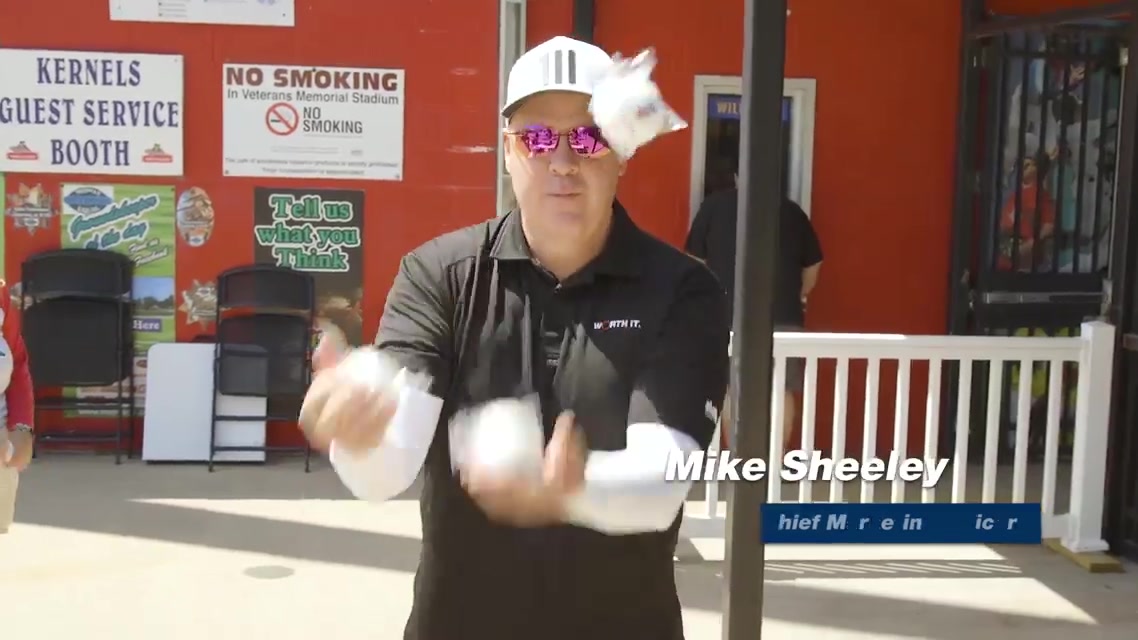
At a minor-league ballpark in Cedar Rapids, Michael Sheeley stands in sunglasses and a white cap, casually tossing a baseball from hand to hand. He is there for UFG Insurance, where he is vice president and chief marketing officer. The company is sponsoring the hometown Kernels. Children are getting baseballs. An intern is preparing to throw the first pitch. The whole production has the sunny, slightly unruly charm of an afternoon game.
This is not where Sheeley's UFG story began. That happened in 1985, at an underwriting desk. Nor is a ballpark the obvious place to explain the career of an insurance executive. It is simply a good place to see the job stripped of abstraction. Insurance is built from contracts, reserves and judgments about risk. A brand is built from moments people remember. At the stadium, a large financial institution becomes a person handing a child a ball.
Sheeley has spent about four decades learning both sides of that equation. His route to marketing passed through underwriting, personal lines management and the daily operations of a life insurance company. He did not arrive at the chief marketing officer's chair by studying the surface of the business. He moved through its machinery.
First, learn the promise
Underwriting is a useful beginning for someone who will eventually market insurance. The work asks whether a promise should be made, on what terms and at what price. It punishes vagueness. A story may be persuasive; a risk still has to make sense. That early discipline gave Sheeley a view of insurance from the point where appetite meets evidence.
He later became personal lines underwriting manager and an assistant vice president. The title brought management into the technical work. Now there were decisions to coordinate, budgets to mind and people to develop. The progression was not glamorous, but it was cumulative. Each assignment added a room to the same house.
Then came a bigger turn. In March 2011, Sheeley was promoted to vice president and chief operating officer of United Life Insurance Company, then a UFG subsidiary. The role put him in charge of day-to-day operations, a staff of 50 and an agency force of more than 2,700. The scale matters because operations makes promises physical. Processes have to run. Agents need support. A leader's bright idea eventually reaches someone's desk on a busy Tuesday.
Ramlo described Sheeley at the time as enthusiastic, dependable and strong in communication. More revealing was his emphasis on established relationships and profitable results. Sheeley was being trusted with a new business line because he had already shown that he could understand the institution, manage within constraints and earn confidence across its distribution network.
A career built by widening the lens
The sideways route to marketing
In 2018, United Fire & Casualty Company elected Sheeley a vice president, with the title VP - Corporate Marketing. Two years later he began serving as UFG's vice president and chief marketing officer. On paper, the move from life operations to marketing could look like a change of profession. In practice, the earlier jobs supplied the material.
An insurance marketer has to translate an invisible product. The policy sits quietly when everything is going well. Its value is tested later, under conditions nobody wished for. That puts a premium on credibility. Flourish without operational substance is soon exposed. Sheeley's experience gave him a working knowledge of the judgment behind the policy and the people behind its delivery.
His career also complicates the familiar idea that growth requires departure. Sheeley stayed with one company but did not keep one job. The institution provided a series of new problems: selecting risks, leading underwriters, running a business line, working with agents, shaping a corporate voice. Longevity became useful because responsibility kept changing.
Joins UFG Insurance as an underwriter.
Takes charge of daily operations at United Life Insurance Company.
Is elected vice president, serving in corporate marketing.
Becomes vice president and chief marketing officer.
Represents the UFG Foundation in a major hometown gift and appears at the Kernels promotion day.
The hometown is part of the job
Cedar Rapids is not a decorative line in the story. UFG was founded there in 1946, and Sheeley's public work repeatedly connects the company to its headquarters city. In April 2024, he represented the UFG Foundation when it presented its largest single gift of the year to United Way of East Central Iowa.
His phrasing is telling. The foundation does not replace employee action; it echoes it. A corporate gift becomes part of a two-decade local tradition rather than a standalone publicity event. Sheeley has used similar language when inviting insurance professionals to recognize peers for community service. Policies and premiums matter, he wrote, but so do meaningful connections and support when communities need it.
This is the part of marketing that cannot be automated into a content calendar. A company may choose to show up, repeatedly, where it lives. Over time, those choices become the brand whether anyone labels them branding or not. The United Way gift, the Go Beyond community-service award and the Kernels afternoon differ in scale, but they share a local grammar: institution, neighbor, habit.
The 2024 annual report of the Cedar Rapids Metro Economic Alliance later included Sheeley among the ambassadors thanked for community service. It is a small notation in a large report. Small notations are often how civic life keeps score.
What the long game teaches
Sheeley's public record is quieter than the usual executive mythology. There is no garage, no dramatic pivot and no promise to overturn an industry by Thursday. There is a degree in management from the University of Northern Iowa, a CPCU professional designation and a career built through adjacent responsibilities. The interest lies in the accumulation.
CPCU stands for Chartered Property Casualty Underwriter. It is a technical credential in insurance and risk management, and it sits neatly beside the arc of his work. Sheeley did not leave technical fluency behind as his titles grew more public. He carried it forward.
That continuity is especially useful in insurance because the business runs on different clocks at once. An underwriter decides what makes sense now. An operator builds a system that must work tomorrow. A marketer tries to earn attention without spending the trust accumulated yesterday. A community representative has to remember that the company's neighbors will still be neighbors when the campaign has ended. Sheeley's assignments placed him inside each of those time horizons.
They also gave him several kinds of customer. In personal lines, the policy sits close to a household. In life operations, thousands of agents form the bridge between company and customer. In corporate marketing, the audience widens again to include distribution partners, employees and the public. The vocabulary changes, but the test remains stubbornly concrete: does the experience support the promise?
This may explain why relationships recur so often in the public language around Sheeley. When UFG honored HUB International California as its 2022 Agency of the Year, he said the company cherished the partnership and looked forward to more success together. When discussing the United Way gift, he located it in a tradition shared by employees and the foundation. When encouraging nominations for UFG's Go Beyond award, he asked insurance professionals to notice peers doing useful work in their communities. The unit of attention is rarely the company alone. It is the company in relation to someone else.
There is a practical humility in that framing. An insurer can write the contract, but independent agents carry it into businesses and households. A foundation can write a check, but local organizations know where resources need to go. A sponsor can put its name on the game, but the game belongs to the town and its fans. Marketing works better when it understands which part of the story it does not own.
Operational knowledge gives marketing language weight.
A long tenure stays alive when each role demands a different kind of judgment.
Agents, colleagues and community partners are not an audience around the business. They are part of it.
A gift, a returned call or a baseball can give a promise a human shape.
For younger operators, the stealable lesson is not “stay at one company forever.” It is to refuse a narrow understanding of the company you are in. Learn who prices the promise. Learn who delivers it. Learn which partners carry it into the market. Learn what the business means in the city where people see its name on a building.
For marketers, the lesson is sharper. If you have not spent time close to consequence, go there. Sit with the underwriters, claims teams, agents and service staff. Language improves when it has met reality. A slogan can travel quickly. Trust travels by a slower road and remembers every pothole.
Sheeley has traveled that road inside UFG since 1985. The underwriter became an operator; the operator became a marketer; the marketer kept appearing as a neighbor. Four decades later, the continuity is the point. He knows what the promise costs, who keeps it and why a child at the ballpark may remember the company that handed over a baseball.