Steve Spray has a growth problem with an unusually personal unit of measurement: the distance between an insurance agent and someone who can make a decision. Cincinnati Financial’s chief executive wants to bring more agencies into the business. He also wants them to experience the local attention that existing partners have come to expect. A larger address book is easy enough to describe. Making every name in it feel known takes rather more work.
Spray came to the CEO’s job in May 2024 after joining Cincinnati Insurance in 1991. He had worked as an independent agent himself. That detail helps explain why, when he talks about the company, the conversation so often returns to the people outside its headquarters. The agent’s office is where a national insurance operation becomes a particular business owner’s question, a household’s concern or a claim that needs an answer.
His argument for keeping those relationships close has a plainspoken foundation. He has called insurance “a relationships business.” In a trade crowded with calculations, exclusions and forms, this sounds almost suspiciously simple. His career supplies the machinery behind the phrase.
An agent before he was an executive
Spray graduated from Van Wert High School in Ohio in 1985. His university years took him to Bowling Green State University, which he attended from 1985 to 1989. Years later, the connections remained active: advisory-board service at Bowling Green, and an invitation to return to Van Wert as the announced speaker at the 2025 R.K. Thompson Self-Reliance Awards banquet.
There is something fitting about that hometown invitation. The awards recognize high-school seniors for making good use of their circumstances and applying themselves to attainable goals. Spray’s own working life has unfolded through a succession of responsibilities within one organization. The route to its highest office involved learning several of the jobs on the way there.
His first Cincinnati role was field marketing representative. The title can sound like a promotional assignment. In Cincinnati’s model, the field representative is closely involved with agencies and the underwriting of commercial business. It puts someone near the decisions that determine whether an insurer is useful to an agent. Spray entered the company through that practical connection.
The agency experience that preceded it gave him another perspective. An agent works with a customer whose needs rarely arrive neatly arranged around an insurer’s departmental chart. Having occupied both sides of that relationship is a meaningful part of his preparation. It helps make sense of his later insistence that a partner should know whom to call.
A specialty business with a familiar front door
In 2007, Spray helped form The Cincinnati Specialty Underwriters Insurance Company. The assignment expanded what Cincinnati could offer through its agent relationships. Excess and surplus lines insurance provides a route for risks that require a different approach from the standard market. For an agent, access to that capability can make the difference between continuing to help a client and having to find another arrangement.
The distribution choice was consequential. Cincinnati Specialty Underwriters works through Cincinnati’s appointed agents, rather than distributing through outside wholesale brokers or managing general agents. It gives an existing network another way to place business. The specialist capability sits behind a familiar front door.
Spray was instrumental in the formation; other colleagues built and led the operation too. Don Doyle, who helped start the subsidiary and led it for 17 years, described its approach at Cincinnati’s first Investor Day in March 2025. By then, Dawn Chapel was taking over its leadership. The business had become an enduring part of the group rather than an experiment attached to one executive’s résumé.
For Spray’s story, the important point is the design decision. Growth could come from making an established relationship more capable. The company could enter another part of insurance while keeping the agent at the center of the transaction. That is a more concrete proposition than simply promising to be close to customers.
The long apprenticeship
From 2011 to 2016, Spray was responsible for sales and marketing, including field underwriters and independent-agency relationships. From 2016 until 2019, he led commercial lines. He then served as chief insurance officer of the property casualty subsidiaries through 2022. Those roles moved him across distribution, underwriting and the broader management of insurance operations.
The progression matters because those functions can pull in different directions. An attractive opportunity for new business still needs an acceptable price. A long relationship still requires sound underwriting. Someone has to translate between the enthusiasm of bringing business in and the obligations that follow after a policy is sold.
He became president in 2022 and joined the board in January 2024. The CEO succession followed that May, with Steven J. Johnston remaining chairman. The separation of the chairman and chief executive roles was part of the planned transition. Spray arrived with a long working knowledge of the operation and a predecessor continuing in the boardroom.
By December 2024, he was announcing changes to the insurance leadership structure. Sean Givler, Will Van Den Heuvel and Teresa Cracas featured in the reorganization. His stated ambitions included stronger agency relationships, worthwhile careers for associates and value for shareholders. The familiar priorities now came with the authority to arrange the organization around them.
The reception is part of the work
One of Spray’s more revealing descriptions of leadership concerns what happens after a sales meeting. Executives visit agents, explain the company’s direction and then host a reception. The informal part gives them a chance to hear how the relationship is working and what needs attention. In his telling, conversation belongs to the operating routine.
That practice has roots in Cincinnati’s history. The insurer was founded by independent agents in 1950. Its co-founder Jack Schiff Sr. treated familiarity with people as part of running the company. Spray inherited a business in which the agency relationship was already embedded in its origins. His task is to carry that habit into a much larger organization.
“Start that relationship and focus on helping them.”
Steve Spray, on appointing independent agents
He has also described how new associates learn to advance: through relationships, decisions and “most of all listening and trying to find solutions.” The advice puts attention ahead of performance theater. A useful answer requires understanding the question first. Any agent who has spent an afternoon explaining the same problem to successive departments might appreciate the distinction.
Listening has an organizational consequence here. Cincinnati emphasizes local authority and representatives who know their markets. That arrangement gives a conversation somewhere to go. Without a person able to act, even the most attentive meeting can become an elaborate way of postponing a decision.
More partners, the same promise
On an April 2025 earnings call, an analyst asked how appointing more agencies would affect Cincinnati’s culture. Spray’s answer returned to the field territory: a representative working with the agent, local claims service and a consistent experience for each new partner. The question was about size. His explanation concerned how work gets organized.
He emphasized selecting agencies whose professional approach fits Cincinnati’s. That is the tension within his expansion plans. More relationships create more opportunities to write insurance. Each appointment also creates an expectation of access and support. The signed agreement begins the work; it cannot perform it.
By early 2026, Spray was describing a business whose net written premiums had approximately doubled from around $5 billion in 2018 to more than $10 billion at the end of 2025. Much of that expansion preceded his CEO appointment, during years when he held other senior roles. It is a measure of the operation he now leads, rather than a personal score to pin to his first months in office.
Scale makes his recurring emphasis on local decisions more demanding. The company must support more business while preserving the speed and familiarity agents value. There is no especially glamorous way to repeat that work. It involves people, responsibilities and a willingness to answer the next call as carefully as the last.
When the weather gets a vote
Insurance has a way of testing a management philosophy without waiting for a convenient moment. In the second quarter of 2026, catastrophe losses pushed Cincinnati’s property casualty combined ratio to 100.8%. For the first half, it was 98.2%. The measure compares claims and underwriting expenses with earned premiums; below 100% generally indicates an underwriting profit.
In July, Spray discussed supporting agents with earlier renewal quotes where pricing was adequate, alongside the need for discipline on underpriced accounts. He also reported more than 200 agency appointments in the first half. Retaining good business, choosing new partners and managing exposure were happening at the same time. The growth story had to accommodate the weather.
Back in the room
A photograph from March 2025 puts Spray at Bowling Green’s business college with fellow insurance leaders. The panel covered careers, the changing industry and the skills students would need. His connection extends beyond that visit: he has served on the university’s Insurance and Risk Management Advisory Board since 2015.
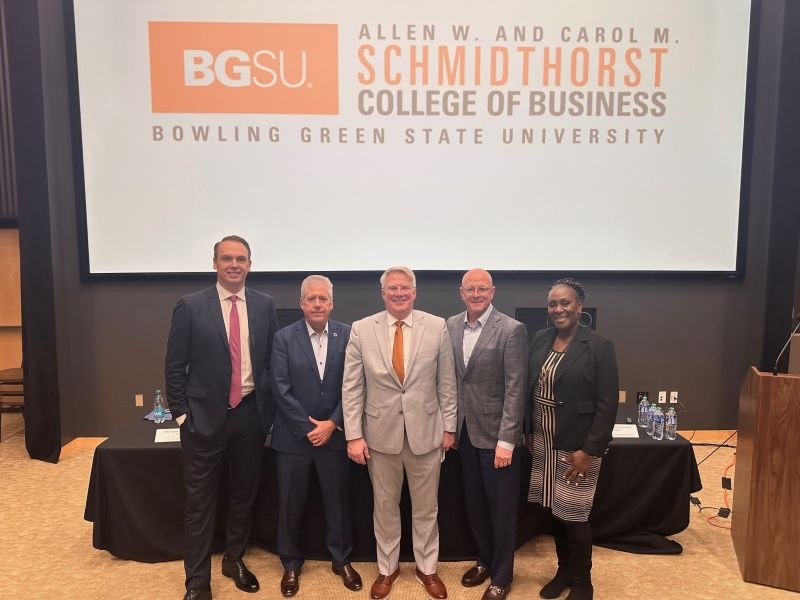
The setting brings his career back to the people who may eventually do the work. A company can add products, agencies and analytical tools; it still needs colleagues able to exercise judgment and sustain a relationship. Spray’s own apprenticeship lasted decades. Developing the next group is part of the assignment now.
His story keeps returning to a room: the agent’s office, the reception after a sales meeting, the university panel. Each offers a chance to learn something that a distant summary might flatten. For the executive directing the expansion, being there carries a practical question. Once someone has explained what they need, who is ready to do something about it?