In 2015, Jack Roche put a warning in writing. Insurance companies were accumulating more data, building more sophisticated models, and acquiring more ways to get the answer wrong. The tools could improve underwriting. They could also overwhelm the judgment of the people using them. A model deserved a hearing. So did the person who understood the customer.
He was then president of business insurance at The Hanover, still two years from the chief executive’s chair. His argument was specific: a backward-looking model could miss a changing market, and sudden shifts in pricing could leave agents scrambling to explain the consequences. He wanted insurers to combine analytical machinery with experienced judgment. The spreadsheet needed someone willing to ask another question.
That tension runs through Roche’s career. He has spent decades in a business that turns uncertainty into numbers, while insisting that conversation belongs in the calculation. Now, with his retirement scheduled for December 31, 2026, he is preparing to entrust the business itself to someone else. Succession gives a long-standing philosophy a deadline.
The apprenticeship before the title
Roche’s route to the top passed through the working parts of insurance. He held underwriting and management positions at Atlantic Mutual and Fireman’s Fund before serving in leadership roles at St. Paul Travelers from 1994 to 2006. His final position there was vice president of commercial accounts. These were jobs concerned with what a carrier should insure, on what terms, and at what price.
He joined Hanover in 2006. His responsibilities expanded from commercial underwriting and product management into field operations and business insurance. By 2009 he was president of business insurance; later he took on broader field responsibilities and the personal and commercial businesses within Hanover Agency Markets. The progression brought the technical and distribution sides of insurance into the same career.
Those assignments help explain his preoccupation with the people between an insurer and its customers. Underwriting establishes the promise a company can afford to make. Agents have to understand that promise well enough to recommend it. A leader who has worked across both functions has reason to care about what gets lost when one stops listening to the other.
- 1994–2006Leadership at St. Paul Travelers
- 2006Joins The Hanover
- 2009President, business insurance
- 2017President and CEO, effective November 4
- 2026Retirement planned for December 31
A business worth keeping, a business worth selling
His appointment was announced in October 2017, and he assumed the chief executive role on November 4. Soon afterward came a decision that made the company’s priorities unusually clear: Hanover would sell Chaucer, its international Lloyd’s business, and concentrate on its American insurance franchise and independent agents.
The interesting detail was that Chaucer had performed well. Roche explained that the business had exceeded expectations, yet produced fewer useful connections with Hanover’s domestic operations than anticipated. It had also evolved toward reinsurance. The two operations were becoming different kinds of insurance businesses, with different ways of reaching customers and assessing portfolios.
Selling a disappointing acquisition requires an explanation. Selling a successful one requires an explanation of what success is for. Roche’s answer was to direct more attention and investment toward specialized products and services that Hanover’s agency partners could use. A profitable asset could still be a less suitable home for the next dollar.
The decision offers a concrete way to read his preference for judgment alongside data. Financial performance matters, but it cannot settle every question about fit. A company can own two businesses that work perfectly well on their own while finding relatively little advantage in owning them together. Roche was willing to act on that distinction.
The organization behind the handshake
An independent agent can work with multiple insurers. That makes the relationship an ongoing choice, rather than something a carrier can assume it owns. Hanover’s approach places those relationships at the center of the business. It must give agents reasons to bring customers back: useful coverage, reliable service, and an organization that can respond.
Roche described a relatively flat company structure in 2018, with close coordination between the field and headquarters. He emphasized collective results over individual advancement and described assembling people around important initiatives instead of relying exclusively on a fixed hierarchy. The organizational chart, in this telling, ought to help work move.
There is something pleasingly practical about that ambition. An agent with a difficult account is unlikely to celebrate the elegance of a reporting line. The question is whether the right people can answer. Roche’s account of culture ties it to that daily requirement: colleagues who understand the priorities and can cooperate across their assigned corners of the business.
“I’m energized by my interactions with others.”
Jack Roche, 2020
He also treated stewardship of the culture as a shared job. Senior leaders could explain the values and organize around them; employees had to make them visible in their work. That is a more demanding arrangement than printing a set of principles. It leaves the daily evidence scattered throughout the company, where customers and agents actually encounter it.
The office moved. The conversations continued.
In 2020, Roche offered a smaller, more domestic view of that leadership style. He was working from a room he and his wife had converted into an office. Two children had returned home from college. The photograph of him at his desk contains the familiar equipment of executive life, relocated among curtains, framed pictures, and a stack of books.
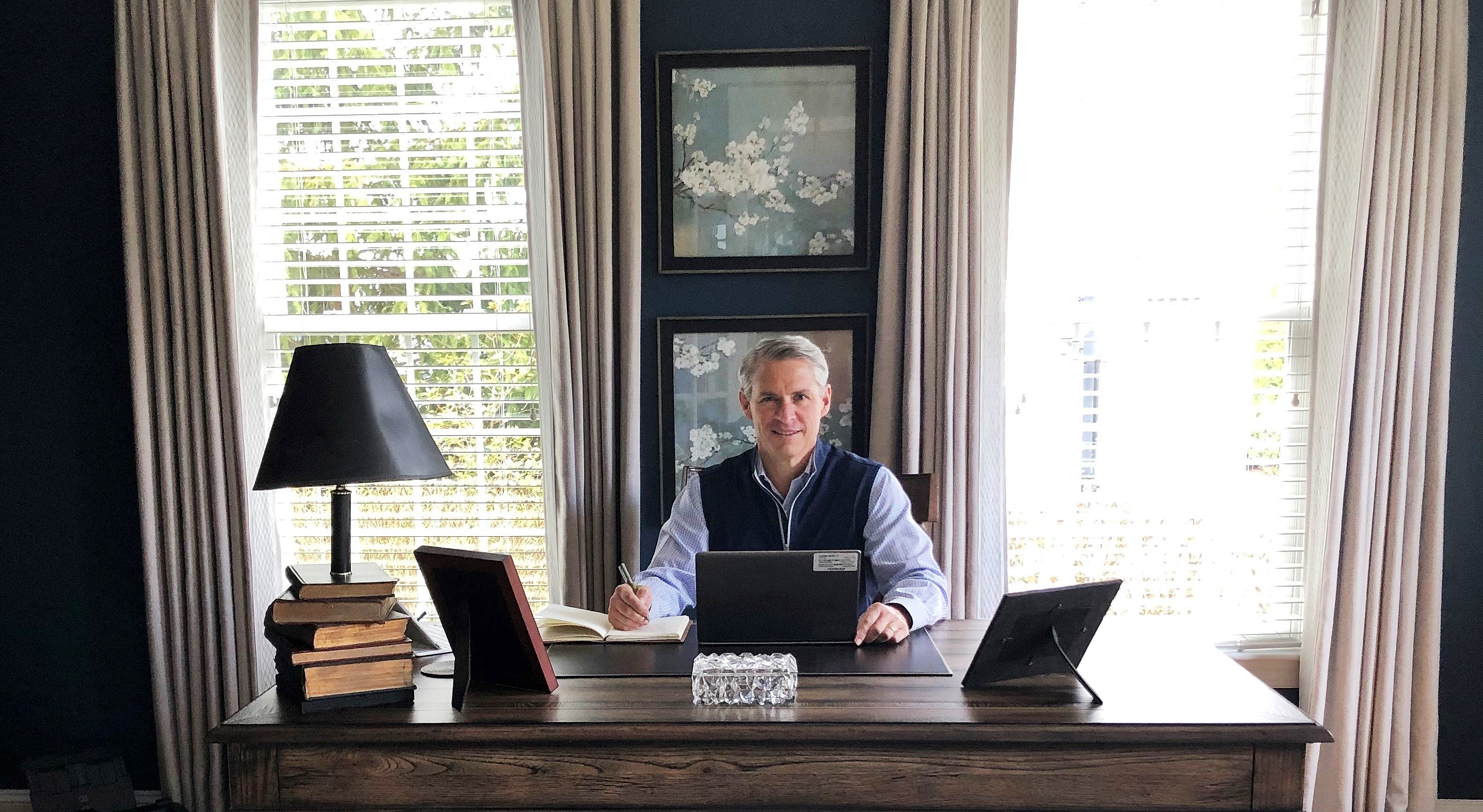
He said he could work effectively there, but preferred being with colleagues or traveling to see agents and others. He described learning through discussions that included listening and being challenged. Video meetings, calls, messages, and the ordinary tools of office communication helped keep the connections going. Technology served a recognizable human purpose.
The admission is useful because it gives his agency philosophy a personal dimension. Roche likes the exchange itself. Other people provide friction, information, and another way to see a problem. The value of a meeting, for him, includes the possibility of leaving it with a better understanding than the one he carried in.
A Connecticut upbringing, a Massachusetts life
Roche grew up in Vernon, Connecticut, near Hartford, and earned a bachelor’s degree at the University of Connecticut. He has credited Marita Zuraitis with helping develop him as a leader and bringing him into Hanover’s transformation under Fred Eppinger. His account of advancement gives other people a substantial part in it.
Off the clock, the edges soften. In a 2014 interview he described golf, skiing, country music, and family sports schedules. His wife Grace preferred tennis; he preferred golf. Marriage evidently supplied its own program of cross-training. He also had a ticket to a seventh World Series game that Boston’s six-game victory had rendered useless. Winning can be inconvenient.
He spoke of authenticity requiring humility. Taken alongside his enthusiasm for leadership development, the point suggests a practical habit: accept that becoming more capable may require someone else’s help. It is an interpretation of the pattern in his comments, rather than a claim that every meeting at Hanover follows the ideal.
When the philosophy meets the accounts
The business still has to produce results. In 2025, Hanover reported approximately $6.59 billion in revenue and $663 million in net income. Its combined ratio was 91.6%. For an insurer, that measure compares losses and expenses with earned premiums; a figure below 100% indicates an underwriting profit. It is a useful check on any elegant account of corporate culture.
Company results, not personal earnings. Combined ratio is shown against a 100% reference.
Roche’s shareholder letter described higher pricing, changes in the business mix, and targeted underwriting action. It also pointed to reducing exposure in selected areas and using sensors and data to help prevent losses. These are consequential choices about which risks to accept and how to manage them. Relationships do not relieve an insurer of the obligation to be selective.
The second quarter of 2026 brought net income of $191.6 million and a combined ratio of 91.2%. Net investment income reached $119.6 million. Roche credited employees, agency relationships, and the leadership team. The figures describe the company at a particular moment; they do not establish that any single management belief caused the outcome.
The next decision belongs to someone else
On July 15, 2026, Hanover announced that Richard “Dick” Lavey would become CEO-elect as Roche prepared to retire. Lavey had joined the company in 2004 and served in senior roles including chief operating officer and president of Hanover Agency Markets. Roche said they had worked together for more than two decades.
There is an apt continuity here. The business Roche helped organize around independent agents is being handed to an executive who has led that part of the organization. The transition has months set aside for the two to work together. Confidence in a successor becomes more useful when accompanied by time to transfer responsibility.
His interest in developing others extends beyond the company. He has served industry organizations including The Institutes and the American Property Casualty Insurance Association. In a 2023 visit to a Saint John’s High School leadership seminar, he discussed teamwork, belonging, and building a community with students. Leadership was presented as something to practice before acquiring a senior title.
As the year closes, the question for Roche becomes how well the organization can carry those practices forward. He has spent much of his career arguing for experience, discussion, and the discipline to reconsider an answer. Now he is making room for a colleague to have the final word. For an executive who values a second opinion, it is a fitting last assignment.
Continue the conversation
- Official biography
- Jack Roche on LinkedIn
- 2026 succession announcement
- 2025 annual report
- Roche on data and underwriting
- A conversation about agents and Chaucer
- The 2014 personal interview
- The 2020 home-office interview
- Watch: Roche’s CNBC interview
- Listen: Worcester Business Journal podcast
- The Hanover website
- The Hanover on YouTube