John Donohue had a company to explain and unhappy agents to face. On the advice of Frank Bellotti, his mentor and Arbella’s vice chairman, he went to see them individually. He asked what had gone wrong and what Arbella could do better. The executive responsible for the business let the people dealing with it describe the problem.
He later called the experience humbling. That is a useful word in a business biography, where difficult episodes often emerge from the editing process wearing a medal. Here was a chief executive spending time on conversations he could not control. His account offers a small, concrete scene through which to understand a much longer career.
“I didn’t try to sell the merits of our company; I just asked questions and listened.”
John F. Donohue, 2017
There is no date attached to those visits in his account. Their importance lies in the method: ask the question, give the other person room, accept the discomfort. Donohue said the company rebuilt the agents’ trust. The lesson required travel and patience. Neither is especially fashionable in a presentation about efficiency.
A company begins where another retreats
Arbella began in 1988, when Kemper was withdrawing from the Massachusetts auto insurance market. Bellotti, the former Massachusetts attorney general, recruited Donohue to help establish the new insurer. Donohue was a lawyer working with Bellotti’s firm and initially advised Arbella from outside its daily operations.
The opportunity was to build an institution with a future in a market another company was leaving. It came with people attached. In his later recollection, Donohue described a beginning that included about 200 employees from Kemper and roughly 200,000 customers. Agents had to decide whether the new company deserved their business. Employees had to decide whether it deserved their working lives.
The word “startup” can conceal that sort of responsibility. An inherited customer relationship is still a relationship somebody must keep. A new name on the paperwork cannot do the persuading by itself. Donohue’s telling of Arbella’s beginnings gives communication an unusually large share of the work.
He chaired the board from the start and became CEO in 2001. Founder, adviser, chairman, executive: his relationship with the company changed over time. By the time he handed over the CEO role, the insurer had become a place where much of his professional life had accumulated.
and chairman
CEO
remains chairman
When the market changed its rules
Massachusetts opened its private passenger auto insurance market to managed competition in 2008. For Donohue, the change brought more flexibility in pricing, products, and coverage. It also brought new pressure on independent agents as direct insurers competed for customers. A familiar way of doing business now had to justify itself under different conditions.
His answer continued to give the agent a substantial role. Insurance involves choices that can be hard to understand before a claim makes them painfully specific. An agent’s advice, in Donohue’s account, helps customers work through those choices and match coverage to their circumstances.
He supported easier digital access too. By 2020, he was discussing live chat and reducing the clicks required to bind business or retrieve information. The point was practical: let the transaction move more easily while preserving access to judgment. A shorter wait is welcome. So is somebody who understands the question.
That combination is less theatrical than declaring an entire business model obsolete. It asks a different kind of discipline from a leader: decide which tasks should become faster, and which conversations still deserve time. The agent visits make that distinction feel lived rather than merely stated.
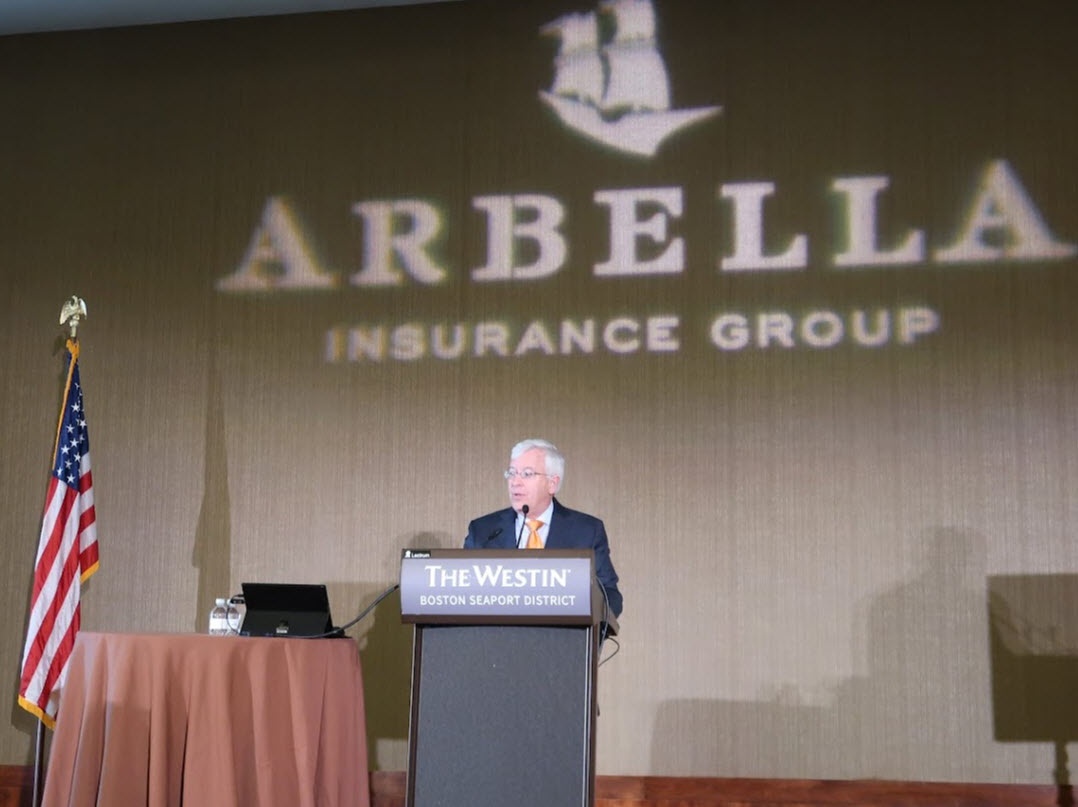
Industry relationships also have ordinary public settings. At the Massachusetts Association of Insurance Agents’ 2022 Big Event, Donohue appeared at Arbella’s Gourmet Luncheon. Conferences supply the lectern, the schedule, and sometimes a rather grand name for lunch. The people in the room supply the reason to keep attending.
Who gets heard inside the company
The listening theme appeared inside Arbella as well. Susan Glynn, speaking about the company’s approach to employees, described regular surveys, an employee advisory council, and a company blog. She tied that approach to Donohue and the board’s original intentions for the business.
Those mechanisms matter because a founder’s access to information changes as a company grows. A colleague can be close to the customer and far from the decision. A survey or council offers a route between those positions. Its usefulness depends on whether the information arriving at the top receives an answer.
In 2020, Donohue and Gayle O’Connell launched Arbella’s diversity and inclusion initiative. The work included employee education, a diversity council, a company blog, and a newsletter. The details give the initiative a visible structure: recurring places for people to learn, speak, and encounter perspectives beyond their own desks.
O’Connell’s participation also keeps the story properly populated. Company culture takes colleagues, managers, and employees to sustain it. A founder can help choose a direction; other people turn that direction into daily experience. Donohue’s career makes more sense with those collaborators in view.
The owners live around the corner
Donohue gave community work a reason rooted in Arbella’s ownership. Its parent is a mutual company. Policyholders are the owners. The surrounding communities therefore contain people whose connection to the business extends beyond buying a product.
“Our owners are our customers.”
John Donohue, 2018
He described the foundation, which began its work in 2005, as a commitment made possible after the company had built enough capital. Employees and agents helped identify nonprofits doing useful work locally. Their knowledge connected giving decisions with organizations they knew through participation and proximity.
That arrangement gives the word “community” some addresses. It can mean an organization an employee volunteers with, an institution an agent knows, or a classroom close enough to visit. A grant decision becomes easier to understand when the people affected by it have names.
Donated to New England organizations over 20 years.
By the March 2025 succession announcement, the foundation reported more than $45 million in giving over 20 years. The total describes institutional work over time. It also gives scale to the foundation role Donohue chose to retain when his responsibilities at the insurer changed.
Public service needs a practical budget
Bellotti’s influence extended beyond advice about agents. Donohue helped drive fundraising for the Francis X. Bellotti Loan Repayment and Forgiveness Program at Boston College Law School. An Arbella contribution of $2 million, combined with more than $1 million from Bellotti’s colleagues and friends, supported graduates working in modestly paid public service jobs.
The purpose was concrete. Someone can want a public service career and still have a loan payment due. An enduring fund helps address that pressure. Honoring a lawyer through support for other lawyers gives a tribute something useful to do after the dinner has ended. A recurring debt requires recurring help. The fund was intended to support successive graduates, carrying Bellotti’s public service example into decisions made long after the people at the dinner went home.
Immigrant support offered another connection between identity and action. Donohue identified himself as a third-generation Irish-American in the immigrant center’s 2018 annual report. He described a longstanding commitment to an organization serving families from around the world, through education, legal services, and advocacy.
In 2017, the organization, now called Rian Immigrant Center, honored him with a Solas Award alongside John Kerry and Noon Elhassan, a Sudanese immigrant and UMass Boston student. The honoree list brought different kinds of experience into the same room. Donohue’s place in it came through his community commitments.
The second career is already underway
Education remained part of that work. In April 2022, Franklin Cummings Tech announced a multiyear $300,000 foundation grant to help expand access to technical career pathways. The plan included recruitment efforts, internships, and possible employment opportunities through Arbella. Donohue connected the grant with economic opportunity through education and employment.
The connection continued into 2026. He and Frances Robinson were named on the committee for the college’s Momentum Celebration. With the Arbella Insurance Foundation as presenting sponsor, the event raised more than $1 million for scholarships. The result belonged to a broad group of donors and organizers; Donohue was one of the people doing the committee work.
Paul Brady had meanwhile succeeded him as Arbella CEO on June 1, 2025. Donohue’s March retirement letter described succession planning over several years. He stayed as chairman of the board and CEO of the foundation. The handoff changed his responsibilities while preserving an ongoing relationship with the institutions he had helped build.
Boston’s coastline gives that continuing work a different scale. Donohue joined the Green Ribbon Commission at its launch in late 2010, the only insurance industry representative invited as a founding member. After retiring as CEO, he said he wanted to devote more time to its work.
His July 2025 discussion focused on financing resilience: deciding which projects come first, and how to pay for them. He wanted the property and casualty industry involved alongside government. His optimism about Boston becoming a model for other coastal cities came with an insistence that difficult funding conversations still lay ahead.
A coastline makes the boundaries between public and private responsibility hard to ignore. Water will give no special consideration to an organizational chart. Decisions require people who can understand different obligations and remain in the conversation long enough to work through them.
The shape is familiar from Donohue’s earlier account of visiting agents. There is a problem to understand, someone else with a perspective, and work to do after the meeting. His CEO tenure ended. The next conversations were already waiting.