A construction project can be halfway finished when its owner decides the investment has run its course. The exit may look tidy in a financial model. On the ground, there are still obligations, people waiting to be paid, and a job that needs completing. In April 2025, Michael Keimig put his finger on that awkward interval: private equity investors may have a different timetable from the multi-year projects they finance. If they walk away, a surety writer can be left with the responsibility.
It is a revealing subject for the President and Chief Executive Officer of Markel Surety. Keimig’s business involves promises with consequences. His career has moved through underwriting offices, regional management, a company acquisition, and the chair of an industry association. Along the way, the scale has changed. The underlying question remains wonderfully resistant to fashionable business vocabulary: who is going to see this through?
A building is inconveniently literal. It cannot be persuaded to become complete by a revised presentation. That gives the people standing behind construction commitments a particular reason to care about what happens after the announcement.
The investor’s clock, the builder’s clock
Keimig discussed the private equity question with interviewer Meg Green. The concern was a possible mismatch between ownership horizons and construction obligations. He was describing a risk, rather than declaring that every investment would end badly. The distinction matters. Capital can arrive, ownership can change, and a project can proceed. The trouble begins when the people and the commitments stop moving together.
Surety adds another party to that relationship. A bond connects a principal, such as a contractor; an obligee, such as a project owner; and the surety company that guarantees the specified obligation. The guarantee matters because confidence alone is a rather flimsy construction material. Someone needs to consider performance and payment if the principal fails to deliver.
A simplified view of a surety bond. The bond’s terms determine the actual obligations.
The business also distinguishes between different promises. A bid bond concerns the contractor’s bid and willingness to enter the contract. A performance bond protects against failure to perform. A payment bond addresses payment to covered workers, subcontractors, and suppliers. These are separate commitments, each attached to something people expect to happen.
Against that background, Keimig’s attention to investment timelines makes sense. An exit is a decision by an investor. Completion is an outcome for a project. They can occur on different dates, with different consequences for everybody else.
A career measured in branch offices
Keimig’s own timetable starts in Maryland. He graduated from Mount St. Mary’s in 1991, studying finance and economics, and began his surety career at Seaboard. Baltimore came first, followed by Dallas. He joined Chubb in 1997, moved into management of its Houston branch in 2002, and was promoted to vice president in 2009.
Those place names give the career a useful sense of proportion. Before he led a national business, he worked within particular markets. His later Texas regional responsibilities at Chubb covered five states. There is a gradual widening of responsibility here, the sort of progression that a short executive biography can make sound much quicker than it was.
In November 2014, SureTec announced that Keimig would join on December 1 as executive vice president and chief operating officer. The job was newly created. He would report to Chairman and CEO John Knox Jr., who pointed to Keimig’s management experience and ability to grow a larger-limit contract bond operation.
Keimig arrived with an ambition that had a conspicuously long horizon: over the next 15 to 20 years, he wanted SureTec to lead the market niches it served. That was his stated aim, not a result already achieved. Still, the timeframe is striking. Many business announcements cannot see past the next reporting period. He was talking about a substantial part of a working life.
- 1991Seaboard Surety
- 1997Chubb Surety
- 2014SureTec EVP & COO
- 2019Markel Surety CEO
- 2024SFAA chair
A new owner, a familiar team
SureTec’s next major change was ownership. Markel completed its acquisition on April 28, 2017. The Houston company offered contract and commercial surety bonds and operated in all 50 states. It would join Markel’s Specialty division and become Markel Surety Corporation. The entire team transferred with the business.
That last detail is easy to pass over. It describes an acquisition in which the organization’s people continued into the new arrangement. An announcement can change the name on the door in a sentence. The relationships behind the door have taken rather longer to assemble.
Knox described the deal as a way to strengthen scale, the product portfolio, and risk capacity while retaining commitments to associates and production partners. Keimig became president and chief operating officer after the acquisition. He assumed the CEO title in 2019.
Read together, the changes describe two kinds of continuity. There was continuity of personnel through the transaction, and continuity of responsibility as Keimig moved into the top job. The organization gained a different corporate setting while carrying its earlier business forward. For a surety operation, whose work concerns commitments extending into the future, that is a particularly apt combination.
The bigger number had a smaller-account clause
On December 31, 2020, Markel Surety announced a National Accounts segment and capacity up to $500 million for its most qualified accounts. Michael Bond would lead the new segment. Lindey Jennings would continue leading Core Accounts, including the legacy business. Branch additions in Red Bank, Chicago, and Sacramento, together with more underwriting resources in Baltimore and Dallas, accompanied the expansion.
Capacity for the most qualified accounts.
A stated offering, not revenue or personal wealth.
The memorable part of the announcement is the qualification attached to growth. Keimig said, “we remain true to our roots,” referring to service for lower-limit accounts. National Accounts would add to the core business. Larger customers were coming into the picture alongside the customers already there.
That makes the expansion more interesting than a large number alone. There were different account groups, different leaders, and a wider branch network. The decision was about how the business would be organized to serve a broader range of needs. Capacity needed people and places around it.
For a reader outside insurance, the choice is familiar. A business gets a chance to take on bigger work. Its existing customers want to know whether they will still receive attention. A plan that answers only the first question leaves the second hanging. Keimig addressed both in the same announcement, giving the larger opportunity a place without writing the earlier customers out of the story.
An office with a rather good dome
In a photograph he shared from a joint SFAA and NASBP legislative fly-in, Keimig stands outside the U.S. Capitol, smiling into the camera. He described it as his office for the day. The setting does rather outshine the usual conference-room background.
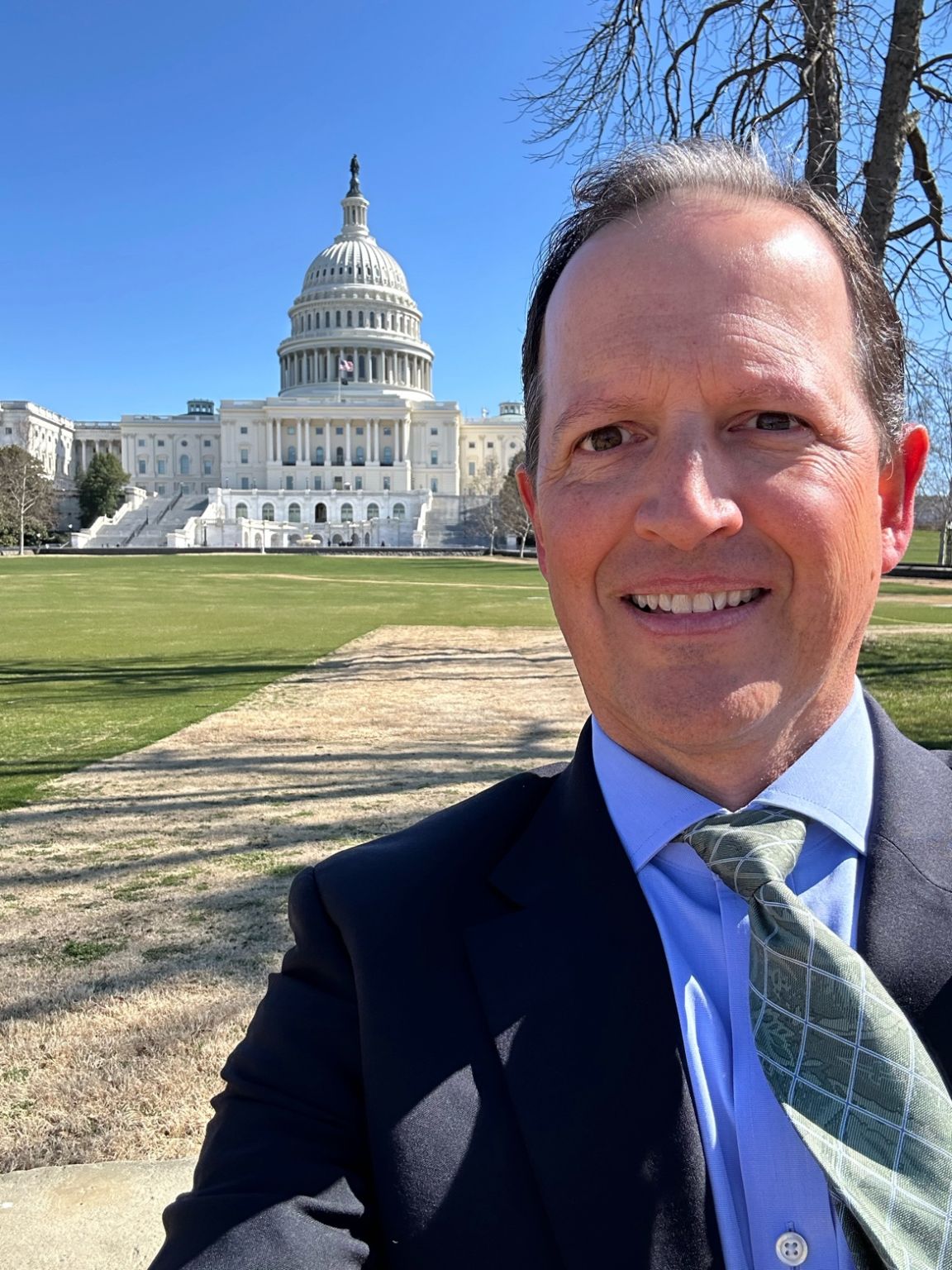
The picture gives a face to another part of his work: explaining the industry to people outside it. Keimig became an SFAA director in 2020. In May 2024, he succeeded Robert Murray as chair, after more than a decade of participation in the association.
An association chair works among companies that have separate commercial interests. That gives the role a different audience from the CEO’s desk. A company has its own customers and accounts. An association has to articulate concerns that members can advance together.
His other roles have included leadership of the Houston chapter of the Construction Financial Management Association, the Dallas Surety Association, and the National Association of Independent Sureties. He has also served with Houston’s Insurance Industry Charitable Foundation chapter and school organizations. The list suggests a career conducted through institutions as well as employers, with meetings continuing well beyond the boundaries of one company.
The people who carry the work forward
A public congratulation to Steve Nelson offers a less formal glimpse of Keimig’s professional relationships. Marking Nelson’s 25 years with SureTec, Keimig described him as a coworker and friend and credited his expertise, wit, grace, and counsel with helping build the business. It is a small exchange, but the details are more personal than the usual ceremonial applause.
Wit has its uses in a business full of obligations. So does counsel. The appreciation gives a little texture to the working relationships behind the organizational chart, without turning a colleague’s anniversary into an invented scene.
Keimig’s public staffing announcements provide another view. In 2024, he welcomed additions to the Southeast team and announced Andrew Brown’s move into the Houston contract-manager role. Brown would keep servicing the existing Southeast business during a transition before concentrating on Houston. The handover was part of the announcement, alongside the appointment itself.
That is an unglamorous detail with a practical purpose. A new role is easy to celebrate. Existing work still needs a responsible person while the new arrangement takes shape. In this case, the announcement spelled out that continuity. It echoes the larger theme of Keimig’s career without requiring a slogan: somebody has to carry the commitment through the change.
Who is still there at the finish?
At SFAA’s June 16, 2026 annual meeting in Washington, members elected Keimig chair for 2026–2027. He and association President and CEO Ryan Work emphasized engagement, advocacy, collaboration, and data-driven insights. His statement returned to “working collectively to advance the value of surety.”
“working collectively to advance the value of surety”
Michael Keimig · SFAA annual meeting · June 2026
The association’s agenda included economic research and workforce development. These are continuing tasks: explaining what bonding contributes, preparing people to enter the profession, and keeping members involved. They do not end when an annual meeting does.
There is a useful symmetry in that work. Keimig started with underwriting responsibilities in branch offices and now helps represent the profession in which he built his career. The wider role still concerns the practical value of commitments that survive uncertainty.
Return to the unfinished project and the investor preparing to leave. The problem is a gap between timetables, but it is also a question of responsibility. Someone has to pay attention to the obligations remaining after other people have moved on. Keimig’s career has made that question his daily business. The completion date still matters, even when the exit date gets the applause.