The useful clue in Jonathan Levine’s career is a website built for risks that were difficult to place. In 2010, while he was a division marketing director at Zurich North America, Levine helped explain ZProgramsMatch.com, an online portal where commercial property and casualty agents could search among 50 specialty insurance programs. Roofers, staffing firms, restaurants, lawyers and transportation companies each carried different exposures. An agent might know a client well and still need help locating a carrier with the right appetite. The site made that search less opaque.
Levine described the problem without dressing it up. “These are niche products, and agents don’t always know where to place this kind of business,” he said at the time. The portal let an agent inspect eligibility rules, coverage highlights and program appetite, then contact the relevant administrator. In other words, the marketing did not stop at attracting attention. It helped a working customer complete a working task.
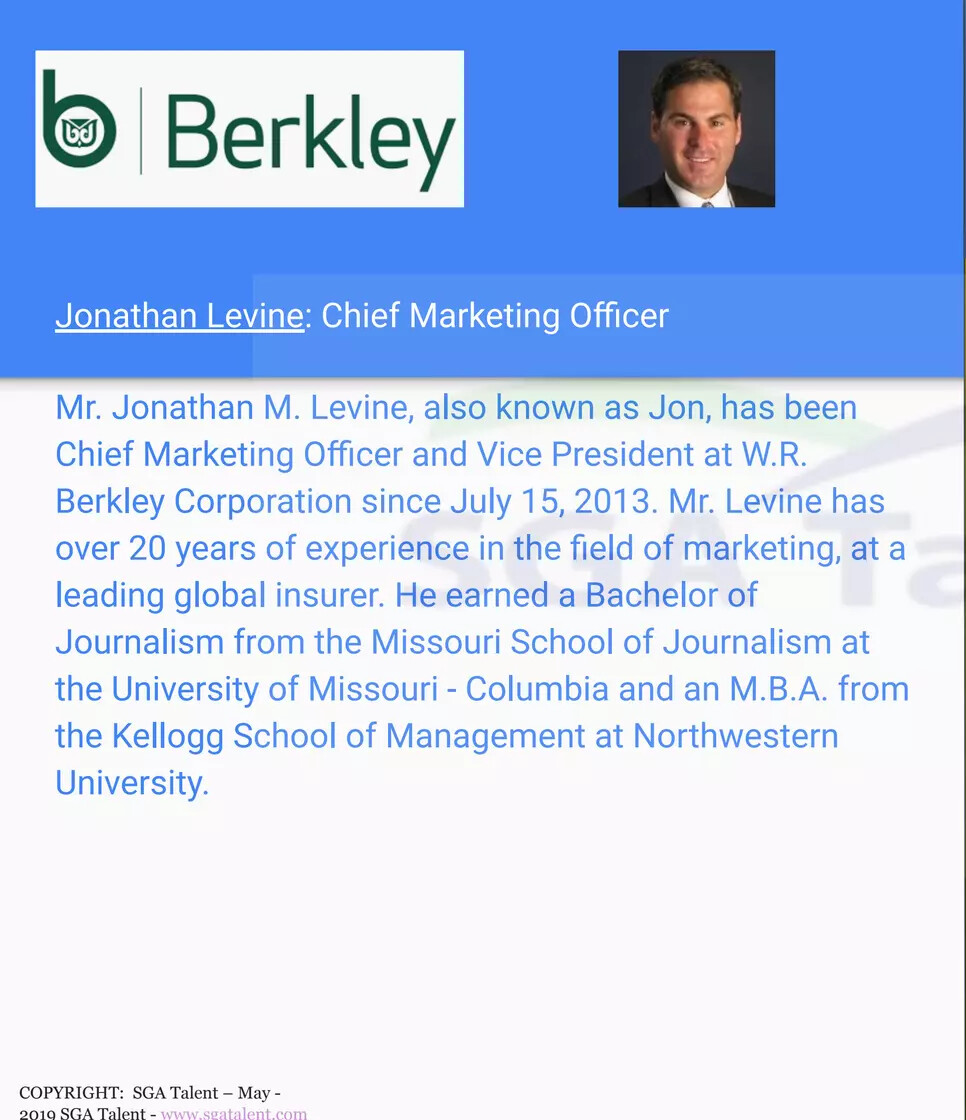
That small piece of industry plumbing is a useful way into a career that now spans more than three decades. Levine has moved from advertising agencies to printing and communications, then into commercial insurance. Since 2013, he has served as vice president and chief marketing officer of W. R. Berkley Corporation. The employers and titles changed. The central challenge did not: make a complicated offer understandable to the person who needs it.
The education of a translator
Levine’s first degree was not in finance or actuarial science. He studied advertising at the Missouri School of Journalism, earning a Bachelor of Journalism in 1991. That is a revealing starting point for someone who would eventually market insurance. Journalism asks a person to identify what matters, arrange evidence and communicate it to an audience that has other things to do. Advertising adds the discipline of making the next action clear.
He entered account management at TracyLocke in 1992, then worked at Temerlin McClain, where his responsibilities included the American Airlines account. By 1995 he was an account supervisor at Frankel. Four years later he moved to Cyrk as an account director. These were client-facing roles, positioned between a business problem and the people responsible for turning it into a campaign.
While that agency chapter was ending, Levine added a second form of training. From 2000 to 2002, he completed an MBA at Northwestern University’s Kellogg School of Management, with a focus on marketing, technology and eCommerce. The timing matters. Companies were learning that a website was not merely a brochure. Search, data and interaction could change how a customer found a product and how a company organized demand.
After a consulting role at RR Donnelley, Levine joined Zurich North America in 2004. He stayed for nine years, ultimately holding vice president-level marketing responsibilities. There, the general skills of advertising met the specific logic of commercial insurance: appetite, eligibility, distribution, program administrators and risks that resist a generic answer.
Push, pull and a place to land
In 2011, Levine articulated a marketing tension that was especially visible as corporate media budgets shifted online. Marketers could push a message outward to create awareness. They could also build a destination that customers sought out because it was useful. His position was practical: the two had to work together. “It’s our responsibility to adapt to today’s marketing realities,” he said. “There is so much clutter in the marketplace that we need to be smart.”
ZProgramsMatch was the operational version of that view. A campaign could tell agents that Zurich wrote specialty programs. The portal answered the question that followed: which program fits this client? Awareness without a useful destination leaves a customer with homework. A destination without awareness sits empty. The marketing system needed both movement and a place to land.
Create awareness around a specialized capability. Give the right buyer a reason to pay attention.
Help the buyer research appetite, eligibility and next steps when the need becomes active.
The principle sounds modest, which may be why it lasts. It applies to any technical B2B company. The more specialized the offering, the less helpful a broad claim becomes on its own. Buyers need to see whether the product fits their exact situation. Useful marketing shortens that distance. It surfaces the expert, exposes the relevant criteria and removes a step from the customer’s search.
A center built around specialists
Levine arrived at W. R. Berkley in July 2013. The company presents a distinct structural challenge for a marketer. Berkley operates through approximately 60 businesses focused on particular industries, products, regions or distribution approaches. Local autonomy is part of the operating model. The individual units are meant to stay close to their agents, brokers and customers, while the parent supplies capital, scale and stability.
In a tightly centralized company, a marketing department can pursue consistency by controlling more decisions. In a decentralized group, the better question is how to create coherence without flattening specialist knowledge. A construction underwriter and a cyber underwriter do not encounter the same buyer, vocabulary or pattern of risk. Their credibility comes partly from those differences. The parent brand has to make the family recognizable while leaving room for each business to sound informed.
Berkley’s current public language centers on deep expertise, entrepreneurial thinking and decentralized authority. The message gives the pieces a common frame: decisions stay near the market, and specialist businesses are backed by a Fortune 500 parent. Marketing’s role is connective. It helps an agent understand both the particular business in front of them and the larger organization behind it.
Career chapters / approximate years
That frame also echoes Levine’s earlier work. ZProgramsMatch did not ask every specialty program to become identical. It made their different appetites searchable through a shared front door. The value came from organizing difference, not erasing it.
Precision in the AI era
Early in 2026, Levine joined a session with Northwestern Kellogg marketing students about strategy in the AI era. The reported discussion connected two ideas: using AI to improve precision and giving decentralized businesses freedom to move. The insurance analogy is apt. Underwriting is an exercise in selecting and pricing particular risks, not reaching every possible customer. Marketing can also use information to identify a fit instead of treating scale as an excuse for a generic message.
The session also brought Levine’s career back to the school where he had studied technology and eCommerce a quarter-century earlier. In the intervening years, digital marketing moved from portals and domain names to machine learning models that can segment, predict and generate. Yet the customer problem remains recognizable. Someone has a need. The organization has distributed expertise. The marketer has to make the match without adding confusion.
Precision is valuable only when it improves that match. A prediction can help identify a likely customer, but the message still has to explain a real capability. A central platform can make expertise discoverable, but the specialist still needs authority to respond. The technology changes the speed and granularity of the work. It does not repeal the need for judgment.
What a specialist brand owes its customer
Specialization creates a communication debt. The company knows why its distinctions matter, but the customer arrives without the internal map. An insurance buyer sees a field of names, coverage forms and appetite statements. An agent may understand the exposure and still need to locate the specific team authorized to handle it. Every unexplained distinction adds work to the buying process.
A useful brand system repays that debt. It does not turn each specialist into a generalist. It gives the customer a clean way to move from the broad promise to the narrow capability. Berkley’s structure makes the challenge easy to see: a parent identity must communicate financial backing and a shared standard, while an individual business must communicate the particular risks it understands. One layer answers, “Can I trust this organization?” The next answers, “Can this team handle my situation?”
Levine’s earlier push-and-pull formulation fits neatly here. Push can establish the parent promise. Pull can let the buyer explore the details on demand. Neither layer has to carry the whole explanation. Together, they form a path from recognition to relevance.
This is also why navigation deserves to be treated as strategy. Naming, search, filters, product pages and contact routes can look like secondary execution work. For a customer facing a specialized decision, they are the experience. If the right expert is difficult to find, expertise has less practical value. If the distinctions are clearly organized, the company begins proving its understanding before the first conversation.
The quiet craft of being useful
Levine’s work is documented most clearly through operating roles, customer tools and concise industry comments. Together, they yield a specific lesson.
In complex markets, marketing earns its place when it behaves like part of the service. It tells an agent where a carrier has appetite. It lets a buyer compare eligibility. It gives dozens of specialist businesses a shared frame without taking away the knowledge that makes them specialist. It pushes enough to be noticed and builds enough pull to reward the attention.
Levine began with the disciplines of advertising and journalism, added management and technology, then carried that combination into insurance. From American Airlines account work to specialty program search, from Zurich to Berkley, his career has stayed close to the boundary between expert knowledge and customer action.
That boundary is where many B2B companies lose people. They have the capability, but they describe it from the inside. They have the specialist, but no obvious route to reach one. They generate attention, but leave the customer to translate the offering alone. The practical alternative is visible in Levine’s work: reduce the search cost, reveal the fit and let clarity carry some of the load.