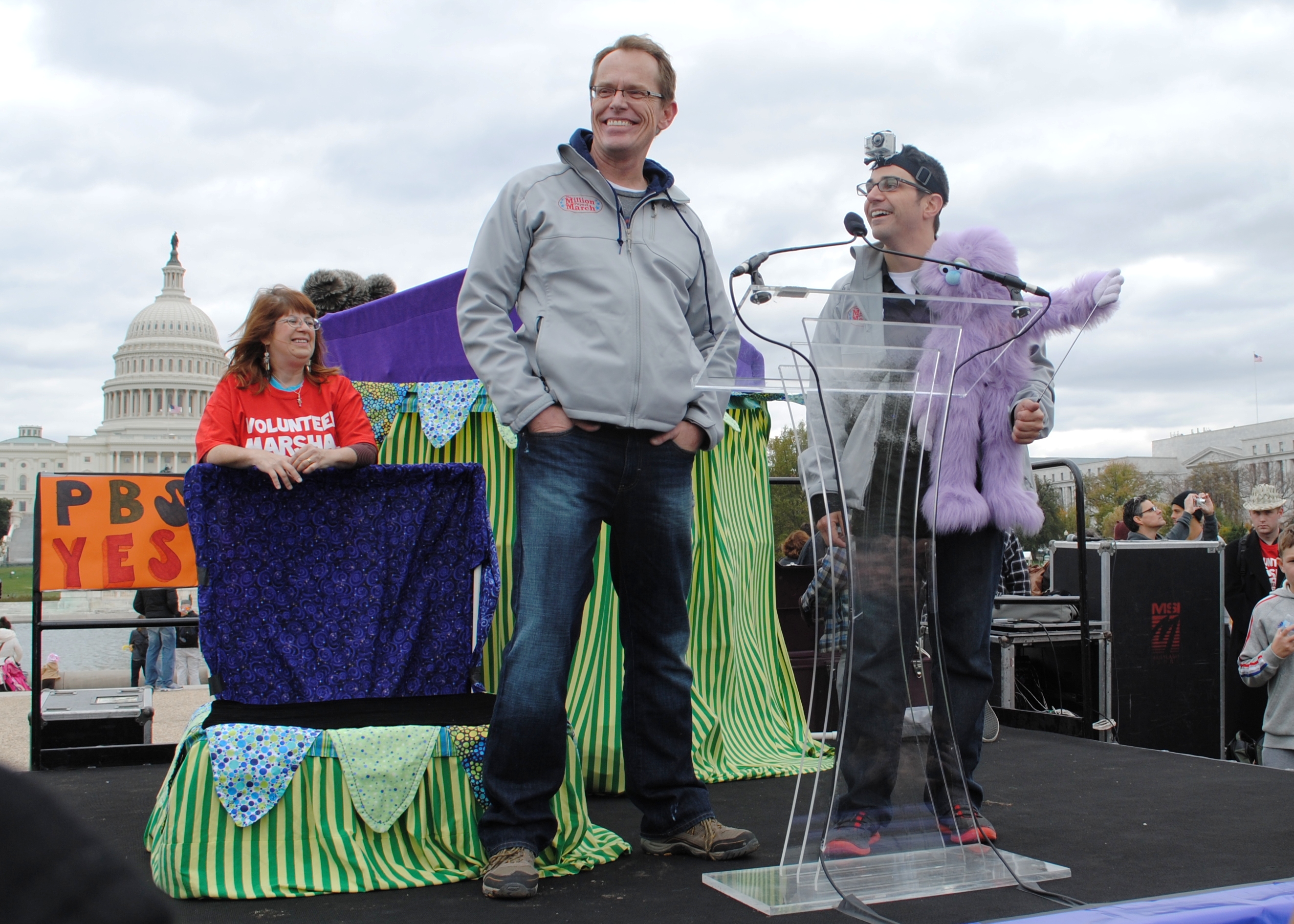
On November 3, 2012, Michael Bellavia stood before a crowd in Washington, D.C., with a purple puppet and a camera strapped to his head. The Capitol rose behind him. The cause was federal support for public broadcasting. The preferred equipment was felt, fur, and a willingness to look a little ridiculous in public.
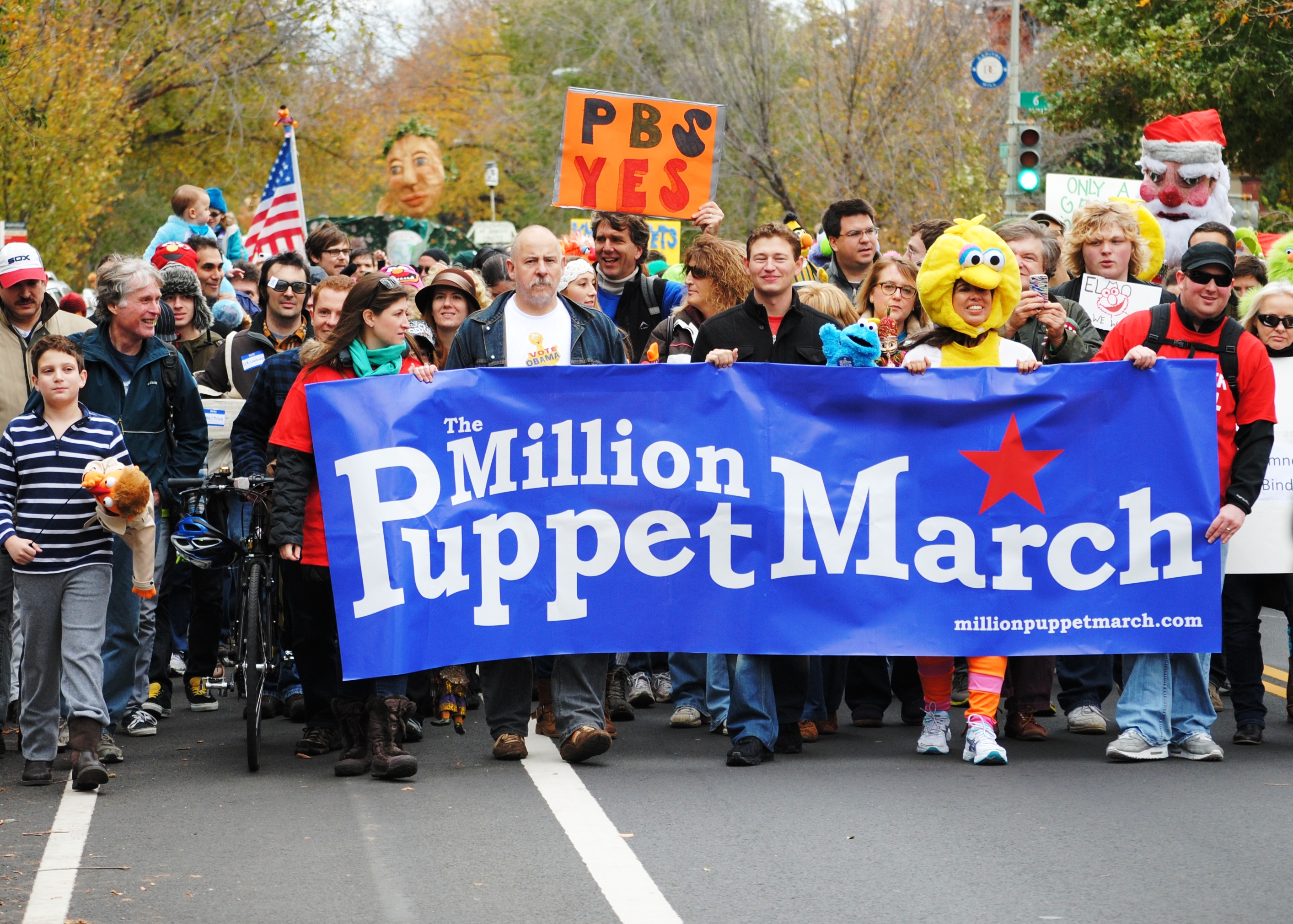
Bellavia and fellow organizer Chris Mecham called it the Million Puppet March. Their estimate of the actual crowd was around a thousand. Political demonstrations have survived greater discrepancies between ambition and attendance. This one had the advantage of an audience already practiced at bringing imaginary creatures to life.
“Stay warm by nuzzling with a puppet,” Bellavia told the gathering. Children, adults, dogs, and homemade characters had come together around something they cared about. The invitation was affectionate, funny, and specific. It also offers a useful introduction to the founder and CEO of HelpGood, whose work often begins with a familiar character and ends with a request to do something.
The award with an awkward name
Six years earlier, Bellavia had encountered another public occasion with an unusual script. At the 2006 Sports Emmys, presenter Charles Barkley struggled with the category called Outstanding Achievement in Content for Non-Traditional Delivery Platforms. Even the title seemed to need a producer.
Animax Entertainment and ESPN.com won for Off-Mikes, an animated series built from Mike & Mike in the Morning. Bellavia was Animax’s general manager at the time. He said the company had learned the category existed only when ESPN entered the work. Recognition had arrived wearing a name longer than some acceptance speeches.
The production itself was a practical exercise in transformation. Animax edited audio from Mike Golic and Mike Greenberg’s radio show, developed a comic scenario around it, and animated the result using traditional 2D techniques and Flash. The episodes appeared online and were adapted for other screens.
That meant finding material with a longer life than a score. The personalities could carry a cartoon after the particular game had slipped out of memory. In Bellavia’s early career, an audience’s attachment to a character was already something to build around.
“To get this kind of validation for our work is truly amazing.”
Michael Bellavia, on Animax’s 2006 Emmy win
His education had taken a different route: a BS in engineering at the University of Michigan, followed by an MBA at Columbia Business School. Technical systems, business decisions, comic timing: the résumé accommodates all three without insisting they belong in separate rooms.
A haunted house with helpful backers
Bellavia’s work with characters also extended into games. He co-founded Night Light Interactive with David Logan in 2012. Its Whispering Willows follows Elena Elkhorn, a girl searching for her missing father in a haunted mansion, with an amulet that lets her enter the spirit realm.
Discussing the game in 2015, Bellavia described an affection for early 2D games and a painterly visual approach made with traditional illustrators and animators. Audio was considered early, too. A house that creaks at the wrong moment can do quite a lot of storytelling without delivering a speech.
The project’s Kickstarter supporters remained part of its development. The team shared decisions with them, and their responses helped shape the game. Those backers then carried their enthusiasm into posts, videos, and livestreams. Bellavia spoke of discovering an unexpectedly strong following in Russia.
There is a practical connection between this haunted house and the later agency work: people who feel involved have reasons to keep talking. A supporter can help make the thing, understand the choices behind it, and introduce it to somebody else. The relationship continues after the initial transaction.
Giving a bear more to say
Smokey Bear presented a rather different character problem. Generations knew his image and his instruction to prevent wildfires. A recognizable face, however, does not automatically provide enough conversation for a social account.
In 2014, Bellavia described the challenge of speaking as Smokey, rather than simply posting information about him. Early updates had been relatively flat. During 2013, the tone became friendlier, with more encouragement for people who acted responsibly. One example celebrated two boys who had put out an unattended campfire.
That small change matters. A public message can spend all its time describing what people do wrong. It can also notice when somebody gets something right. The second approach gives the audience a role worth volunteering for. Smokey could acknowledge a good decision, and the person making it could answer back.
An editorial reading of the progression in Bellavia’s character and campaign work.
By September 2024, Bellavia described more than 15 years working on Smokey’s social presence with his team and campaign partners. The assignment involved the Ad Council, the US Forest Service, and the National Association of State Foresters. The bear’s message remained tightly bounded; the ways of delivering it kept changing.
In late 2016, the team made a mannequin-challenge video before obtaining approval. Bellavia later recalled it as a successful experiment that helped move the social strategy forward. By 2024, Smokey could participate in a Chappell Roan dance trend while still having a very particular reason to be online.
Bellavia also expressed a wish for a new Smokey song. The old one had helped lodge an extra “the” in the character’s name. After years spent giving a bear more conversational range, he was still attending to the basics of the introduction.
The joke has an assignment
HelpGood’s 2024 account of Smokey’s eightieth birthday supplied another revealing example: a video riffing on comedian Tim Robinson. The campaign reported nine million plays, reach of four million accounts, and more than 100,000 followers gained. Those are campaign figures for a particular video, rather than a measure of how many wildfires were prevented.
The distinction is useful. A joke can earn the chance to deliver an instruction. It cannot certify that everybody who laughed followed it. Bellavia’s explanation of the account emphasized celebrating people who helped prevent fires and making the character approachable. The creative work has to preserve the reason the bear showed up.
That is also why the puppet march remains more than an amusing detour in his biography. In an August 2024 essay, Bellavia recalled impulsively tweeting the original march hashtag after Mitt Romney’s promise to defund public broadcasting. A short online response became an event that other people could join.
His essay, titled Is Your Nonprofit Brat?, examined the Harris campaign’s adoption of internet culture. He urged nonprofits to understand memes as something people participate in and reshape. Trying to control every contribution can miss the appeal of the form.
He also warned about jokes that flatten complicated issues or hurt the communities a campaign intends to help. Speed and informality do not remove responsibility. For an agency leader with a background in comedy, that qualification deserves space beside the punch line.
A company built around the invitation
HelpGood, established in 2016, gives this work an organizational home. Bellavia oversees the agency’s vision and growth, client acquisition, and client success. Its clients include nonprofits, government agencies, universities, foundations, and other organizations pursuing a public purpose.
The range of work includes research, branding, campaigns, websites, and communications. A cause may need a memorable idea, but it also needs a usable place for someone to respond. The agency’s capabilities include the practical machinery around the creative work: media planning, analytics, and optimization.
The company has worked on the launch of Love Has No Labels as well as the long-running Smokey campaign. Its public client lists also span education, environmental projects, and community organizations. The throughline is the task of getting people to understand an issue well enough to become involved.
- 2006
- Animax and ESPN.com receive the Sports Emmy for Off-Mikes.
- 2012
- The Million Puppet March brings supporters to Washington.
- 2026
- HelpGood places No. 77 on Inc. Regionals Pacific.
There is a business record alongside the campaign work. HelpGood ranked No. 1,988 on the 2024 Inc. 5000 and No. 2,193 in 2025. In 2026, it placed No. 77 on Inc. Regionals Pacific, with reported two-year growth of 82 percent. The lists describe company growth; they offer no shortcut for judging a campaign’s social results.
The agency is also a certified B Corp. In June 2024, HelpGood became a signatory to the Women’s Empowerment Principles. In its statement there, Bellavia connected better outcomes with prioritizing diversity, equity, and inclusion in client choices, project staffing, and partnerships. These are commitments about how the company works, alongside what it makes.
Room for other people
Bellavia’s public résumé leaves room for performance beyond a campaign brief. He has done improv at iO West, Upright Citizens Brigade, and Second City in Los Angeles, and appeared on game shows including Wheel of Fortune and Let’s Make a Deal. Evidently, some professional lives allow for both an MBA and a very different kind of audition.
He has also advised Brave Trails, an organization focused on LGBTQ+ youth leadership, since 2014. His professional connections include leadership in the Producers Guild’s new media community. These activities place him around people building things together, whether the immediate task involves a production, an organization, or a young person’s opportunity to lead.
His public advice continues into 2026 through Forbes Nonprofit Council contributions on donors, boards, and nonprofit teams. The subjects are less furry than a puppet march. They still concern the conditions under which people choose to help, and the work required to keep them involved.
The photograph from Washington remains an unusually good calling card. Bellavia is at the microphone; the purple puppet has an arm extended; his collaborator is smiling beside him. A public argument has become a gathering with something for people to do. In that picture, participation looks inviting enough to try.
Keep the conversation going
- How Smokey Bear found his voice online - Digiday
- The 2012 puppet march - Current
- Animax’s broadband Emmy - Animation World Network
- Off-Mikes and Animax - Los Angeles Business Journal
- Whispering Willows: a conversation with Bellavia - BagoGames
- Is your nonprofit brat? - Michael Bellavia
- Smokey Bear online in 2024 - Marketing Brew
- Smokey’s eightieth birthday campaign - Roastbrief
- HelpGood’s Inc. rankings
- HelpGood’s Women’s Empowerment Principles statement
- HelpGood team and biography
- HelpGood capabilities statement
- Michael Bellavia’s Forbes Nonprofit Council contributions