A credit card has a peculiar memory. It remembers the payment you missed long after you have changed jobs, rebuilt your savings, or recovered from whatever caused the trouble. Mercury Financial built a business around the possibility that this memory can be too blunt. Someone with an imperfect record might still be a perfectly workable customer. The difficult part is deciding who, at what price, and with whose money.
- Mercury develops and services cards for near-prime Americans; a bank issues them.
- Atlanticus acquired the business in 2025, adding about 1.3 million serviced accounts.
- In 2026, the MERCURY name changed hands separately. The receivables stayed put.
A customer between two doors
Mercury’s territory is the awkward middle of consumer credit. These are people who may struggle to qualify for mainstream cards, yet want something more useful than an expensive financial stopgap. At its 2018 card launch, predecessor CreditShop described a middle market of Americans with FICO scores between 575 and 675. That was its stated target then, rather than a universal approval rule.
The original proposition was concrete: an unsecured Mastercard, access to a FICO score, and account performance reported to major credit bureaus. Customers could make ordinary purchases while establishing a new payment record. The absence of a security deposit mattered. Money tied up as collateral is money unavailable for groceries, a repair, or the next bill.
“Your credit past should not define your future.”Mercury Financial’s public promise
First Bank & Trust of Brookings, South Dakota, issues the cards. Mercury supplies the credit platform and servicing machinery. Visa and Mastercard provide the payment networks used across its programs. Understanding that division of labor makes the company easier to understand: the name on the customer experience and the bank extending credit need not be the same institution.
First came the portfolio
The company’s roots reach back to CreditShop, whose history is commonly dated to 2013. Its consequential leap came in March 2017, when it acquired a $1.6 billion Mastercard portfolio from Barclaycard. Värde Partners acquired CreditShop later that year. The Mercury Mastercard arrived in May 2018. The sequence is revealing. This business had acquired substantial scale before introducing its own branded card.
CreditShop publicly became Mercury Financial in March 2021, alongside an announced $100 million capital injection. In July 2023, client funds managed by Neuberger Berman supplied a $200 million debt facility. Those dollars supported lending and growth. They were not a software subscription milestone, and the debt facility was not venture equity. A card platform needs capital behind every balance its customers carry.
Its expertise sits where consumer behavior meets risk analytics. Underwriting determines who receives an offer and how much credit they get. Servicing determines what happens afterward. Funding keeps the receivables financed. Interest and fees help generate the economics, while credit losses, financing costs and customer support consume them. A generous approval policy is easy to announce; making the whole arrangement durable takes considerably more work.
The payment button has a business model
For a customer, the machinery becomes visible on a phone. The Mercury Cards app offers transaction checks, payment scheduling, split payments and automated monthly payments through Easy Pay. Smart Spot suggests a personalized payment amount. FICO monitoring lets a borrower watch the record they are trying to improve. These tools address the practical business of managing an account after the excitement of approval has passed.
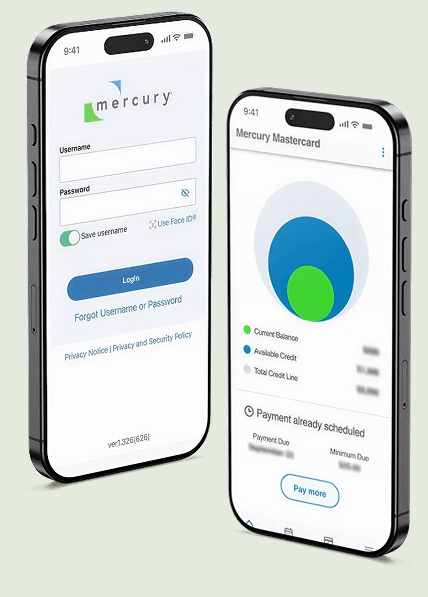
Development partner Robosoft describes the earlier friction: routine account questions reaching live agents, limited mobile control, and a rigid voice menu. Its response combined a native app with conversational servicing in English and Spanish. The vendor reports that servicing transaction costs fell from $4.25 to $0.10. Those are vendor-reported figures for servicing transactions, rather than a measured reduction in every cost of running Mercury.
There is a useful operating lesson here: find the small task customers repeat, then remove the unnecessary handoff. A balance inquiry should not require the same attention as a difficult dispute. The savings can create room to serve more accounts. Whether they produce a cheaper card for the borrower is a separate question.
Access still has a price
Atlanticus’s acquisition presentation supplied a revealing snapshot. Mercury’s portfolio had a weighted average FICO score of 644 and an average APR of 27.3%, using July 2025 data. These were portfolio averages, not an advertised rate for every applicant. They describe a company taking credit risk and charging for it. Financial inclusion does not erase the arithmetic of revolving debt.
Mercury competes for attention with providers such as Mission Lane and Credit One Bank. Secured cards, including Capital One’s, offer another route, with a refundable deposit. The useful comparison includes the actual annual fee, interest rate, credit limit and payment obligations in a particular offer. Rewards alone tell a small part of that story. An interface can simplify repayment; it cannot make an unaffordable balance manageable.
Then they sold the name
On September 11, 2025, Atlanticus acquired Mercury, adding approximately $3.2 billion in gross card receivables and 1.3 million serviced accounts. Later filings recorded about $166.5 million in cash consideration, plus contingent consideration. The buyer also assumed approximately $2.8 billion in collateralized debt. The headline purchase price and the size of the loan book measure different things.
The next transaction was stranger. On September 30, 2026, Mercury sold the MERCURY word mark and related intellectual property for $27.5 million. Atlanticus retained the underlying receivables. Mercury received 12 months of rights to solicit new card customers under the name, followed by up to five additional years of use for legacy servicing and continuing obligations. The brand could move while the lending business stayed.
That leaves a sharper way to judge Mercury’s promise. Watch what happens after the card arrives: the payment, the statement, the disputed transaction, the next credit decision. A second chance becomes useful through those ordinary encounters. The name on the plastic is only the beginning.