In Medly’s first year, co-founder Chirag Kulkarni sometimes rode along with the company’s lone delivery driver. At the door, he handed over medicine, collected a copay and asked questions. The pharmacy was coming to the patient. For a business built around an app, this was an admirably old-fashioned way to learn whether the thing worked.
- Medly paired local pharmacies with free prescription delivery.
- A $100 million funding round helped finance expansion.
- Bankruptcy brought an asset sale to Walgreens and closure.
- Later fraud allegations put its reported growth under scrutiny.
The scene, described in a 2021 Built In interview, captures the attraction of Medly. A prescription is a small object surrounded by a large amount of work. Someone must get it filled, sort out insurance, answer questions and bring it home. Medly offered to take over much of that work. Its eventual collapse makes the distinction between a good customer proposition and a trustworthy company painfully concrete.
A pharmacy with the errand removed
Launched in 2017 by second-generation pharmacy owners Marg and Sahaj Patel, Medly combined physical dispensing locations with digital access. Patients could manage prescriptions, arrange delivery and consult pharmacists. Local stores also welcomed walk-ins. The company occupied the space between the neighborhood pharmacy and the delivery app: clinical expertise at one end, a bag arriving at the door at the other.
The intended customer was easy to recognize: someone juggling work and family, someone needing repeated prescriptions, someone for whom a trip outside was difficult. Medly’s Baltimore launch described pharmacist chat in more than a dozen languages and help finding copay or manufacturer assistance. Staff also worked through insurance requirements. These services addressed obstacles that a prettier checkout screen could not remove.
“The crux issue we’re trying to solve is access.”Chirag Kulkarni, co-founder, 2021
Against CVS, Walgreens and independent pharmacies, Medly emphasized convenience and personal support. Alongside digital rivals, including NowRx, it competed on the practical business of getting medication to people. Free same-day delivery was its calling card. “Free” described the delivery fee; it did not erase medication charges or insurance copays. The patient saved a journey. The company still had to pay for one.
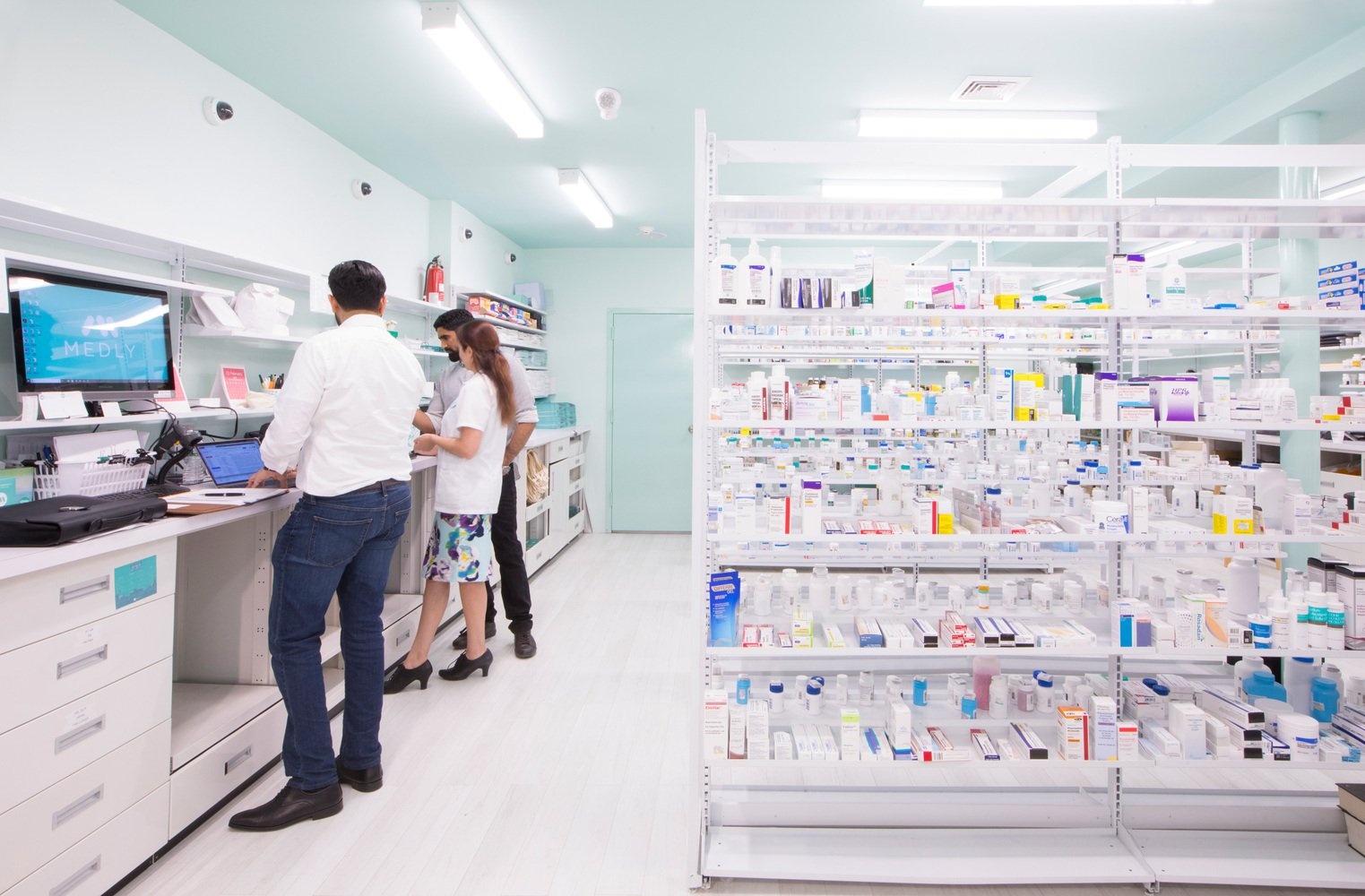
The app came with shelves
Medly’s business model followed the prescription. It earned payments from patients and health insurers for medicines it dispensed. Technology helped coordinate the work; delivery made the service attractive. That meant the operating challenge included drug purchasing, dispensing, reimbursement and transport. Software could reduce friction, but it could not make those responsibilities disappear.
In July 2020, Medly announced a $100 million Series B co-led by Volition Capital and Greycroft, with Horsley Bridge and Lerer Hippeau participating. The company reported 50,000 patients and more than 500,000 prescriptions delivered. Those were company-reported milestones at the time. The investment was intended to fund new markets and its platform.
Then the map grew. In June 2021, Medly announced an agreement to buy Pharmaca, a chain with 28 stores selling prescriptions, supplements, vitamins and other wellness products. The deal promised a presence in almost 30 markets. It also answered a plausible customer request: if you were bringing the prescription, why not bring the over-the-counter medicine too?
- 01 Prescription
- 02 Insurance + pharmacist
- 03 Local dispensing
- 04 Doorstep
One simple arrival. Several jobs before the doorbell.
The acquisition also changed the problem Medly had to solve. A service that looked consistent to a patient now depended on integrating another chain’s stores, systems and customers. More categories meant more things to stock and coordinate. The strategic attraction was clear. Whether the combined operation could support its promises was a separate question.
The money behind “free”
The clearest immediate financing break came in August 2022. Medly’s bankruptcy counsel says an expected $100 million loan did not materialize. By December, the company had filed for Chapter 11. Financing that had been expected to support the operation was absent; the plan shifted toward selling assets.
Different transactions, different measures. The sale price is not a company valuation or a calculation of investor losses.
In February 2023, Walgreens agreed to pay $19.35 million for selected pharmacy assets. A Walgreens representative described pharmaceutical records and other assets across 22 Pharmaca and four Medly pharmacies. Medly closed its remaining operations. In April, the bankruptcy cases converted to Chapter 7 liquidation. Buying records and inventory did not preserve the company patients had known.
The numbers needed their own examination
The later account was more troubling than a financing shortfall. In September 2024, the SEC sued former CEO Marg Patel, former CFO Robert Horowitz and former head of prescription operations Chintankumar Bhatt. It alleged that financial information used to raise more than $170 million overstated revenue, partly through fake prescriptions. It also alleged that employee warnings about inaccurate reporting went uncorrected.
The SEC’s amended complaint places accounting problems as early as January 2020, before the failed loan. That chronology matters: the regulator’s account describes weaknesses predating the final cash crisis. These are allegations. A July 2025 court order allowed substantial claims to proceed while dismissing scheme-liability claims against Horowitz. That ruling assessed the pleadings; it did not establish fraud liability.
Keep the doorstep test
There is something useful to copy from the early delivery rides: study the moment the customer actually receives the service. Ask what took too long, what needed explaining and what made the next refill harder. The lesson from the later allegations is equally practical: connect reported sales to underlying prescriptions, fulfillment and payment records, and give reviewers access to check them.
A delivery pharmacy needs conditions an app cannot supply alone: workable reimbursement, dependable dispensing, affordable routes and adequate cash. Where those conditions are absent, a popular service can remain expensive to provide. Medly understood the appeal of removing an errand from a patient’s day. Its story leaves a harder question for anyone copying the idea: can the business behind that relief withstand the same close attention as the experience at the door?
Historical company channels: Website · LinkedIn · X · Instagram · Facebook · Blog and app archive links
Further reading: The 2021 expansion interview · The Walgreens asset sale · The SEC announcement · The July 2025 court order