The useful accident in Mediavine’s history begins with a friend. The company had built advertising technology for its own websites. Somebody else wanted it. Then somebody else did, too. In a 2023 interview, co-founder Amber Bracegirdle remembered the requests multiplying until helping acquaintances became an actual business. The advertising bill had quietly become the product.
- Mediavine sells and manages ads for independent publishers.
- Its current network exceeds 20,000 publishers, according to the company.
- New main-program publishers keep 75% to 90% of eligible ad revenue.
- Journey gives smaller sites an earlier route into monetization.
01 The neighbor with the same problem
Go back to 2004. Eric Hochberger, Steve Marsi and Matt Richenthal started with content writing and search-engine marketing. They built websites, including The Hollywood Gossip, TV Fanatic and, later, Food Fanatic. Those sites needed advertising income. Writing about television could attract a reader; getting paid for that reader required another kind of expertise.
Bracegirdle’s account identifies the irritation: the team wanted to recover advertising dollars it wasn’t seeing from its outside ad manager. Hochberger built technology for their four sites. Other publishers recognized their own problem in the solution. That matters. The founders had already used the machinery under the same conditions as the people asking to buy it.
02 The machinery beneath the recipe
Today, Mediavine takes on the advertising work behind a publisher’s website: connecting demand, managing placements, optimizing auctions and reporting earnings. Its customers include food writers, travel publishers, reference sites and larger media portfolios. The Everygirl, Salt & Lavender and Chef Dennis appear among the brands on its website. The reader gets the recipe. The publisher gets a business operation behind it.
Its technical specialty includes server-to-server header bidding, which puts much of the auction work on servers. In August 2022, Mediavine announced the first direct server-side OpenPath integration with The Trade Desk. The aim was fewer browser timeouts and a more direct purchasing route. Raptive and Freestar also serve publishers; Mediavine’s case rests on its particular technology, demand connections and support, rather than a promise that every website will earn more.
03 Follow the missing quarter
The cost is visible in the split. For new main-program sites launched after January 1, 2026, Mediavine’s published publisher shares are 75% for Official, 80% for Select, 85% for Signature and 90% for Premiere and Premiere Plus. Legacy arrangements differ. Optional partner ads have separate terms. These percentages describe the main programs, not a universal price for every Mediavine product.
At the Official rate, an illustrative $1,000 of eligible gross advertising revenue leaves $750 for the publisher and $250 for Mediavine. That retained quarter pays for a service the publisher would otherwise have to arrange. But a bigger share of a smaller pot can still leave you poorer. Compare net earnings, ad density, page performance and contract terms together.
Your share of the advertising dollar
Same hypothetical gross revenue at each rate. Program qualification and agreements apply; this is not an earnings forecast.
There is a reason to look beyond the commission. Raptive, a direct alternative, also bundles ad management, audience tools and publisher support. These services overlap. A useful comparison starts with your own audience and website, then asks which partner can produce better net results without making the reading experience worse. A percentage is easy to advertise. The outcome takes more work to establish.
“We still answer to you, our publishers.”
Eric Hochberger · 2023
04 A smaller front door
For years, publishers chased the familiar 50,000-monthly-session threshold. The current main-program minimum is $5,000 in annual ad revenue. Journey, introduced in March 2024, serves growing sites earlier. Its current requirement is 1,000 sessions from Tier 1 countries, including the United States, Canada, Britain and Australia, within 30 days.
One application now routes sites to the appropriate offering. Journey is self-supported, and its inventory is sold separately from the main Mediavine pool. Crossing a number doesn’t guarantee acceptance: original content, human traffic, advertiser safety and reader experience remain part of the review. A publisher who needs substantial hands-on help should pay attention to that difference in support.
05 Getting the reader back
The next problem is familiar to anyone dependent on search: a visit can vanish before you build a relationship. Mediavine’s Grow and audience features offer subscriptions, saved content, recommendations and automated emails. They make return visits easier while helping publishers develop first-party audience data. In April 2026, its Index Exchange partnership added curated audience segments to Index Marketplaces.
In 2023, Hochberger said Mediavine had put millions of dollars into Grow and had no outside investment. That is a substantial commitment to the relationship around the pageview. Still, monetization technology cannot order Google to deliver tomorrow’s readers. A business with thin traffic or an audience that never returns remains exposed.
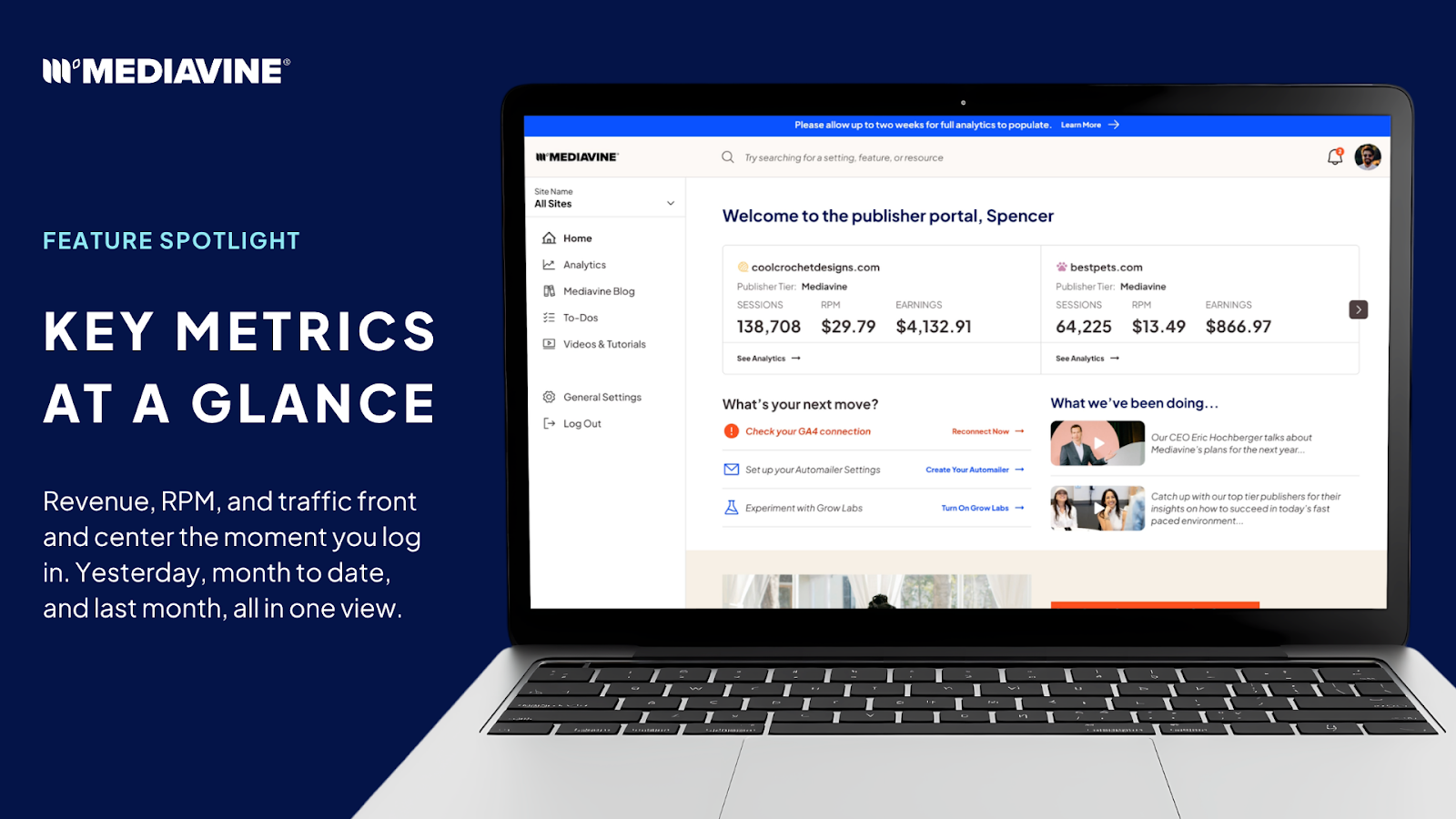
The operating details matter here, too. Mediavine rebuilt its dashboard in April 2026 around publisher feedback, bringing previously scattered metrics and controls together. Its remote-first workforce gets paid volunteer time, parental leave and professional development. The product asks publishers to trust a distant team with their income; clear reporting and accessible support are practical parts of that bargain.
06 Knowing which tools to let go
There is a quieter lesson in the products Mediavine no longer owns. Trellis, its WordPress framework, went to Feast Design Co. in December 2024. Create, the recipe and how-to plugin, was purchased by founding developer John-Michael in mid-2025. An old product list would give readers the wrong picture of the company.
Feast later explained that modernizing the original Trellis stack demanded an impractical amount of rebuilding and manual configuration. Its legacy optimization API is scheduled to close October 20, 2026; existing themes will continue operating. Owning a tool also means maintaining it as the surrounding web changes. Sometimes a specialist becomes the sensible next owner.
07 Start with the bill you already pay
The copyable part is specific: solve an operating problem you understand, test the solution in your own business, then listen when other people ask for it. For publishers, the parallel is to measure what each reader actually earns, give that reader reasons to return and compare an ad partner’s total economics. Mediavine’s opportunity grew from doing that work for itself. Its customers still have to do the publishing.